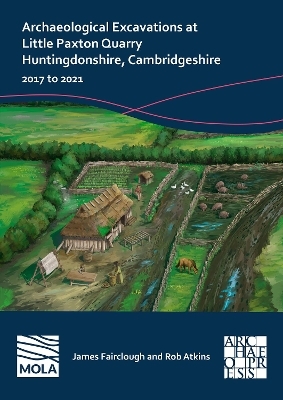
Archaeological Excavations at Little Paxton Quarry Huntingdonshire, Cambridgeshire
Archaeopress (Verlag)
978-1-80327-831-5 (ISBN)
Archaeological excavations at Little Paxton Quarry, Huntingdonshire, Cambridgeshire were undertaken by MOLA between 2017 to 2021 and these were located near to both the River Great Ouse and the A1 (Great North Road).
Small quantities of pitting occurred in both the early and late Neolithic periods, followed by a single cremation deposit that dated to the early Bronze Age and a moderate sized middle Bronze Age cremation cemetery with 12 cremations deposits, one of which was urned. Two parallel late Bronze Age to early Iron Age pit alignments were recorded. Permanent occupation took place from the middle Iron Age period, with two settlements located 0.5km apart. One of these settlements continued into the middle Roman period.
Post-Roman evidence included two graves that formed part of a Saxon early medieval cemetery excavated in 2016 by Phoenix Consulting. In the medieval period the southern extent of the DMV Boughton settlement was found and these previously unknown remains were directly beyond the southern extent of the core of the hamlet, which is a Scheduled Monument. In the excavation this part of the hamlet dated from the 11th to at least the 14th century and comprised fields, paddocks and connecting routeways as well as a small area of possible domestic occupation.
James Fairclough is a Project Officer with MOLA Northampton, where he has worked since 2014, leading numerous sites, including the Saxon cemetery at Great Ryburgh and areas on the A14 infrastructure project. Between joining MOLA and graduating with a degree and Masters from the University of Manchester in 2012, he worked for Archaeological Solutions on sites across East Anglia. As well as working in the commercial field, James continues to help supervise research projects in the Vale of Pickering in North Yorkshire, targeting preserved Mesolithic sites. This work has been in conjunction with a number of universities and has included sites such as Star Carr and No Name Hill.
Chapter 1: Introduction
Project background
Location, topography and geology
Historical and archaeological background
Site phasing
Results
Chapter 2: The archaeological evidence – James Fairclough and Rob Atkins
Period 1: Neolithic to early Iron Age (c4000 – 400BC)
Period 2: Middle Iron Age to Roman (c3rd or 2nd century BC – late 4th century AD)
Period 3: Saxon to modern
Chapter 3: Finds
Worked flint – Yvonne Wolframm-Murray
Prehistoric pottery – Lyn Blackmore
Iron Age and Roman pottery from Area B – Anna Rebisz-Niziolek and Adam Sutton
Iron Age and Roman from Areas C, D and L – Anna Rebisz-Niziolek
Medieval and post-medieval pottery – Paul Blinkhorn
Post-Roman pottery from Area B – Paul Blinkhorn
Registered finds of Area B – Tora Hylton
Small finds in Areas C, D and L – Chris Faine
Metalworking debris from Areas D, C and L – David Dungworth
Worked and unworked stone from Areas C and D – Kevin Hayward
Ceramic building material from Areas C, D and L – Rob Atkins
Fired clay from Area C – Mary Ellen Crothers
Radiocarbon dating – Chris Chinnock
Chapter 4: Human, faunal and environmental evidence
Human bone from Area B – Chris Chinnock
Cremated human bone from Area C – Chris Chinnock
Animal bone from Area B – Sander Aerts
Animal bone from Areas C, D and L – Chris Faine
Plant macrofossils and other remains from Area B – Val Fryer
Environmental remains from Areas C, D and L – Dominika Kofel-Lubczynska
Shell from Area C – Matt Law
Pollen from Area C – Suzi Richer
Chapter 5: Discussion – Rob Atkins with James Fairclough
Period 1: Neolithic to early Iron Age (c4000BC to 400BC)
Period 2: middle Iron Age to Roman (c3rd or 2nd century BC– late 4th century AD)
Period 3: Saxon to modern
Bibliography
| Erscheinungsdatum | 31.08.2024 |
|---|---|
| Verlagsort | Oxford |
| Sprache | englisch |
| Gewicht | 304 g |
| Themenwelt | Geisteswissenschaften ► Archäologie |
| ISBN-10 | 1-80327-831-5 / 1803278315 |
| ISBN-13 | 978-1-80327-831-5 / 9781803278315 |
| Zustand | Neuware |
| Informationen gemäß Produktsicherheitsverordnung (GPSR) | |
| Haben Sie eine Frage zum Produkt? |
aus dem Bereich