


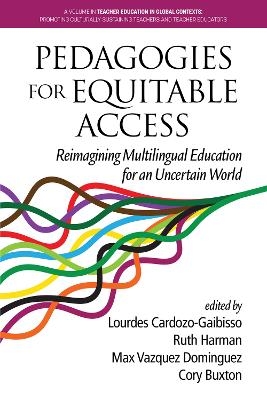
Pedagogies for Equitable Access
Reimagining Multilingual Education for an Uncertain World
Seiten
2024
Information Age Publishing (Verlag)
979-8-88730-745-9 (ISBN)
Information Age Publishing (Verlag)
979-8-88730-745-9 (ISBN)
This book examines the impact of COVID-19 on education, focusing on the rapid shift to online learning and its challenges. It explores instructional strategies, curriculum adaptations, teacher education practices, and pedagogical innovations in multilingual/multicultural settings, emphasizing equity and accessibility.
During the COVID-19 pandemic, public health recommendations for physical distancing created an urgent need for new and remixed online and distance ways of preparing, teaching, and assessing learning practices. This new context forced teacher educators, administrators, and public policymakers around the globe to rethink, reshape, and redesign curriculum, instruction, and assessment practices and modalities. While online education has been an option available to many for decades, no other moment in recent history has demanded such a rapid shift in educational practices, impacting tens of millions of teachers and hundreds of millions of students worldwide. Fortunately, in some cases, highly innovative advances in technological resources have supported educators in designing and implementing transformative approaches. In the field of language education, educators have had to reconceptualize online instruction so that digital and other multimodal resources are designed to fully engage multilingual students in optimal and equitable learning contexts.
This edited book serves the purpose of focusing the research agendas of K-12 educators, teacher educators, and policymakers on the lessons and insights the field can gain from this crisis as we adapt to the post-pandemic future of language education. As argued over the past three years, the pandemic has exposed multiple structural issues related to accessibility, inequity, and poverty—ubiquitous issues that have existed in our societies for decades. It has also drawn attention to the notion of 'competing priorities,' challenging our ability to determine what can and cannot be done in terms of human, financial, and logistical capacity around the globe. With this focus in mind, the aim of this edited book is to provide readers with robust and systematic thinking about the multifaceted strengths and challenges that have emerged during and after the COVID-19 pandemic. Specifically, informed by a critical perspective on societal power dynamics and equity, this edited book explores the following interconnected topics in multilingual/multicultural settings: (i) instructional strategies and curriculum adaptations (ii) in-service and pre-service teacher education practices (iii) classroom-based pedagogical innovations and assessment.
During the COVID-19 pandemic, public health recommendations for physical distancing created an urgent need for new and remixed online and distance ways of preparing, teaching, and assessing learning practices. This new context forced teacher educators, administrators, and public policymakers around the globe to rethink, reshape, and redesign curriculum, instruction, and assessment practices and modalities. While online education has been an option available to many for decades, no other moment in recent history has demanded such a rapid shift in educational practices, impacting tens of millions of teachers and hundreds of millions of students worldwide. Fortunately, in some cases, highly innovative advances in technological resources have supported educators in designing and implementing transformative approaches. In the field of language education, educators have had to reconceptualize online instruction so that digital and other multimodal resources are designed to fully engage multilingual students in optimal and equitable learning contexts.
This edited book serves the purpose of focusing the research agendas of K-12 educators, teacher educators, and policymakers on the lessons and insights the field can gain from this crisis as we adapt to the post-pandemic future of language education. As argued over the past three years, the pandemic has exposed multiple structural issues related to accessibility, inequity, and poverty—ubiquitous issues that have existed in our societies for decades. It has also drawn attention to the notion of 'competing priorities,' challenging our ability to determine what can and cannot be done in terms of human, financial, and logistical capacity around the globe. With this focus in mind, the aim of this edited book is to provide readers with robust and systematic thinking about the multifaceted strengths and challenges that have emerged during and after the COVID-19 pandemic. Specifically, informed by a critical perspective on societal power dynamics and equity, this edited book explores the following interconnected topics in multilingual/multicultural settings: (i) instructional strategies and curriculum adaptations (ii) in-service and pre-service teacher education practices (iii) classroom-based pedagogical innovations and assessment.
| Erscheinungsdatum | 22.08.2024 |
|---|---|
| Reihe/Serie | Teacher Education in Global Contexts: Promoting Culturally Sustaining Teachers and Teacher Educators |
| Sprache | englisch |
| Maße | 156 x 234 mm |
| Gewicht | 369 g |
| Themenwelt | Geisteswissenschaften ► Sprach- / Literaturwissenschaft ► Sprachwissenschaft |
| Sozialwissenschaften ► Pädagogik ► Sonder-, Heil- und Förderpädagogik | |
| ISBN-13 | 979-8-88730-745-9 / 9798887307459 |
| Zustand | Neuware |
| Informationen gemäß Produktsicherheitsverordnung (GPSR) | |
| Haben Sie eine Frage zum Produkt? |
Mehr entdecken
aus dem Bereich



aus dem Bereich
Eine Wiederentdeckung
Buch | Softcover (2025)
Piper (Verlag)
CHF 19,55
Das umfassende Standardwerk auf der Grundlage der aktuellen amtlichen …
Buch | Hardcover (2024)
Duden (Cornelsen Verlag)
CHF 48,95


