


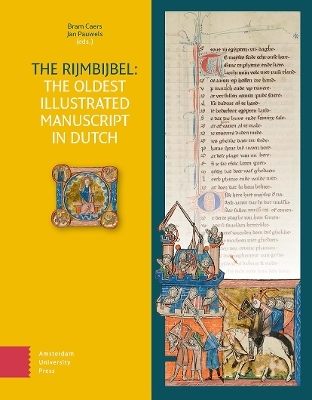
The Rijmbijbel
The Oldest Illustrated Manuscript in Dutch
Seiten
2024
Amsterdam University Press (Verlag)
978-90-485-6796-6 (ISBN)
Amsterdam University Press (Verlag)
978-90-485-6796-6 (ISBN)
The oldest illustrated manuscript in Dutch contains a 13th-century Rijmbijbel (Rhymed Bible) by Jacob van Maerlant, a biblical paraphrase in paired rhyme, followed by a history of the First Jewish-Roman War, some decades after the death of Christ. The introductory essay of this book provides an explanation for a general audience
The oldest illustrated manuscript in Dutch contains a 13th-century Rijmbijbel (Rhymed Bible) by Jacob van Maerlant, a biblical paraphrase in paired rhyme, followed by a history of the First Jewish-Roman War, some decades after the death of Christ. The manuscript is lavishly illustrated, featuring no fewer than 159 precious miniatures. Due to its famous author, luxurious character, and the high artistic quality of its illuminations, it ranks among the international masterpieces of that period.
The introductory essay of this book provides an explanation for a general audience: it takes the reader to the time of the manuscript’s creation, its composition, the authorship of the text, its illustrations, subsequent owners, and how it gained recognition. The introduction is followed by a selection of 40 full-colour miniatures, each accompanied by the Middle Dutch text, a contemporary English translation, and a brief commentary to guide the reader. The oldest illustrated manuscript in Dutch contains a 13th-century Rijmbijbel (Rhymed Bible) by Jacob van Maerlant, a biblical paraphrase in paired rhyme, followed by a history of the First Jewish-Roman War, some decades after the death of Christ. The manuscript is lavishly illustrated, featuring no fewer than 159 precious miniatures. Due to its famous author, luxurious character, and the high artistic quality of its illuminations, it ranks among the international masterpieces of that period.
The introductory essay of this book provides an explanation for a general audience: it takes the reader to the time of the manuscript’s creation, its composition, the authorship of the text, its illustrations, subsequent owners, and how it gained recognition. The introduction is followed by a selection of 40 full-colour miniatures, each accompanied by the Middle Dutch text, a contemporary English translation, and a brief commentary to guide the reader.
The oldest illustrated manuscript in Dutch contains a 13th-century Rijmbijbel (Rhymed Bible) by Jacob van Maerlant, a biblical paraphrase in paired rhyme, followed by a history of the First Jewish-Roman War, some decades after the death of Christ. The manuscript is lavishly illustrated, featuring no fewer than 159 precious miniatures. Due to its famous author, luxurious character, and the high artistic quality of its illuminations, it ranks among the international masterpieces of that period.
The introductory essay of this book provides an explanation for a general audience: it takes the reader to the time of the manuscript’s creation, its composition, the authorship of the text, its illustrations, subsequent owners, and how it gained recognition. The introduction is followed by a selection of 40 full-colour miniatures, each accompanied by the Middle Dutch text, a contemporary English translation, and a brief commentary to guide the reader. The oldest illustrated manuscript in Dutch contains a 13th-century Rijmbijbel (Rhymed Bible) by Jacob van Maerlant, a biblical paraphrase in paired rhyme, followed by a history of the First Jewish-Roman War, some decades after the death of Christ. The manuscript is lavishly illustrated, featuring no fewer than 159 precious miniatures. Due to its famous author, luxurious character, and the high artistic quality of its illuminations, it ranks among the international masterpieces of that period.
The introductory essay of this book provides an explanation for a general audience: it takes the reader to the time of the manuscript’s creation, its composition, the authorship of the text, its illustrations, subsequent owners, and how it gained recognition. The introduction is followed by a selection of 40 full-colour miniatures, each accompanied by the Middle Dutch text, a contemporary English translation, and a brief commentary to guide the reader.
Edited by Bram Caers and Jan Pauwels.
INTRODUCTION, A collaborative effort on a medieval masterpiece. A statue, a poem and a painting, Maerlant, an innovative author, The Rijmbijbel: a rich text tradition, A European phenomenon, Under the microscope, Penwork in the Rijmbijbel, Illustration in the Rijmbijbel, An 18th-Century Comeback, Further reading, TEXTS AND MINIATURES FROM THE RIJMBIJBEL.
| Erscheinungsdatum | 12.09.2024 |
|---|---|
| Verlagsort | Amsterdam |
| Sprache | englisch |
| Maße | 156 x 198 mm |
| Gewicht | 320 g |
| Themenwelt | Kunst / Musik / Theater ► Design / Innenarchitektur / Mode |
| Geschichte ► Allgemeine Geschichte ► Mittelalter | |
| Geisteswissenschaften ► Geschichte ► Regional- / Ländergeschichte | |
| Geisteswissenschaften ► Religion / Theologie | |
| Geisteswissenschaften ► Sprach- / Literaturwissenschaft ► Anglistik / Amerikanistik | |
| Geisteswissenschaften ► Sprach- / Literaturwissenschaft ► Literaturwissenschaft | |
| ISBN-10 | 90-485-6796-3 / 9048567963 |
| ISBN-13 | 978-90-485-6796-6 / 9789048567966 |
| Zustand | Neuware |
| Informationen gemäß Produktsicherheitsverordnung (GPSR) | |
| Haben Sie eine Frage zum Produkt? |
Mehr entdecken
aus dem Bereich

aus dem Bereich
Geschichte einer Augsburger Familie (1367-1650)
Buch | Softcover (2024)
Kohlhammer (Verlag)
CHF 47,60


