Heat and Cold Storage, Volume 1 (eBook)
442 Seiten
Wiley-Iste (Verlag)
978-1-394-31251-1 (ISBN)
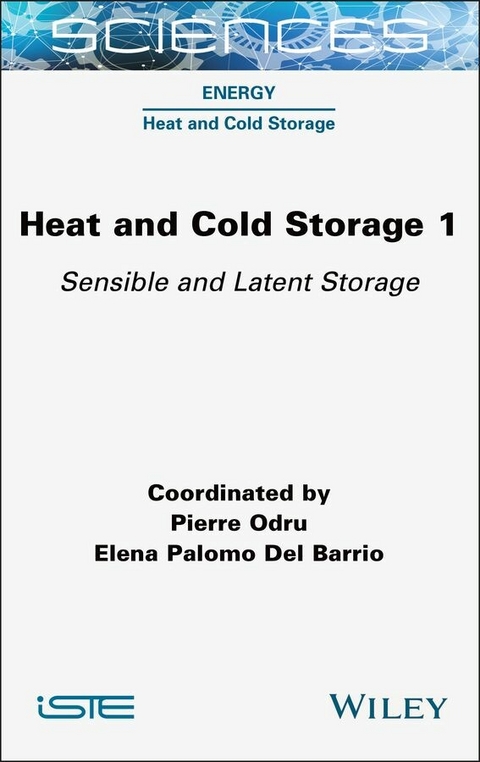
Heat and Cold Storage 1 is dedicated to sensible and latent heat storage processes.
Beginning with some theoretical reminders, this book presents the main situations of low-temperature and high-temperature sensible storage for electricity generation. It also analyzes latent storage on phase-change materials (PCMs) from a fundamental standpoint, presenting the mechanisms to prepare PCMs and their integration into heat and cold storage processes. The most promising materials are presented, along with ways of improving the materials studied. Notions of technico-economic profitability are also defined.
Finally, the book looks at heat storage in thermodynamic solar power plants and the wide variety of physical storage principles involved.
Pierre Odru is an engineer at the Ecole Centrale de Lyon, France, and has retired from IFPEN. He worked in research and development in deep-sea oil production, gas transport with IFPEN and energy storage for the French National Research Agency.
Elena Palomo Del Barrio is a professor at the University of Bordeaux, France, and Scientific Director of the Thermal Energy Storage Department at CIC energiGUNE in Spain. She is a world-renowned specialist in phase-change materials and has published over 100 articles in international journals.
Heat and Cold Storage 1 is dedicated to sensible and latent heat storage processes. Beginning with some theoretical reminders, this book presents the main situations of low-temperature and high-temperature sensible storage for electricity generation. It also analyzes latent storage on phase-change materials (PCMs) from a fundamental standpoint, presenting the mechanisms to prepare PCMs and their integration into heat and cold storage processes. The most promising materials are presented, along with ways of improving the materials studied. Notions of technico-economic profitability are also defined. Finally, the book looks at heat storage in thermodynamic solar power plants and the wide variety of physical storage principles involved.
1
Sensible Heat Storage: Overview
Régis OLIVÈS
PROMES, CNRS, UPVD, Perpignan, France
1.1. Introduction
Heat and cold are two very important fields of the energy economy. They are used for the air-conditioning of living spaces, but they are also essential in the industry in the transformation and generation of materials and products. Nowadays, they are obtained from fossil fuels, either directly or using electricity, which is also often generated by power plants. But this combustion generates CO2 emissions, contributing to the global warming, and these fuels are not sustainable, since they are not renewable, posing serious risks to the future development of humanity.
At the scale of humanity, sun is an inexhaustible source of heat. However, solar energy lacks concentration, it is intermittent and even lacking for a part of the year and its availability is often shifted with respect to the needs, particularly depending on the season. This explains the potential interest in the efficient storage of heat and also cold.
Two very different types of heat storage can be identified: low-temperature storage, the most widespread and mainly used for domestic air-conditioning and water heating, and high-temperature storage, more complex, essentially used to smooth power generation subjected to the intermittence of renewable energies. This work describes the processes of sensible heat storage, by far the most developed, but does not cover the processes using phase change materials, which will be described in the following chapters, or the sorption processes, which will be dealt with in Volume 2.
1.2. General principles
Sensible heat is the heat stored in a material, except for phase changes (solid–liquid–gas transitions). Sensible heat storage in a material consists of its enthalpy increase during the storage phase, heat being released during the discharge phase. The material can be a liquid or a solid. The perceptible effect is temperature change. Stored energy is written as follows:
Here, Q12 (Joule) is the sensible heat, T1 and T2 (K) are the initial and final temperatures, cp (J/kg·K) is the specific heat capacity of the body and it may be temperature dependent. If the specific heat capacity cp remains constant, the relation (with ρ density, V volume) is written as follows:
It can be noted that for a given specific heat capacity and for a given amount of stored heat, the storage volume V is inversely proportional to the density of the material. These relations can be easily transposed to sensible cold storage. Sensible heat storage is by far the easiest to implement and also the oldest. If the material remains stable during temperature changes, the system is indefinitely reversible.
1.3. Storage configurations
There are various storage configurations that use liquid or solid materials for storage, in association or not with a gaseous or liquid heat-transfer fluid, carrying or not solid particles. The dimensioning depends on the type of configuration, operating temperatures, heat transfer modes involved, flow rates of the heat transfer fluid, thermophysical properties of the materials used, geometry of the storage tank and objectives in terms of energy and power. Depending on the storage technology, phenomena such as stratification may be predominant in the operation mode, dimensioning, management and efficiency of the storage.
Figure 1.1. Various sensible heat storage configurations.
Figure 1.1 shows three types of liquid storage configuration. In configuration (a), the storage involves filling the tank with heat-transfer fluid, which is also used as storage material. The release therefore involves emptying the tank and using the heat contained in the liquid. The recovered energy is therefore directly linked to the quantity of liquid and the available power is given by its circulating flow. After passage through an exchanger that may use the heat supplied by the storage, the liquid may then be stored at lower temperature in a so-called “cold” tank. Therefore, storage and release consist of the fluid passage from one tank to another. This configuration is currently used in concentrated solar power plants. The storage material is then quite often a mixture of molten salts, such as the binary mixture NaNO3/KNO3. In configuration (b), the storage consists of extracting the liquid from the bottom of the tank in order to heat it and then injecting it back at the top. The liquid is used both as heat-transfer fluid and storage material. The same is applicable to configuration (c) where, in contrast, a system placed inside the tank provides the heat to be stored. This can be done in various ways: flow of heat-transfer fluid, electric resistance, etc.
Configurations (b) and (c) are typically present in water heaters using electric power, solar power, etc. Specific studies have been conducted on these, particularly on stratification. For high temperature applications (>120°C), water is no longer the preferred fluid. Oils and molten salts are rather used. Given its high cost, a lower volume of liquid is used by associating it with inexpensive solid materials. At very high temperatures, air may prove to be the only viable technical solution. Considering the average air storage capacity, choosing solid materials for storage then becomes inevitable. Hence, the storage tank is filled with a solid material that takes up a part of the volume. The remaining volume (porosity) allows the heat-transfer fluid to supply with or extract the heat essentially stored in the solid material. This material can have a bulk granular form or an organized form. Granular materials of centimetric size can be natural rocks or ceramic materials (alumina, bauxite, recycled ceramic materials from industrial or municipal solid waste, etc.). Organized materials can be self-supported structured elements such as bricks or a material such as concrete, in which a set of tubes are inserted.
1.4. Modeling of thermocline storage
Operating this storage referred to as dual media involves the control of three zones: two high and low temperature zones separated by a high gradient zone, the thermocline.
Figure 1.2. Dual media heat storage.
The thermal modeling of storage on solid material relies on the coupling of convection heat transfer around the material and conduction transfer inside. There are two possible cases:
-
The temperature of the medium can be considered homogeneous, and in this case the lumped heating or cooling method known as the lumped capacitance method can be used.
-
There is a temperature distribution in the material, which requires complete or approximate calculation.
The first approach, very useful in storage, uses the lumped capacitance method. This highlights the influence of the material and of its thermophysical properties, and also of its geometry. Figure 1.3 shows a schematic representation of the lumped heating of a solid immersed in a fluid.
Figure 1.3. Lumped heating of a solid by a fluid
The energy supplied by the fluid is transferred by convection and leads to an increase in the internal energy of the solid:
When the solid is at an initial temperature Ts,i and it is subjected to a step in temperature at the initial moment, the result of integration is:
Let us consider θ = Ts – Tf, θi = Ts,i – Tf, which leads to the following expression:
which yields:
The dimensionless form of this equation features Biot and Fourier numbers:
and:
The characteristic length is the ratio between the volume of the required material and the surface through which transfer takes place:
This yields the following:
– For a plate of thickness e:
– For a cylinder of radius R:
– For a sphere of radius R:
Therefore, the stored energy is:
It should be noted that this relation is also an expression of the storage efficiency.
These relations are valid for Biot numbers Bi < 0.1, therefore for thermally thin materials. Nevertheless, Xu et al. (2012) propose an extension of the lumped capacitance method to Biot numbers Bi > 0.1. An effective Biot number is introduced. In summary, for a flat plate, this effective Biot number is written as follows:
For a cylinder, the correction is given by the following relation:
Finally, for a sphere, we have:
Generally speaking, the expression of the stored energy and therefore of the efficiency is given as follows:
This extension is interesting and quite precise in many cases. In the end, this situation corresponds to a storage that is limited by the convective transfer properties and therefore by the convective coefficient and the transfer surface. This explains the...
| Erscheint lt. Verlag | 13.8.2024 |
|---|---|
| Reihe/Serie | ISTE Consignment |
| Sprache | englisch |
| Themenwelt | Geisteswissenschaften ► Geschichte |
| Naturwissenschaften ► Physik / Astronomie | |
| Schlagworte | Cold storage • Energy Storage • Heat storage • latent storage • phase-change materials (PCMs) • Storage processes • thermodynamic solar power plants |
| ISBN-10 | 1-394-31251-2 / 1394312512 |
| ISBN-13 | 978-1-394-31251-1 / 9781394312511 |
| Informationen gemäß Produktsicherheitsverordnung (GPSR) | |
| Haben Sie eine Frage zum Produkt? |
 EPUB (Adobe DRM)
Kopierschutz: Adobe-DRM
Adobe-DRM ist ein Kopierschutz, der das eBook vor Mißbrauch schützen soll. Dabei wird das eBook bereits beim Download auf Ihre persönliche Adobe-ID autorisiert. Lesen können Sie das eBook dann nur auf den Geräten, welche ebenfalls auf Ihre Adobe-ID registriert sind.
Details zum Adobe-DRM
Dateiformat: EPUB (Electronic Publication)
EPUB ist ein offener Standard für eBooks und eignet sich besonders zur Darstellung von Belletristik und Sachbüchern. Der Fließtext wird dynamisch an die Display- und Schriftgröße angepasst. Auch für mobile Lesegeräte ist EPUB daher gut geeignet.
Systemvoraussetzungen:
PC/Mac: Mit einem PC oder Mac können Sie dieses eBook lesen. Sie benötigen eine
eReader: Dieses eBook kann mit (fast) allen eBook-Readern gelesen werden. Mit dem amazon-Kindle ist es aber nicht kompatibel.
Smartphone/Tablet: Egal ob Apple oder Android, dieses eBook können Sie lesen. Sie benötigen eine
Geräteliste und zusätzliche Hinweise
Buying eBooks from abroad
For tax law reasons we can sell eBooks just within Germany and Switzerland. Regrettably we cannot fulfill eBook-orders from other countries.
aus dem Bereich