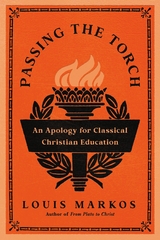
Passing the Torch (eBook)
240 Seiten
IVP Academic (Verlag)
978-1-5140-1131-7 (ISBN)
Louis Markos (PhD, University of Michigan) is professor in English and scholar in residence at Houston Christian University, where he holds the Robert H. Ray Chair in Humanities. His 27 books include The Myth Made Fact; From Plato to Christ; From Achilles to Christ; Ancient Voices: An Insider's Look at Classical Greece; Heaven and Hell; Apologetics for the 21st Century; Atheism on Trial; and Passing the Torch: An Apology for Classical Christian Education. He has published over 300 essays and given over 300 public lectures. He is committed to the concept of the professor as public educator. He has two grown children and lives in Houston, Texas.
Louis Markos (PhD, University of Michigan) is professor of English and scholar in residence at Houston Baptist University. He is the author of many books, including The Myth Made Fact: Reading Greek and Roman Mythology through Christian Eyes; Ancient Voices: An Insider's Look at Classical Greece; From Achilles to Christ: Why Christians Should Read the Pagan Classics; Atheism on Trial: Refuting the Modern Arguments Against God; On the Shoulders of Hobbits: The Road to Virtue with Tolkien and Lewis; and Restoring Beauty: The Good, the True, and the Beautiful in the Writings of C. S. Lewis.
Introduction
The Nature of Man
BEFORE WE CAN DETERMINE how children should be educated, we must determine who those children are as human beings. Here are ten aspects of our common humanity that have implications for the way we educate the next generation.
WE ARE NOBLE
In act 2, scene 2 of Hamlet, the prince of Denmark, freshly returned from his studies at the University of Wittenberg, gives voice to a gloriously high view of man that reverberated throughout the Renaissance: “What a piece of work is a man, how noble in reason, how infinite in faculties, in form and moving how express and admirable; in action how like an angel, in apprehension how like a god: the beauty of the world, the paragon of animals.”1
It is true that the melancholy prince follows his paean to man’s greatness by quipping, “And yet, to me, what is this quintessence of dust,” but I will defer his pessimistic coda to focus on what can be learned about the unique status of man in nature by parsing Hamlet’s speech phrase by phrase:
-
“What a piece of work is a man”: Man is a work of art, a creation that has been carefully crafted and lovingly fashioned. There is nothing in him that is random or haphazard. He is God’s workmanship (see Ephesians 2:10), and anyone who does not see that lacks eyes to see man’s inherent design.
-
“How noble in reason”: Unlike the animals, man has been endowed with reason, and that reason is the chief source of his nobility. There is a part of him that stands outside nature, that can in fact analyze, assess, and even alter it.
-
“How infinite in faculties”: Though there are individual animals that exceed him in their powers of sight, smell, hearing, taste, and touch, man possesses a wondrous combination of faculties that allows him to explore his world through a multitude of lenses.
-
“In form and moving how express and admirable”: Though, again, there are beasts that can run and swim, jump and swing with a dexterity that surpasses his abilities, there is a meaning and a beauty in his movements that speak of a greater harmony and proportion.
-
“In action how like an angel”: Though he shares qualities with the animal kingdom, there is a part of him that reaches upward to the angelic, that soars past the limits of his heavy physical body.
-
“In apprehension how like a god”: Not just angelic, there is a part of him that is truly divine, a kind of overarching vision that takes in all the world, from the lowest depths to the highest heavens.
-
“The beauty of the world”: Man is the crown of creation, so much so that all the wonders of nature find their completion in him.
-
“The paragon of animals”: He is the standard against which all other living creatures are measured.
Despite the ongoing efforts of modern thinkers such as Peter Singer to break down the dividing wall between humans and animals, the fact remains that man’s reason lifts him above the narrow confines of the natural world.2 Our reason is at once supernatural and metaphysical. It renders us unique in the animal kingdom, as does our ability to use our reason in coordination with our bodily senses and mental faculties.
We do not merely react to stimuli, as the behaviorist would have it, nor do we confine ourselves, as the empiricist would have it, to the evidence presented to our senses. Like animals, we move up, inductively, from causes to effects; unlike animals, we can also reason downward (deductively) from first principles that are engraved in our psyche rather than observed in the ever-shifting ephemera of nature. There are many animals that perform intricate bodily movements, but they do so for purely practical reasons: to evade predators or attract mates. Only man moves his body in accordance with an external standard that he perceives by his rational and aesthetic judgment and that he calls beauty.
Only man believes propositions because they are true, performs actions because they are good, and creates works of art because they are beautiful. Indeed, only man has the rational capacity to determine that some things are true and others false, some good and others evil, some beautiful and others ugly. In his philosophical, ethical, and aesthetic judgments, he so soars above the animals that he touches on the precincts of the angelic and even of the divine.
Truly, man is a marvel and a paragon; his connections to the natural world only highlight the many ways in which he transcends the clay out of which he was formed. Rightly does David exclaim with joy and wonder at how each individual human being is fearfully and wonderfully knit together in the womb of his mother (Psalm 139:13-14).
Such is man, and as such should he be treated: not merely as a product of unconscious material forces but as a creature endowed with purpose and design; not merely as a slave to natural instincts and primordial desires but as a rational and volitional agent whose choices affect his own destiny and that of the world; not merely as a means to some political or social or economic end but as an end in himself. There is no doubt that we are strongly shaped and influenced by our surroundings, but there is that within us which transcends those influences.
No pedagogical scheme, no theory of education, no initiative for training up the next generation can hope to succeed if it does not take into account the nobility of man: his reason, his freedom, his giftedness, his high status in nature. I do not mean to suggest there are nefarious American educators out there, whether utilitarian or progressive, who consciously deny man’s dignity, freedom, or rationality. I maintain, rather, that when educational institutions, whether public or private, secular or Christian, do not hold that vision at the center of their pedagogical goals, they risk reducing students to an army to be regimented, a workforce to be trained, a faction to be indoctrinated, a commodity to be molded, or a consumer to be conditioned.
Hear again the distinction Lewis makes in chapter one of The Abolition of Man:
Where the old [traditional form of education] initiated, the new merely “conditions.” The old dealt with its pupils as grown birds deal with young birds when they teach them to fly: the new deals with them more as the poultry-keeper deals with young birds—making them thus or thus for purposes of which the birds know nothing. In a word, the old was a kind of propagation—men transmitting manhood to men: the new is merely propaganda.
When educators forget or downplay the dignity of each student, they will be tempted to do things to them rather than for them. Rather than form them in a manner consistent with their unique and essential nobility, they will be tempted to form them in accordance with principles of utility or ideology that are foreign to that nobility.
WE ARE DEPRAVED
Educational schemes that do not take into account man’s nobility can be easily manipulated by corporate agendas or progressive ideologies to shape students for ends that violate their inherent worth and value. Pedagogical theories and initiatives, however, can be equally compromised if they deny that man, though noble, is fallen, broken, rebellious, and depraved. There is that within us that strives upward to the angelic, but there is also that within us that sinks downward to the beast—or the devil.
G. K. Chesterton hits the nail squarely on the head when he argues, in chapter two of Orthodoxy, that original sin, the belief that we have inherited a sinful nature from fallen, disobedient Adam, is the only doctrine of the Christian faith that can be proven. Just look around you; if you have the requisite courage and honesty, look at yourself. The greatest mystery of man is not that the same human race produced an Adolf Hitler and a Mother Theresa but that every one of us has a little Hitler and a little Mother Theresa wrestling within us.
It is not just that we think and say and do bad things; it is that there is a corruption at the core of our being. Like the apostle Paul, we do not do the good we know we should do, and we do the bad we know we should not (see Romans 7:18-23). We know that we do bad things, that we have violated a universal law that transcends time, place, and culture. We may claim that such a law does not exist, but we prove every day that we know it does, for we expect other people to treat us in accordance with that law.
The ancient Greco-Roman writers lacked a theological understanding of sin because they lacked the biblical revelation of a just and holy God against which to measure human sinfulness. Yet, that is not the whole story. The pagans knew full well that there were certain heinous acts that violated the divine order of the universe. Such taboo crimes brought bloodguilt on both the perpetrator and his community and called out for expiation.
In the Oedipus of Sophocles, those crimes are patricide and incest; in his...
| Erscheint lt. Verlag | 29.4.2025 |
|---|---|
| Verlagsort | Lisle |
| Sprache | englisch |
| Themenwelt | Geisteswissenschaften ► Religion / Theologie ► Christentum |
| Schlagworte | biblical worldview • Character • Educational Philosophy • faith-based • great books • Greek • holistic • Humanism • Intellectual • Latin • Liberal Arts • Logic • moral and spiritual formation • Quadrivium • Socratic method • Tradition • Traditional • Trivium • Virtue Ethics • wisdom |
| ISBN-10 | 1-5140-1131-X / 151401131X |
| ISBN-13 | 978-1-5140-1131-7 / 9781514011317 |
| Informationen gemäß Produktsicherheitsverordnung (GPSR) | |
| Haben Sie eine Frage zum Produkt? |
 EPUB (Wasserzeichen)
DRM: Digitales Wasserzeichen
Dieses eBook enthält ein digitales Wasserzeichen und ist damit für Sie personalisiert. Bei einer missbräuchlichen Weitergabe des eBooks an Dritte ist eine Rückverfolgung an die Quelle möglich.
Dateiformat: EPUB (Electronic Publication)
EPUB ist ein offener Standard für eBooks und eignet sich besonders zur Darstellung von Belletristik und Sachbüchern. Der Fließtext wird dynamisch an die Display- und Schriftgröße angepasst. Auch für mobile Lesegeräte ist EPUB daher gut geeignet.
Systemvoraussetzungen:
PC/Mac: Mit einem PC oder Mac können Sie dieses eBook lesen. Sie benötigen dafür die kostenlose Software Adobe Digital Editions.
eReader: Dieses eBook kann mit (fast) allen eBook-Readern gelesen werden. Mit dem amazon-Kindle ist es aber nicht kompatibel.
Smartphone/Tablet: Egal ob Apple oder Android, dieses eBook können Sie lesen. Sie benötigen dafür eine kostenlose App.
Geräteliste und zusätzliche Hinweise
Buying eBooks from abroad
For tax law reasons we can sell eBooks just within Germany and Switzerland. Regrettably we cannot fulfill eBook-orders from other countries.
aus dem Bereich