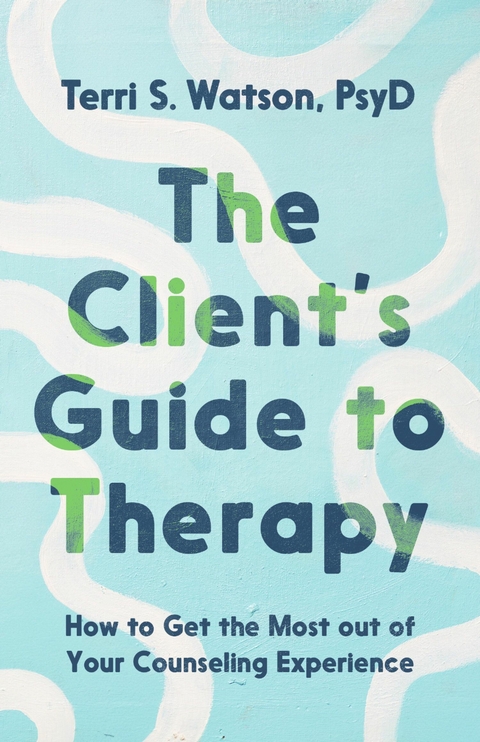
The Client's Guide to Therapy (eBook)
168 Seiten
IVP Academic (Verlag)
978-1-5140-0883-6 (ISBN)

Terri S. Watson (PsyD, ABPP) is a professor of psychology at Wheaton College. She is also a board-certified clinical psychologist, an approved clinical supervisor with the Center for Credentialing and Education, and an approved supervisor with the American Association for Marriage and Family Therapy. She maintains a private practice and provides supervision and clinical consultation for community and private organizations.
Terri S. Watson (PsyD, ABPP) is a professor of psychology at Wheaton College. She is also a board-certified clinical psychologist, an approved clinical supervisor with the Center for Credentialing and Education, and an approved supervisor with the American Association for Marriage and Family Therapy. She maintains a private practice and provides supervision and clinical consultation for community and private organizations.
Getting Started
Welcome to the counseling journey! Whether you are new to the idea of therapy or a current counseling client looking to make the most of your experience, reading The Client’s Guide to Therapy is a significant step in your personal growth journey. The following pages provide a modest and practical guide to the psychotherapy experience from start to finish. Integrating wisdom from scientific studies about effective counseling with real-life experiences from both counselors and counselees, this guide will address common questions and provide practical suggestions to guide you through each stage of therapy. My hope is that the information and examples in this book will demystify the process and break down any barriers that would keep those in need of counseling from seeking services.
For most new endeavors, whether for business or pleasure, we can find an abundance of guidebooks and resources to prepare us to make the most of the experience. One of my favorite parts of traveling is the process of trip planning. I greatly enjoy the hours spent poring over travel guides, examining online reviews, and collecting travel tips from knowledgeable guides. Accessing my inner travel nerd helps me to be well-informed about the opportunities and challenges that the destination brings and enables me to gain the most out of the traveling adventure.
As a psychologist in clinical practice for nearly forty years, I have been surprised by the scarcity of resources available to clients embarking on the counseling journey. The whole process of psychotherapy, from finding a therapist to knowing when you are finished, can be downright mystifying. Clients are often unsure about their role and how to partner with their therapist to cocreate a meaningful and effective therapy experience. An active and empowered client has the potential to gain the most from the counseling experience and ensure that psychotherapy is customized to address their real needs and concerns. However, accurate information from a trustworthy guide can prove to be elusive, and it is easy to become overwhelmed by online searches as you try to determine what kind of therapy or therapist will address your needs. This task is incredibly daunting when you are in distress and need to find a therapist yesterday.
My favorite travel books include several features. Helpful guides provide great suggestions about not-to-miss sites and experiences, how to find a reputable guide, practical wisdom on navigating the basics (travel, food, money), and even what to do if things go wrong, for example, if you lose your passport (flee to the nearest embassy!). While this particular guidebook may not include inspiring travel photos, it will include snapshots of wisdom from insiders about how to gain the most from the counseling experience. It will also provide a map of sorts to help you know you are on the right track, make the most of challenging and illuminating detours, and determine when you have reached your destination.
Where Are We Headed?
Like any good travel guide, we will start with the highlights. Chapter one addresses the question, “Why should I consider therapy?” with an overview of the many reasons people seek counseling, the benefits that can be gained, and the common barriers that often keep people from much-needed treatment. Chapter two explores some practical questions about how to choose a therapist as a trustworthy guide for the counseling journey. Chapter three provides guidelines for beginning well and establishing a good working relationship with your therapist. Chapter four maps out the therapeutic process and describes how your personalized treatment plan is developed, while chapter five offers practical suggestions on how to gain the most from your counseling experience. In chapter six, we consider strategies for traversing the detours and impasses that inevitably occur during psychotherapy. The final chapter wraps up the stages of counseling with suggestions on how to know when you have reached the end of your therapy journey and how to end well.
If you are a prospective or current client with religious and spiritual commitments, this book aims to situate the process of psychological growth and transformation within God’s overall plan for human flourishing and growth in spiritual maturity. Bringing our spiritual and religious values to the counseling and psychotherapy experience is of great importance and can imbue the process with deeper meaning and lasting impact. Each chapter includes a section on faith perspectives to encourage integrated psychological and spiritual growth throughout each stage of the counseling process.
In this book, I use the terms counseling/counselor and psychotherapy/therapist interchangeably as I believe that the two approaches to mental health care are more alike than different in contemporary practice. Historically, distinctions have been made between the two, with counseling described as an approach that tends to be more wellness-focused by providing guidance and practical strategies that draw on client strengths, while psychotherapy has been described as a mental health treatment that helps clients identify the root causes of current symptoms and problems by providing an in-depth exploration of thoughts, feelings, and behaviors.1 As I will discuss in chapter four, the primary difference between treatment approaches has more to do with the therapist’s theoretical orientation than their professional identity. Thus, some counselors will be quite depth-oriented, while a psychotherapist or psychologist may also be strength-based and practically focused.
Throughout the book, I have attempted to balance valuable research findings with the very human and more subjective aspects of the therapeutic process. For example, we have learned quite a bit from research about the factors that lead to effective psychotherapy outcomes. This science of psychotherapy is invaluable for both clients and therapists as it highlights what aspects of the therapeutic process deserve particular emphasis. But it is equally valid that psychotherapy is a remarkably human encounter, fraught with all of the mystery and complexity of person-to-person interactions. I believe the relational dimensions of the therapy experience are among the most important, and I will seek to amplify both the client and therapist roles in fostering a solid therapy relationship of trust and collaboration as a necessary foundation for change and growth.
Why Read This Book?
In medicine, there is a practice called role induction that basically means educating patients about how they can play an active role in participating in a medical procedure to gain the maximum benefit. It makes good intuitive sense that people receiving health care services want to know what they are supposed to do to be a part of the healing process. For too long, patients in psychotherapy have been unnecessarily mystified by what they can do to gain the most from the counseling experience. I hope this book serves as a kind of role induction for anyone currently in or considering therapy. The fact that you have chosen to read this book shows that you are already the best kind of therapy client—motivated, curious, and proactive.
I also hope to let you in on the therapist’s side of the experience to demystify the process further. I invite you to see us as fellow human beings and travelers who are also on our own mental health journey, indeed with our own set of issues and baggage. We have an ethical responsibility to manage our issues sufficiently so that the client’s welfare will always precede. However, it is essential to the therapeutic process to bring our own authentic and flawed selves to the therapeutic encounter.
Ideally, my therapist colleagues will also find this guide to be a helpful and trustworthy resource for their clients, which will lead to stronger therapeutic collaboration and even better therapy outcomes. My aim is to pull back the curtain of the counseling process honestly and accurately as I try to put into words what we most want our clients to know. May this guide serve as an encouragement for you as you empower your clients to be trusted partners with you throughout their psychotherapy experience.
Throughout the book, you will find practical advice and helpful stories from my conversations with clients, colleagues, and friends and my own experiences as a therapy client. I have taken great care to change any identifying information to protect the anonymity of these persons and to seek permission when exact quotes are used.
Faith Perspectives: The Therapeutic Process as a Wilderness Journey
In this book I describe the counseling experience as a personal journey. But exactly what kind of travel adventure are we talking about? The rich symbolism of the wilderness journey provides a compelling vision for psychotherapy as an invitation to personal and spiritual transformation. Let’s take a closer look at the wilderness journey and how this analogy offers a deeper understanding of what is possible through the counseling experience.
The wilderness experience as a metaphor for spiritual growth and personal transformation has inspired Jewish and Christian people throughout the centuries and provides us today with a meaningful way to understand the therapeutic endeavor. As recounted in Scripture, the wilderness as a place of transformation is a prominent theme in Judeo-Christian history. In...
| Erscheint lt. Verlag | 8.4.2025 |
|---|---|
| Verlagsort | Lisle |
| Sprache | englisch |
| Themenwelt | Geisteswissenschaften |
| Medizin / Pharmazie ► Medizinische Fachgebiete ► Psychiatrie / Psychotherapie | |
| Schlagworte | Anxiety • Attachment • behavioral • Better Help • Biblical • Christian • Clinician • Cognitive • cognitive behavioral • Counselor • Depression • EMDR • Emotions • Expect • Faith • good fit • Mental Health • Pastoral • Process • Psychology • psychotherapy • session • Spiritual Formation • Stress • Therapist • Wellness • what to expect |
| ISBN-10 | 1-5140-0883-1 / 1514008831 |
| ISBN-13 | 978-1-5140-0883-6 / 9781514008836 |
| Informationen gemäß Produktsicherheitsverordnung (GPSR) | |
| Haben Sie eine Frage zum Produkt? |
 EPUB (Wasserzeichen)
DRM: Digitales Wasserzeichen
Dieses eBook enthält ein digitales Wasserzeichen und ist damit für Sie personalisiert. Bei einer missbräuchlichen Weitergabe des eBooks an Dritte ist eine Rückverfolgung an die Quelle möglich.
Dateiformat: EPUB (Electronic Publication)
EPUB ist ein offener Standard für eBooks und eignet sich besonders zur Darstellung von Belletristik und Sachbüchern. Der Fließtext wird dynamisch an die Display- und Schriftgröße angepasst. Auch für mobile Lesegeräte ist EPUB daher gut geeignet.
Systemvoraussetzungen:
PC/Mac: Mit einem PC oder Mac können Sie dieses eBook lesen. Sie benötigen dafür die kostenlose Software Adobe Digital Editions.
eReader: Dieses eBook kann mit (fast) allen eBook-Readern gelesen werden. Mit dem amazon-Kindle ist es aber nicht kompatibel.
Smartphone/Tablet: Egal ob Apple oder Android, dieses eBook können Sie lesen. Sie benötigen dafür eine kostenlose App.
Geräteliste und zusätzliche Hinweise
Buying eBooks from abroad
For tax law reasons we can sell eBooks just within Germany and Switzerland. Regrettably we cannot fulfill eBook-orders from other countries.
aus dem Bereich