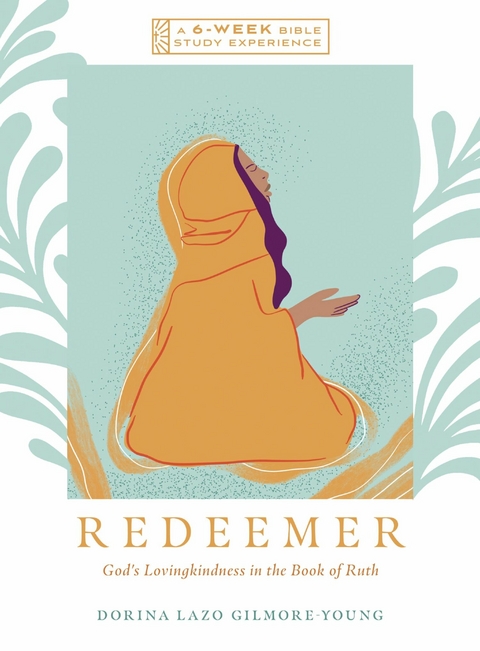
Redeemer (eBook)
176 Seiten
IVP Bible Studies (Verlag)
978-1-5140-0836-2 (ISBN)
Dorina Lazo Gilmore-Young (MFA, Hollins) is a writer, speaker, podcaster, and journalist. As the author of several Bible studies and devotionals including Create in Me a Heart of Mercy and Breathing Through Grief, Dorina frequently speaks at churches and retreats. She is also the author of several children's books, including Cora Cooks Pancit and Chasing God's Glory. A self-described foodie and an avid runner, Dorina lives in Central California with her husband Shawn and three daughters.
Dorina Lazo Gilmore-Young (MFA, Hollins) is a writer, speaker, podcaster, and journalist. As the author of several Bible studies and devotionals including Create in Me a Heart of Mercy and Breathing Through Grief, Dorina frequently speaks at churches and retreats. She is also the author of several children's books, including Cora Cooks Pancit and Chasing God's Glory. A self-described foodie and an avid runner, Dorina lives in Central California with her husband Shawn and three daughters.
GROUP SESSION: THE TURNING POINT
Today we are going to talk about turning points in our lives. A turning point is when the action, the energy, or perhaps the circumstances change. The book of Ruth drops us right into a major turning point in the lives of our main characters.
DISCUSS
-
1. What are some of the questions you have brought with you to this study of the book of Ruth?
-
2. In today’s video, you heard about a turning point in my life and in Ruth’s life. Is there a time that felt like a turning point in your life? If so, share with the group something about that experience.
-
3. One of the themes that emerges in the book of the Ruth is God’s heart for the vulnerable. READ the following passages aloud and notice what they tell us about God and his heart of mercy. Take a few minutes to list some of those characteristics of God in the space below.
-
4. Looking at that list, name something that either surprises you about God, or something that you struggle to accept about him.
-
5. Who are the vulnerable women in your community?
-
6. What conditions led to their vulnerability?
-
7. What is one small thing you can do to honor these women today? Maybe it’s looking someone in the eyes, stopping for a conversation, or taking time to learn more about these women in your community. Brainstorm some ideas together.
-
8. In the video, I shared about how Ruth starts out as helpless and moves toward hopeful. Are you or someone close to you facing anything in life that feels helpless? If you are comfortable, share this with others.
PRAY
As you close your time, I’ve included a few suggestions to guide you in prayer together:
-
›Thank God for who he is, naming those characteristics we read in Scripture.
-
›Ask God to meet you and others in circumstances that feel helpless.
-
›Ask God to comfort and provide for the women in your community who might be feeling helpless in different ways.
-
›Ask for courage and wisdom to honor the vulnerable women in your community.
If you prefer, write out a prayer in the margins or in a journal.
MEMORY VERSE
WEEK ONE
Ruth replied, “Don’t urge me to leave you or to turn back from you. Where you go I will go, and where you stay I will stay. Your people will be my people and your God my God. Where you die I will die, and there I will be buried. May the LORD deal with me, be it ever so severely, if even death separates you and me.”
Day One • What’s in a Name?
Look back over Ruth 1. How might you describe this chapter in a word or a feeling? What title would you give this chapter?
My first job out of college was as a newspaper reporter at The Fresno Bee in Central California. That led to a teaching opportunity where I walked students through the principles of investigative journalism. They learned that a top-notch article nails six questions: Who? What? When? Where? Why? and How?
Because the book of Ruth is exquisitely written, we want to start this journey with the posture of an investigative journalist. Answering these questions will enhance our understanding of the book of Ruth, the context in which these events take place, and the significance of Ruth herself in the greater biblical narrative.
Review Ruth 1:1-5.
List the principal figures in this chapter and how they are related or connected.
In his timeless play Romeo and Juliet, Shakespeare penned Juliet’s famous protest: “What’s in a name? That which we call a rose by any other name would smell as sweet.” Juliet’s words try to say that names are not important. She loves Romeo whether he is a Montague or not. Her love for him is deep and pure. She doesn’t care about his name or his family affiliation. Of course, through the play, we learn that it’s not that simple. Names do matter in surprisingly deep ways. Names often carry our stories, our family legacy, our connection to our cultural heritage, and more.
In the book of Ruth and in the Bible in general, the meaning of names is significant. Names also gave an indication of who the person might become. Naomi means “my joy” and “pleasant” in Hebrew, while Ruth means “friendship.” As we follow along in this story, we will see why both names are significant. Elimelek means “my God is King,” while his sons are named Mahlon, meaning “sick and dying,” and Kilion, meaning “puny and tiny.” Sometimes biblical names are unfortunate and ironic, but they’re worth paying attention to because they add to our understanding of the context.
Review Ruth 1:19-21.
What does Naomi tell her people to call her and what does this indicate about the condition of her heart when she arrives in Bethlehem?
It’s curious to me that even though Naomi (or, now, Mara) experiences so much hardship, she continues to call God “the Almighty,” showing she still trusts him. Perhaps she was able to hold on to such faith because she recalled another woman who endured much hardship and calamity in her life: Hagar. In fact, Hagar’s predicament was so awful that she fled to the desert. And yet Hagar—who was entirely vulnerable because she was a female, a servant, and a foreigner—is the first person in Scripture to name God.
Read Genesis 16:13-14.
What name does Hagar give God, and what does that name mean?
God saw Hagar, had compassion on her, and was present with her in her time of need. If you don’t know all of Hagar’s story, I would encourage you to read Genesis 16 when you have time. Hagar’s story reminds us of God’s grace and mercy, especially in our most vulnerable moments.
God saw Hagar, and God saw Naomi. And God sees you and me.
As you close your time today, I’ve included some prompts for prayer. You can write your prayers here or in a journal.
God, in this season of life,
I feel most seen when . . .
I feel invisible when . . .
I am carrying these heavy burdens . . .
God, thank you for carrying these burdens with me. Thank you for seeing me. Keep my heart from bitterness toward you and others. Amen.
Day Two • Moving Day
Let’s explore a bit more today about when and where the book of Ruth takes place in the context of history and what instigated the family’s initial move from Bethlehem to Moab.
Read Ruth 1:1-5 to refresh your memory.
What did you learn in these verses regarding the time period of the events we are reading about?
The book of Ruth occurred during the time of the judges (1375–1050 BC) after Joshua’s death. If you have not read the book of Judges, it’s a pretty rough period in the history of Israel—a time when “everyone did as they saw fit” (Judges 17:6). The nation experienced a repeated cycle of following God, forgetting God, doing some pretty terrible things and suffering the consequences, and then begging God for help. Over and...
| Erscheint lt. Verlag | 11.2.2025 |
|---|---|
| Reihe/Serie | IVP Bible Study Experience |
| Verlagsort | Lisle |
| Sprache | englisch |
| Themenwelt | Geisteswissenschaften ► Religion / Theologie ► Christentum |
| Schlagworte | Bible study • bible study for women • Book of Ruth • church small group • group study • old testament bible study • ruth bible study • Scripture • six week bible study • video bible study • Women's Bible Study • women's ministry |
| ISBN-10 | 1-5140-0836-X / 151400836X |
| ISBN-13 | 978-1-5140-0836-2 / 9781514008362 |
| Informationen gemäß Produktsicherheitsverordnung (GPSR) | |
| Haben Sie eine Frage zum Produkt? |
 EPUB (Wasserzeichen)
DRM: Digitales Wasserzeichen
Dieses eBook enthält ein digitales Wasserzeichen und ist damit für Sie personalisiert. Bei einer missbräuchlichen Weitergabe des eBooks an Dritte ist eine Rückverfolgung an die Quelle möglich.
Dateiformat: EPUB (Electronic Publication)
EPUB ist ein offener Standard für eBooks und eignet sich besonders zur Darstellung von Belletristik und Sachbüchern. Der Fließtext wird dynamisch an die Display- und Schriftgröße angepasst. Auch für mobile Lesegeräte ist EPUB daher gut geeignet.
Systemvoraussetzungen:
PC/Mac: Mit einem PC oder Mac können Sie dieses eBook lesen. Sie benötigen dafür die kostenlose Software Adobe Digital Editions.
eReader: Dieses eBook kann mit (fast) allen eBook-Readern gelesen werden. Mit dem amazon-Kindle ist es aber nicht kompatibel.
Smartphone/Tablet: Egal ob Apple oder Android, dieses eBook können Sie lesen. Sie benötigen dafür eine kostenlose App.
Geräteliste und zusätzliche Hinweise
Buying eBooks from abroad
For tax law reasons we can sell eBooks just within Germany and Switzerland. Regrettably we cannot fulfill eBook-orders from other countries.
aus dem Bereich