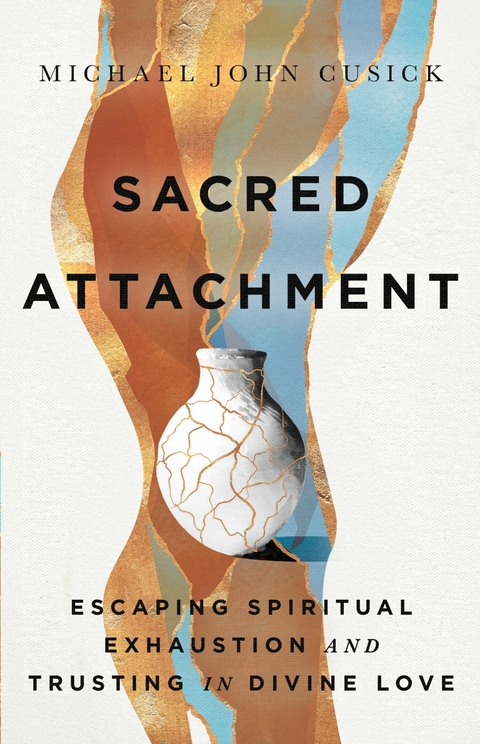
Sacred Attachment (eBook)
192 Seiten
IVP Formatio (Verlag)
978-1-5140-0832-4 (ISBN)
Michael John Cusick is the CEO and founder of Restoring the Soul, an intensive counseling ministry in Denver. He is a licensed professional counselor, spiritual director, and former assistant professor of counseling at Colorado Christian University. Michael is the author of Surfing for God, and his articles have appeared in such places as Relevant, Huffington Post, and Red Letter Christians. He and his wife, Julianne, have two grown children and live in Littleton, Colorado.
Michael John Cusick is the CEO and founder of Restoring the Soul, an intensive counseling ministry in Denver. He is a licensed professional counselor, spiritual director, and former assistant professor of counseling at Colorado Christian University. Michael is the author of Surfing for God, and his articles have appeared in such places as Relevant, Huffington Post, and Red Letter Christians. He and his wife, Julianne, have two grown children and live in Littleton, Colorado.
1
SPINNING
ESCAPING AND EXPERIENCING
GOD’S EMBRACE
There are parts of life that can’t be gotten out of, and I have had to learn, here, that we are all, at the end, held somehow.
TA-NEHISI COATES
A bitter cold Sunday morning and the seven Cusicks, including my four-year-old self, are crammed into our maroon Pontiac station wagon for the long ride to Carmel of the Holy Family, a Roman Catholic convent. My father’s sister is a cloistered Carmelite nun. In the unspoken pecking order of Catholic religious vocations, life as a Carmelite is the military equivalent of becoming a Navy SEAL. Not for the faint of heart.
The Carmelites go all the way back to the fourteen hundreds. Like Saint Teresa of Ávila, Saint Thérèse of Lisieux, and Saint John of the Cross, they make vows of chastity, poverty, and obedience while choosing to withdraw from the world into a community devoted to contemplating the love and mystery of Christ.
Family visits to Carmel felt like Christmas morning—and Halloween, wrapped together and placed under the tree. There were smiles and laughter. But it also felt a little spooky because once inside the convent the nuns were restricted to greeting visitors from behind the grille–a metal grid of bars preventing the nuns from having physical contact with the outside world. So when you’re four years old, no matter how much your parents explain about monastic vows and devotion to God, and you visit your aunt and a group of nuns behind bars, it still seems like you’re visiting a prison full of women dressed like penguins.
After the initial excitement we kids would get bored and play in another part of the visitation room. As my parents would visit with my aunt, Sister Anne, the other twenty or so nuns would wander in and out to say hello. More joy and laughter, but no matter what, the greetings were limited to a hand reaching through the bars of the grille.
My sister Colleen and I would sit cross-legged, rolling a ball back and forth between us, while my brother Jimmy hovered in the corner near the grille playing with his Hot Wheels collection. When my sister and I got bored, we would wander over to the corner and begin to play with Jimmy’s cars.
In the corner of the parlor was a cabinet mounted on the wall and level with a counter. My parents and all of us kids sat in the room on one side of the counter. On the other side of the grille the nuns had a counter of their own and would pull up chairs throughout the visit. Inside the cabinet was a metal cylinder that looked like a giant can of Campbell’s soup. The cylinder was set up on a lazy Susan allowing it to spin around so that visitors and nuns could pass food or gifts or other items back and forth.
I don’t remember what prompted my brother to do what he did that day. Jimmy was about ten then, six years older than me. I naturally looked to him for guidance and usually followed along with whatever crazy ideas he might present. So with the adults preoccupied in grown-up conversation, Jimmy lifted me up into the cabinet, set me on the lazy Susan, and closed the cabinet door. The next thing I remember was spinning around and around and around.
Immediately, I felt pulled between sheer childlike glee and unadulterated terror. Was this a game where I should be enjoying myself? Or was I too being sent behind bars for some heinous deed I didn’t remember committing?
The spinning inside that cabinet seemed to last forever. Being spun around had always made me dizzy and nauseous, so I wanted Jimmy to stop me but couldn’t mouth any words. Just when I hoped he had read my mind, the spinning stopped. I exhaled with a sense of relief as all three feet of me stood helpless in the dark.
Just then the doors opened. But instead of seeing Jimmy’s face, Sister Anne leaned in and wrapped her arms around me. She wasn’t anxious or alarmed, so neither was I.
Picture this: a group of women who will never bear their own children, who have extremely limited contact with outsiders, who have been set apart from their own relatives and siblings except for the infrequent touch of family and friends from behind the grille. Breaches in this protocol were not simply infrequent—I suspect they were unprecedented.
And by all accounts, unacceptable. After all, these nuns had taken vows to withdraw from the world. Here I was, a four-year-old kid in my devout Catholic family, and I was on the wrong side of the grille. Behind bars with a dozen cloistered nuns.
Even today as I recall this moment, I imagine bishops or cardinals or even the pope himself breaking into the room and catching me trespassing. In my mind their glasses are down on the tips of their noses like curmudgeonly English schoolmasters straight out of a Dickens novel.
It would take me many years to realize that my fear and anxiety about being on the wrong side and scrutinized by the religious authorities was a template for my understanding of God. If I crossed the line, God was like that displeased religious figure. If I broke the rules, God would surely break me.
But all of that fear washed away when I became aware of the joy and sense of welcome that surrounded me there. If we ambushed each other, it was an ambush of love. Sister Anne held me and ran her fingers through my hair and kissed my cheeks. This wasn’t some grandmotherly cheek pinching in that patronizing kind of way. She simply took delight in who I was.
Next came Sister Jean Marie, my aunt’s best friend and soulmate in the convent. Other nuns gathered around and hugged me. Sister Bernadette, born and raised in Slovakia, and who spoke with a lingering Slovakian accent, had a permanent smile on her face. Her hugs were so solid and strong, just one step short of crushing the wind out of me, but I felt so safe in her embrace, her maternal tenderness a welcome place for me to be four years old.
I don’t recall which of the nuns suggested that we dance. A few small tables were pushed to the side, the nuns circled up, maybe four or five of them, and we began to sway. It started with “Ring around the Rosie” before progressing into another familiar favorite.
I still question whether we actually sang and did the hokey pokey, but the image of my preschool self dancing with a group of cloistered nuns makes me smile. Together we put our left hand in, and we put our left hand out. We put our right hand in and our right hand out. You know the rest of it: You put your whole self in, and you put your whole self out. You do the hokey pokey, and you turn yourself around.
And so, the reason my life changed that day is that from the moment of being placed into the cabinet in the container that would spin me around to the surprise of being welcomed into the arms of the nuns on the wrong side of the bars, I learned that’s what it’s all about.
What it’s all about is an invitation to be held in loving connection. To participate in a dance where we are seen, soothed, safe, and secure. Seen as little children in our smallness and innocence. Soothed by being held in the arms of someone stronger whose only concern is our well-being. Safe, even when we find ourselves in a container that feels disorienting and dangerous. In those moments of being seen, soothed, and safe, we also find an unexpected gift of being secure.
Looking back, I can interpret my life through that Carmel moment. That experience at the convent foreshadowed various movements of my life. The first movement, taking me into adulthood, involved that same sense of apprehension and hiding my shame. Next, I learned that life is like spinning in that cabinet, disorienting and uncertain, often confusing and unfamiliar. Finally, in recent years I have experienced the surprise of love, an awareness that when we are held and embraced securely, we somehow have everything we need no matter where we land. I realized that God delights in doing the unprecedented in order to bring us to childlike trust so that he can heal our hearts and restore our souls.
In the midst of these movements, however, I rarely saw their impact clearly.
LOVE HAS YOU
Before I was dropped into that cabinet, I was placed into another kind of container—my family of origin. In my case this was shaped by alcoholism, emotional and sexual abuse, generations of mental illness, and shame. You see, that same year of spinning was also when my father stopped drinking for the first time. The same year my uncle began touching me inappropriately. This inauspicious legacy often limited my ability to trust and to receive love. The raw, unrelenting pain in my heart left my soul numb and kept my mind looking for answers.
You likely inherited your own generational and familial challenges. Perhaps your family maintained an image of unity and bliss to those around you but fractured into anger and abuse behind closed doors. Your parents or caregivers may have struggled with issues and addictions that hindered or incapacitated their ability to provide your basic needs, including those for attention, safety, and affirmation. You may have been forced to carry adult burdens rather than enjoy a carefree childhood.
Or perhaps your family loved and supported you well. You not only had all your basic necessities provided, but you also...
| Erscheint lt. Verlag | 7.1.2025 |
|---|---|
| Verlagsort | Lisle |
| Sprache | englisch |
| Themenwelt | Geisteswissenschaften ► Religion / Theologie ► Christentum |
| Schlagworte | addiction • Addiction Recovery • Anxiety • Burnout • Christian • Christian Spirituality • contentment • Deconstruction • Depression • Divine attachment • Embodiment • Emotions • Experience • Faith • Faith Deconstruction • God • Healing • Healing from trauma • Joy • Mysticism • Peace • post traumatic stress • PTSD • Recovery • restoration • restoring • restoring the soul • self • Shame • Soul • Spirituality • Stress • Trauma • trauma counseling • Trauma Informed • vulnerability • Wholeness |
| ISBN-10 | 1-5140-0832-7 / 1514008327 |
| ISBN-13 | 978-1-5140-0832-4 / 9781514008324 |
| Informationen gemäß Produktsicherheitsverordnung (GPSR) | |
| Haben Sie eine Frage zum Produkt? |
 EPUB (Wasserzeichen)
DRM: Digitales Wasserzeichen
Dieses eBook enthält ein digitales Wasserzeichen und ist damit für Sie personalisiert. Bei einer missbräuchlichen Weitergabe des eBooks an Dritte ist eine Rückverfolgung an die Quelle möglich.
Dateiformat: EPUB (Electronic Publication)
EPUB ist ein offener Standard für eBooks und eignet sich besonders zur Darstellung von Belletristik und Sachbüchern. Der Fließtext wird dynamisch an die Display- und Schriftgröße angepasst. Auch für mobile Lesegeräte ist EPUB daher gut geeignet.
Systemvoraussetzungen:
PC/Mac: Mit einem PC oder Mac können Sie dieses eBook lesen. Sie benötigen dafür die kostenlose Software Adobe Digital Editions.
eReader: Dieses eBook kann mit (fast) allen eBook-Readern gelesen werden. Mit dem amazon-Kindle ist es aber nicht kompatibel.
Smartphone/Tablet: Egal ob Apple oder Android, dieses eBook können Sie lesen. Sie benötigen dafür eine kostenlose App.
Geräteliste und zusätzliche Hinweise
Buying eBooks from abroad
For tax law reasons we can sell eBooks just within Germany and Switzerland. Regrettably we cannot fulfill eBook-orders from other countries.
aus dem Bereich