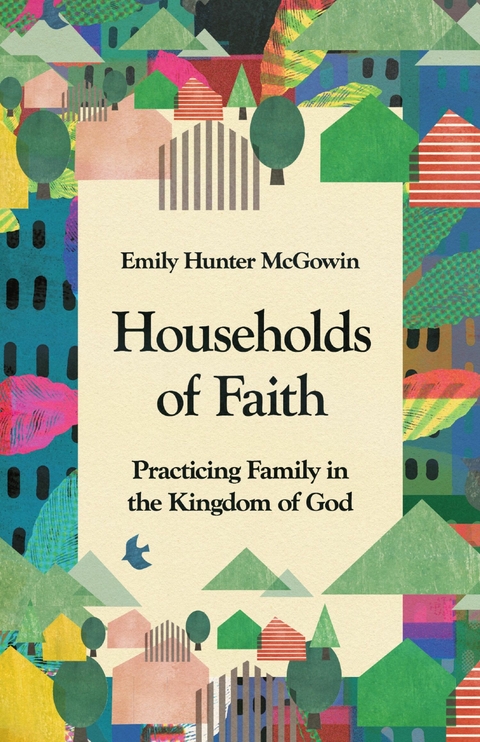
Households of Faith (eBook)
256 Seiten
IVP (Verlag)
978-1-5140-0007-6 (ISBN)
Emily Hunter McGowin (PhD, University of Dayton) is associate professor of theology at Wheaton College. She is the author of Quivering Families and Christmas, and coeditor of God and Wonder. Her articles have appeared in Christianity Today and The Week. She is a priest and canon theologian in the Anglican diocese of Churches for the Sake of Others. She and her husband, Ron, also a priest, live in Chicagoland with their three children.
Emily Hunter McGowin (PhD, University of Dayton) is associate professor of theology at Wheaton College. She is the author of Quivering Families and Christmas, and coeditor of God and Wonder. Her articles have appeared in Christianity Today and The Week. She is a priest and canon theologian in the Anglican diocese of Churches for the Sake of Others. She and her husband, Ron, also a priest, live in Chicagoland with their three children.
Introduction
I don’t have family figured out.
This may not be the wisest way to begin, but I think it’s important to manage expectations from the start. I am a theologian, priest, and professor, as well as a daughter, sister, wife, and parent. I have done a lot of thinking about families (almost a decade of research and writing), and spent many years living in families (first my family of origin and then the one I created with my husband, Ronnie). Still, I feel like I’m making it up as I go on a regular basis.
So, please don’t assume I write this book as one who has found The Answer for how to be a healthy, gospel-oriented, Jesus-loving, kingdom-rooted Christian family in the twenty-first century. Instead, I write as a fellow laborer in the field, a colearner in the gospel, someone trying to figure out what life in God’s kingdom means for households as they face the challenges and opportunities of the contemporary world.
Because Ronnie and I both come from homes marked by abusive relations, alcoholism, and chronic instability, we had to forge a new path when we got married. Many times, we discussed the fact that we didn’t have models. We didn’t know how to do this mutually loving, mutually self-giving, mutually supportive marriage thing. We didn’t know how to parent without codependency, fear, and violence. Our mothers did the very best they could—and we are grateful for their endurance and examples. But they could only teach so much on their own. So, Ronnie and I set out to make our own way, trusting that God would lead us and accompany us.
We have been practicing family together for over twenty years now. We have three children in their adolescent and teen years, and one elderly cat. We make our home in the western suburbs of Chicago where I work at a Christian liberal arts college. Ronnie pastors a small Anglican congregation that we serve with another priest, while also managing our household and children. We have lived in five states and served churches in the Southern Baptist, Methodist, Episcopal, and Anglican traditions. I have studied in Baptist and Catholic institutions. Together we have endured the deaths of his brother and mother, the addictions of family members, the dissolution of friendships, a grueling PhD program, abusive church leadership, unemployment, medical emergencies, bankruptcy, and more. Of all the things we’ve done together, our family is the thing I am most proud of—not in an arrogant way, but in a wonderstruck, I-can’t-believe-we-managed-to-do-this way. We know well the gift this is, and we are grateful for the ways we’ve been enabled to stop patterns of dysfunction and abuse.
At the same time, we’re also grappling daily with the realities of our sinful world and trying to figure out how to be a Christian family through it all. We love our home country, the United States, but we cannot deny its wicked foundation in White supremacy, settler colonialism, genocide, and race-based chattel slavery.1 We have sought to tell the truth to our children from their earliest days, to help them be more loving and just neighbors and more faithful heralds of Jesus’ good news. But they’ve had their hearts broken—and ours too—over the past several years watching so many self-professed Christians in the United States sell their souls to Trumpism, Covid denial, election denial, White nationalism, abuse cover-ups, and more. Learning how to be disciples as a family in this moment has been the most challenging task of our lives.
I don’t say all this to claim any special kind of authority. In fact, one of the biggest hurdles of this cultural moment is the growing realization that the people many of us trusted to have The Answer do not have it. In fact, it’s clear from the fruit of their lives and ministries that they never did. While we twisted ourselves into knots and jumped through hoops trying to conform to the blueprints we were given for gender roles, singleness, marriage, and parenting, the leaders we looked to for guidance were exposed, one after the other, as colossally and catastrophically wrong. The Western church has undergone a true apocalypse—literally, an unveiling—in the past few decades. And White Christians especially have finally begun to wake up to the ways in which their understanding of the gospel has been twisted and perverted by the besetting sins of the American empire.
I write this book as a disciple of Jesus who is very much still on the way. This volume is what I have to offer the people of God at this time in this place given all that I’ve experienced and learned so far. Whatever you find here that is true, good, and beautiful, please take and use. Whatever is not, please set it aside and say a prayer for me.
Christian Families in Between
Most of the households I know were completely overwhelmed by the challenges of the Covid-19 pandemic and its mishandling. Even so, despite the distress, the way our family and many others were forced to pivot and restructure life jolted us out of our ruts. Suddenly, it was possible to imagine another way of living. Things could be different from what they are.2 And that was a powerful, albeit intimidating, realization.
Such disruptions in the status quo also forced us to seek out the trustworthy and settled things amid the quaking all around us. Through the cultural and political upheavals of the past century and a half, many Christians have looked to the “traditional family” as a source of stability. I understand the impulse. There has never been an idyllic past for families. But even just fifty years ago there was still a broad consensus in the West about many things: that lifetime monogamy is ideal, premarital sex is unwise, and two opposite-sex parents are important for childrearing. Today such expectations are openly contested and condemned by many as oppressive and wrong. When it feels like so much is changing so rapidly, it makes sense that people, especially Christians who are used to revering tradition, would reach for something stable.
It’s also impossible to overstate the importance of our families to our lives. Family functions, for better or worse, as our foundation, our lodestone, our North Star. “No wonder,” as Anglo-American author Rodney Clapp says, “we want to call it natural and believe it to be as final and invulnerable as the force of gravity.”3 Many things in the created order appear unchanging. The earth rotates and orbits the sun, causing patterns for days and seasons, as well as a glorious, revolving display of constellated stars. The earth’s rivers run into the seas and the moon governs the ocean’s tides. Gravity ensures that everything falls to the earth, from ripe southern pecans to discharged rocket boosters. All these things and more give creatures a sense of security—as they should. We know creation comes from a good God who made all things with a good purpose. The order we perceive in the world is surely for the good of all creatures. Why not the family too?
Yet, we also know creation is fallen, influenced top to bottom by evil, sin, and death. Our depraved condition extends to all human relationships, including the families we form. We are creatures of time, too, and as we move through time, both as individuals and communities, we accumulate a mix of things beneficial and poisonous. Such accretions—like proverbial moss growing on a rolling stone—make us who we are and influence the course of our lives. “History is not the past,” African American author James Baldwin says. “It is the present. We carry our history with us. We are our history.”4 There is no ground, therefore, for nostalgia—a romantic, highly selective, longing for the past. Nor is there ground for the myth of constant progress, an idealism that says we are always and inevitably improving with the passage of time.
The truth is families have never been constant in the way many imagine. The paradigm for family (not to mention marriage and sex), which many Christians assume to be divinely designed is, in fact, a relatively recent development. The traditional family of Christian talk radio and conservative political platforms emerged in the nineteenth century among the White middle class of Western Europe and the United States, alongside industrial capitalism and Western imperial expansion. Despite the desire to hold on to something eternal and unchanging, many Christians today are seeking to preserve something that is highly contextual and changeable—and not even especially good for us.
Even though God in Christ has reconciled the world to himself, we remain today in “the time between the times” as attributed to American Episcopal priest Fleming Rutledge—already experiencing God’s kingdom in part but awaiting its full consummation. We see occasional glimpses of God’s redemption in our everyday lives, but also recognize that much yet remains to be redeemed. As a result, Christians above all must be cautious about what we look to for security, “for this world in its present form is passing away” (1 Cor 7:31). Transient things ought not be confused with eternal things, and historical things ought not take the place of transcendent ones. The biblical word for such mistaken trust is idolatry. Idols promise a guaranteed return in exchange for our worship. But they are liars, and their “blessings” are smoke and ash.
Because all Christians live in the tension between the already kingdom and the not-yet kingdom, so too do Christian families. There are ways in which we are able, by the Spirit’s power, to experience the eternal...
| Erscheint lt. Verlag | 28.1.2025 |
|---|---|
| Verlagsort | Lisle |
| Sprache | englisch |
| Themenwelt | Geisteswissenschaften ► Religion / Theologie ► Christentum |
| Schlagworte | Biblical • biblical households • Blended • Christian • Christian family • Christian homemaking • Christian household • Christian parent • Christian parenting • Church • Community • Discipleship • Domestic • faithful • Families • Family • family discipleship • god's design for families • homemaking • imperfect • Jesus • multigenernational • multigenernational household • non traditional • Nuclear • Nuclear family • parenting • Practice • relationships • Spiritual • Theology • Togetherness • Traditional • traditional family |
| ISBN-10 | 1-5140-0007-5 / 1514000075 |
| ISBN-13 | 978-1-5140-0007-6 / 9781514000076 |
| Informationen gemäß Produktsicherheitsverordnung (GPSR) | |
| Haben Sie eine Frage zum Produkt? |
 EPUB (Wasserzeichen)
DRM: Digitales Wasserzeichen
Dieses eBook enthält ein digitales Wasserzeichen und ist damit für Sie personalisiert. Bei einer missbräuchlichen Weitergabe des eBooks an Dritte ist eine Rückverfolgung an die Quelle möglich.
Dateiformat: EPUB (Electronic Publication)
EPUB ist ein offener Standard für eBooks und eignet sich besonders zur Darstellung von Belletristik und Sachbüchern. Der Fließtext wird dynamisch an die Display- und Schriftgröße angepasst. Auch für mobile Lesegeräte ist EPUB daher gut geeignet.
Systemvoraussetzungen:
PC/Mac: Mit einem PC oder Mac können Sie dieses eBook lesen. Sie benötigen dafür die kostenlose Software Adobe Digital Editions.
eReader: Dieses eBook kann mit (fast) allen eBook-Readern gelesen werden. Mit dem amazon-Kindle ist es aber nicht kompatibel.
Smartphone/Tablet: Egal ob Apple oder Android, dieses eBook können Sie lesen. Sie benötigen dafür eine kostenlose App.
Geräteliste und zusätzliche Hinweise
Buying eBooks from abroad
For tax law reasons we can sell eBooks just within Germany and Switzerland. Regrettably we cannot fulfill eBook-orders from other countries.
aus dem Bereich