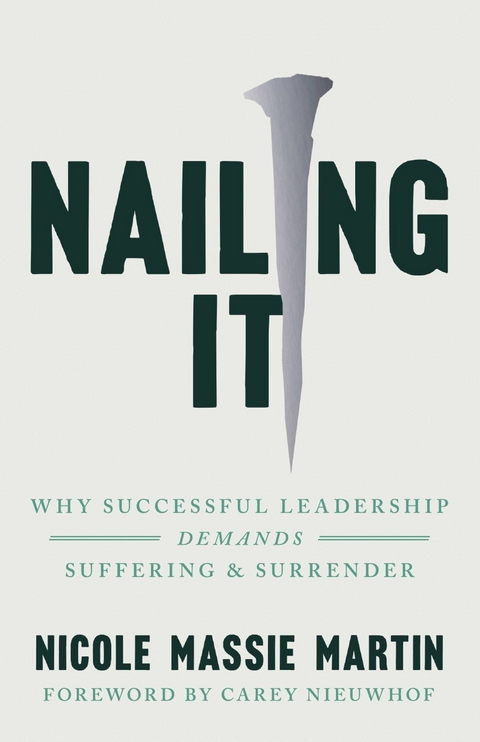
Nailing It (eBook)
224 Seiten
IVP (Verlag)
978-1-5140-0975-8 (ISBN)
Rev. Dr. Nicole Massie Martin holds degrees from Vanderbilt University, Princeton Theological Seminary, and Gordon-Conwell Theological Seminary. She is the Chief Operating Officer at Christianity Today and founder and Executive Director of Soulfire International Ministries. She is an accomplished writer and author, serves on various boards and councils, and leads the Grow Ministry at Kingdom Fellowship AME Church in Maryland. She and her husband, Mark, are proud parents to two amazing daughters.
Rev. Dr. Nicole Massie Martin holds degrees from Vanderbilt University, Princeton Theological Seminary, and Gordon-Conwell Theological Seminary. She is the Chief Operating Officer at Christianity Today and founder and Executive Director of Soulfire International Ministries. She is an accomplished writer and author, serves on various boards and councils, and leads the Grow Ministry at Kingdom Fellowship AME Church in Maryland. She and her husband, Mark, are proud parents to two amazing daughters.
Introduction
THE TIME IS NOW
This book may not make you money. It’s unlikely to increase your status, get you the next best job, or bring you into new stratospheres of power. This is the book you pick up when you finally realize that traditional leadership no longer works for who you are or for the people you serve. For generations, leaders have been encouraged to wear leadership like a store-bought suit and to simply tailor it to fit our contexts. We’ve believed the idea that good leadership is about getting things done and that teams are designed to help us get there.
And then came millennials who started demanding more from their workplaces. No longer satisfied with simply doing a job, they pushed their organizations to actually care. They grew weary of narratives where leaders and staff members went to places they hated just for a paycheck and strived to belong to places that valued who they were beyond what they did.
And then came greater diversity. Traditional leadership teachings and styles hung on predominantly White male models that were assumed to fit every lifestyle. But women needed room for their natural gifts to shine, and people of color needed space to elevate the values they brought into their roles. Even White men grew weary of the leadership status quo, craving innovative ways to lean into changing realities. This increased the need for new, more comprehensive models of leadership to accommodate this newer, more diverse leadership landscape.
And then came the Covid-19 pandemic. Prior to March 2020, it was almost unheard of to consider how an employee felt or what they needed in order to work effectively. But when entire workforces were required to work from home and people had space to think more carefully about what it meant to do a job, things began to change. Motivations for work changed. How people felt about teams changed. The willingness to acknowledge mental health and to create environments for flourishing changed, and this was not limited to just one industry. Every organization was affected by this gradual shift from a mission-centric to a people-centric workplace. None of these factors are negative in and of themselves, but each brings new challenges and opportunities to rethink the way we’ve always done leadership.
These and many other shifts have affected every area of business, even reaching to churches and faith-based organizations where work fatigue increased with changes in society. Volunteers have started to expect more from the places where they serve. Faith-based staff members are carrying greater responsibilities and experiencing higher levels of burnout. When you add increased visibility through social media and the gut-wrenching stories of moral failures among leaders, what you get is a leadership crisis. There are greater demands on leaders to serve with compassion than in the past and greater awareness of the impact of toxicity in the workplace. In both secular and sacred spaces, there is a deficit of leaders who operate with integrity in their empathy and a proliferation of wounded employees. How can we bridge the gap between the lack of strong leadership and the overabundance of needs? The only way to solve this is to shift the way Christian leaders think about leadership in order to shift the way they lead.
The emphasis of this book is on Christian leaders for several reasons:
-
1. Christian leaders are located everywhere. They serve in the church, at the bank, in schools, and in just about every field imaginable. Christian leaders have the greatest capacity to reach the largest amount of people in the world.
-
2. Christian leaders ought to be guided by principles that go beyond their occupations. Regardless of where they serve, Christian leaders theoretically answer to a higher calling. This allows them to be centrally influenced by the gospel in a way that makes them more open to God-directed changes and pivots.
-
3. Christianity itself is in crisis. While Christian leaders are everywhere, what we observe across the ecclesiastical landscape is a type of identity crisis within churches where even the people inside of them have no idea who they are. We have lost sight of what it means to be lights in darkness. We have forgotten what it means to prioritize the needs of the least of these, elevating internal needs over those in the church’s community. As a result, we have lost sight of what it means to be a disciple and follower of Jesus. This crisis creates a vacuum where it is easier to learn a new trade than it is to learn how to follow Christ.
-
4. We have disconnected faith from discomfort and leadership from sacrifice. At the core of Christianity is the cross, and at the core of leadership is servitude. When both are in crisis, the default is to lean toward what is comfortable and easy. But it is a dangerous world when leaders care more about their comfort than their calling and when faith is more about height than it is about depth.
-
5. God is the only one who can solve the crises we face in society and in our lives. Self-help books will not solve the deeper issues. Doing what we’ve always done will simply get us the same results. Only God can prompt us to redirect our lives in a way that brings healing and hope to the world. Without him, we can do nothing.
Now more than ever, we need courageous Christian leaders in every field who are willing to turn to God for a revelatory vision of how to lead in times of intense trauma. We need people who don’t mind taking up their crosses to follow Christ, not only to the mountain tops but also into the valleys of pain. We need a revival of crucified living that might take us to resurrected leadership for the glory of God and the good of the people! But necessary tasks hardly ever come easy.
A PREVIEW OF THE JOURNEY
We are about to begin an excursion together to wrestle with what it looks like to lead with crucified lives so that a truer vision of God’s healing grace may be resurrected in and through us. I am defining the “crucified life” as the day by day, moment by moment process of taking up our crosses to follow Jesus. Some scholars, such as Michael Gorman, have used the term cruciformity to describe this process of “letting the cross of the crucified Messiah be the shape, as well as the source, of life in him.”1 Since crucifixion names the finished work of Christ on the cross and cruciformity names the spiritual discipline of being shaped by the cross, it’s important to use both terms to illuminate the true glory of resurrection. This journey will invite you to rethink your context, your capacity, and your calling in ways that are designed to make you unsettled enough for God to do something new. As much as it would be easier for God to do miraculous works in our lives when things are smooth, disruption is the primary means to bring about lasting change. If you’re ready, we will walk together to disrupt our previous ideas about leadership, crucifying them on the cross, and making room for God to resurrect visions of healing in their place. Here’s how we’ll do it.
In the first section, we’ll unpack the problem of why the world feels more stressed and traumatized now than ever before. We’ll explore some of the themes mentioned above that have contributed to our current crises and get real about dangers of American triumphalism. While the context is carefully structured for Americans, there is no doubt that principles of power, ego, performance, and more can be applied across global contexts. The purpose of discussing the roots of the issues is to build the courage to figure out what we can do about it.
In the second section, we’ll take time to investigate the progression from where we are to where we want to be. We’ll wade through seven areas of traditional leadership that will need to be reframed through the lens of crucifixion and resurrection. I will regularly use the phrase traditional leadership, knowing that each element presents itself in various forms of leadership teaching and philosophies. We’ll begin with larger concepts, including power and ego. These will set the stage for looking at our motivations to lead. From there, we’ll move to more internal challenges of reconsidering speed, performance, and perfection. After this, we’ll shift to organizational perspectives on loyalty and scale. Throughout each of these chapters, you’ll see a combination of stories from fictional accounts to historic reflections to futuristic projections to define what’s at stake. While we may experience some natural turbulence that comes from tussling with the past, we’ll land the plane with either questions to reflect on or summary points you may consider.
The last section is all about the promise of God for those who are willing to take the leap of faith into new leadership realities. You’ll see Jesus as the center point for most of the scriptural application, but this last chapter will expand to deepen our biblical basis of hope. We’ll dream together to find out what is possible and be encouraged to know that we are not alone. In the end, my hope is that you will finish this book with greater conviction to lay it all down before Christ who can raise up something more glorious through you.
MY PRAYER FOR YOU
I cannot tell you how honored I am...
| Erscheint lt. Verlag | 8.4.2025 |
|---|---|
| Vorwort | Carey Nieuwhof |
| Verlagsort | Lisle |
| Sprache | englisch |
| Themenwelt | Geisteswissenschaften ► Religion / Theologie ► Christentum |
| Schlagworte | Anxiety • BIPOC • Business book • Career • Change Management • Christian • Church • Communication • C-suite • evolving • Executive • leading • Mentorship • ministry • new model • organization • Performance • Power • Sacrificial • servant • Strategy • Stress • Suffering • Women • Work • workplace |
| ISBN-10 | 1-5140-0975-7 / 1514009757 |
| ISBN-13 | 978-1-5140-0975-8 / 9781514009758 |
| Informationen gemäß Produktsicherheitsverordnung (GPSR) | |
| Haben Sie eine Frage zum Produkt? |
 EPUB (Wasserzeichen)
DRM: Digitales Wasserzeichen
Dieses eBook enthält ein digitales Wasserzeichen und ist damit für Sie personalisiert. Bei einer missbräuchlichen Weitergabe des eBooks an Dritte ist eine Rückverfolgung an die Quelle möglich.
Dateiformat: EPUB (Electronic Publication)
EPUB ist ein offener Standard für eBooks und eignet sich besonders zur Darstellung von Belletristik und Sachbüchern. Der Fließtext wird dynamisch an die Display- und Schriftgröße angepasst. Auch für mobile Lesegeräte ist EPUB daher gut geeignet.
Systemvoraussetzungen:
PC/Mac: Mit einem PC oder Mac können Sie dieses eBook lesen. Sie benötigen dafür die kostenlose Software Adobe Digital Editions.
eReader: Dieses eBook kann mit (fast) allen eBook-Readern gelesen werden. Mit dem amazon-Kindle ist es aber nicht kompatibel.
Smartphone/Tablet: Egal ob Apple oder Android, dieses eBook können Sie lesen. Sie benötigen dafür eine kostenlose App.
Geräteliste und zusätzliche Hinweise
Buying eBooks from abroad
For tax law reasons we can sell eBooks just within Germany and Switzerland. Regrettably we cannot fulfill eBook-orders from other countries.
aus dem Bereich