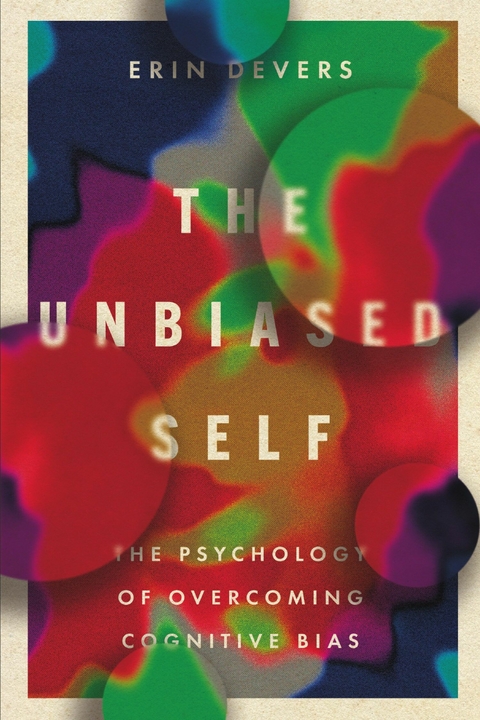
The Unbiased Self (eBook)
192 Seiten
IVP Academic (Verlag)
978-1-5140-0977-2 (ISBN)
Erin Devers (PhD, Indiana University) is professor of psychology at Indiana Wesleyan University. As a social psychologist and educator, she has focused on creative ways to nudge students, fellow educators, and parents toward good decision-making practices. Her work has been published in the Journal for Personality and Social Psychology, Christian Scholar's Review, and the Journal for Psychology and Christianity, among others.
Erin Devers (PhD, Indiana University) is professor of psychology at Indiana Wesleyan University. As a social psychologist and educator, she has focused on creative ways to nudge students, fellow educators, and parents toward good decision-making practices. Her work has been published in the Journal for Personality and Social Psychology, Christian Scholar's Review, and the Journal for Psychology and Christianity, among others.
Two
Who You Think You Are Creates Bias
If file folders are the fundamental unit of thinking, then opening the “self” file folder has very important implications, since it is the biggest file folder and it is chronically open. No one has figured out how to keep this file folder closed. If the “self” file folder is chronically open, the content of the file matters, for a reason best termed “self-schematicity,”1 which means that the important pieces of our self-concept will guide how we process new information, including making judgments about other people.2 A self-schema is in many ways like any other schema discussed in the last chapter, in that the self-schema guides attention and helps us operate efficiently.3 In a similar way to our creation of other schemas, we want to be right, even, if not especially, in our self-schema, which leads us to filter information to confirm what we already think about the self, rather than view the self objectively or accurately. On the other hand, the self-schema is unique relative to other schemas because of its size and relationship to self-esteem maintenance. The self-schema contains the information that is most important to our own self-concept; the mind organizes the important information into the big subfolders of the larger identity folder.
Let’s begin by tracing the history and development of the self-schema specifically. Most researchers agree that the self-schema begins at around eighteen months. When my children were around six months, they were not yet mobile but could sit independently. In an effort to entertain them, I would place them in front of a large mirror. This was entertaining because I had basically given them a friend. At this stage of development, babies are not yet able to separate the self from the environment; therefore, they possess no self-schema. Human faces are one of the most interesting things to babies, and since I couldn’t stare at my babies without taking time to cook or do laundry, a mirror provided a handy form of entertainment. At around eighteen months old, babies start to distinguish their bodies from the environment, and this is measured by a cute demonstration.45 Imagine putting a baby in front of a mirror and drawing a red mark on the baby’s nose with clown makeup. Before eighteen months, the baby is likely to try to touch the other baby in the mirror and might even touch the mirror baby’s nose to wipe off the mark. By eighteen months, the baby looks in the mirror, but touches her own nose. This tell us that at this point in development, even though the baby cannot use language to explain the self, the baby knows that the other baby in the mirror is a reflection of the self, not another baby friend. This is when psychologists claim the self-schema begins.
WHO YOU THINK YOU ARE BIASES YOU
This process of self-schema development is motivated by a desire to be right about ourselves, not to become accurate or righteous, but to figure out how to navigate the world. As young children, we are trying to figure out what makes us unique. A child might adopt the label of “the funny one” because they received laughter in response to their jokes. Another child might endorse the label of “the pretty one” after having gotten compliments on their appearance from others.6 I told my oldest daughter going into kindergarten that some kids would be better than her at different things. When she came home, she told me that she was “good at reading, but other kids were better at cutting.” This type of self-knowledge is gained through social comparison,7 and these labels become the subfolders of the self-schema. We look at other people and measure our differences. You are the “pretty one” if others are uglier. Likewise, you are the “funny one” when other people are less funny. Another way we learn about ourselves is through examining our behaviors.8 I may consider myself to be a workaholic if I count up the number of hours I spend working. People may consider themselves to be fast drivers if they have received more than five speeding tickets this year. Comparing ourselves to others and examining our own behaviors are methods to learn more about the self.
As the self-schema starts to fill, it becomes too unwieldy, just like the “puppy” file folder did for my daughter. So, we start to organize the information within the “self” file folder. Given the constraints of memory, we do not keep all the information, even as it relates to the self. There are things that happen to us that are forgotten.9 The amount of incoming information that is related to the self is not possible for our minds to process and organize well. Even the self-schema is incomplete.10 So instead of thinking of the self-schema as containing all the things that have ever happened to us, it makes sense to think about two different self-concepts. The available self-concept is everything about the self that we have organized and might be able to access if something prods our memories.11 This is a huge file folder. I often think of the available self-concept as the combination of everything from the hard drives of every computer I have ever owned in one giant file folder. On the other hand, the working self-concept is what we are currently activating about the self.12 Think of the working self-concept as the open files on a computer’s desktop. We have a few files and windows that we leave open so we can easily access them the next time we open the computer. In the language of the self, the working self-concept is the aspects of the self that are relevant to our current situation. When voting, we are likely thinking about our national and political identities. When with parents, we think about our identity as a son or daughter. Thus, the working self-concept is not stable because it shifts given differing context, environment, and motivation, while the available self-concept is relatively stable because it is less context dependent.13
As we interact in the world, we are guided by the working self-concept, but there are pieces of the available self-concept that might have proved useful had they been developed and reinforced in childhood. The available self-concept develops over the course of childhood and adulthood though the consolidation of memories.14 The available self-concept loses information through forgetting.15 The working self-concept develops as a result of daily practices. We activate aspects of the self that help us navigate the world.16 Think of your own childhood. Consider the feedback you received from teachers, parents, and peers about what you were like. Perhaps, you were told that you were the “athletic one,” the “smart one,” the “funny one,” or the “pretty one.” Did that affect how you navigated life? If you were the funny one growing up, you might have relied on jokes to help get you out of tough situations. Aspects of the self that help you navigate the world, like being the “funny one,” are likely to be activated frequently because of their utility. In a more concrete way, if you were the “athletic one,” it is likely that this aspect of the self was frequently activated because your parents enrolled you in sports. Frequently activating these aspects of self becomes habitual over time so not only was being the “funny one” or the “athletic one” something that became a regular part of the working self-concept, but you also became self-schematic for it. Had you been placed in different environments and been encouraged for different skills, different aspects of your identity might have become part of your working self-concept.
Participants in an experiment were asked to select adjectives that described themselves from a list that included words such as independent, honest, intelligent, friendly, and ambitious. The participants were sorted into groups based on whether they selected the word independent as self-descriptive. Then participants completed a task in which experimenters measured how quickly participants were able to categorize the words as either describing “me” or “not me.” Not surprisingly, participants who had earlier selected independent as self-descriptive, were faster at categorizing independent-related words in the “me” category. Subsequent to this study, a body of research emerged to demonstrate that people who are schematic for particular traits are “chronically sensitive” to things that are consistent with the schema.17 Chronic sensitivity is another way of saying that there are aspects of the self that are part of the working self-concept most of the time. Rarely do these aspects get moved to the storage room of the available self-concept. They are the files that are always open on our mind’s desktop. Those files are who we think we are most of time. To find out what “self” subfolders you have, stop and take a minute to complete this sentence ten times with the first things that come to mind: “I am ____________.”18 Whatever answers come to mind first reflect subfolders that are most likely your larger ones because they were the easiest for your mind to access. This information comes directly from the working self-concept that is open frequently on the desktop of your mind. You might have filled in the blank with trait words, as most Americans do, such as smart, interesting, funny, hardworking, or patient.19 You might have included some group...
| Erscheint lt. Verlag | 11.3.2025 |
|---|---|
| Verlagsort | Lisle |
| Sprache | englisch |
| Themenwelt | Geisteswissenschaften ► Psychologie ► Sozialpsychologie |
| Religion / Theologie ► Christentum ► Moraltheologie / Sozialethik | |
| Schlagworte | Christian psychologist • Christian Psychology • christian social worker • coginitive bias • explicit bias • Implicit Association Test • Implicit Bias • implicit racial bias • Individualism • Prejudice • Psychology • self esteem • self-esteem • Social Sciences • Sociology |
| ISBN-10 | 1-5140-0977-3 / 1514009773 |
| ISBN-13 | 978-1-5140-0977-2 / 9781514009772 |
| Informationen gemäß Produktsicherheitsverordnung (GPSR) | |
| Haben Sie eine Frage zum Produkt? |
 EPUB (Wasserzeichen)
DRM: Digitales Wasserzeichen
Dieses eBook enthält ein digitales Wasserzeichen und ist damit für Sie personalisiert. Bei einer missbräuchlichen Weitergabe des eBooks an Dritte ist eine Rückverfolgung an die Quelle möglich.
Dateiformat: EPUB (Electronic Publication)
EPUB ist ein offener Standard für eBooks und eignet sich besonders zur Darstellung von Belletristik und Sachbüchern. Der Fließtext wird dynamisch an die Display- und Schriftgröße angepasst. Auch für mobile Lesegeräte ist EPUB daher gut geeignet.
Systemvoraussetzungen:
PC/Mac: Mit einem PC oder Mac können Sie dieses eBook lesen. Sie benötigen dafür die kostenlose Software Adobe Digital Editions.
eReader: Dieses eBook kann mit (fast) allen eBook-Readern gelesen werden. Mit dem amazon-Kindle ist es aber nicht kompatibel.
Smartphone/Tablet: Egal ob Apple oder Android, dieses eBook können Sie lesen. Sie benötigen dafür eine kostenlose App.
Geräteliste und zusätzliche Hinweise
Buying eBooks from abroad
For tax law reasons we can sell eBooks just within Germany and Switzerland. Regrettably we cannot fulfill eBook-orders from other countries.
aus dem Bereich