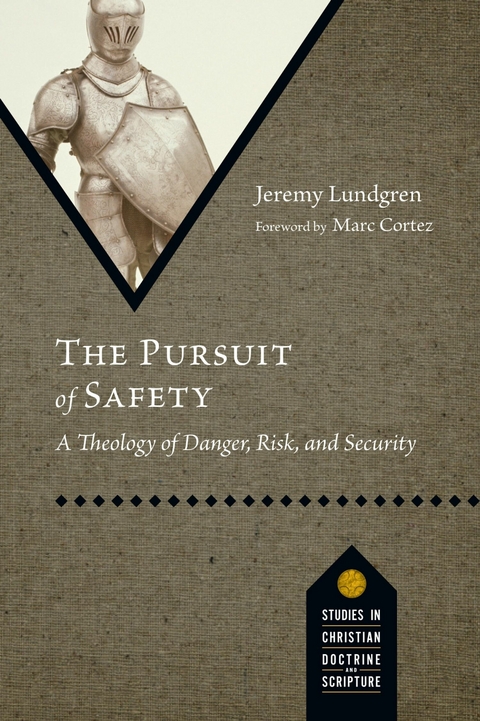
The Pursuit of Safety (eBook)
312 Seiten
IVP Academic (Verlag)
978-1-5140-0802-7 (ISBN)
Jeremy Lundgren (PhD, Wheaton College) is director of Nicolet Bible Institute and coordinator of the MA in Biblical and Theological Studies program at Wheaton College.
Jeremy Lundgren (PhD, Wheaton College) is director of Nicolet Bible Institute and coordinator of the MA in Biblical and Theological Studies program at Wheaton College.
Tokens of Safety
If with Christ you died to the elemental spirits of the world, why, as if you were still alive in the world, do you submit to regulations—“Do not handle, Do not taste, Do not touch”?
ON A TRIP SEVERAL years ago, my wife, Kaci, and I shuffled our three small children out to the front porch of a restaurant to find a table and wait for our food. Once the children were settled, I ran a quick errand a couple blocks away and returned to find them sitting just where I left them. Something was wrong, though. The kids were subdued, and Kaci looked like she had something she needed to say.
After I had left, our oldest son, Samuel—a preschooler at the time—said he needed to go to the bathroom. Kaci could not haul all three children and our bags to the bathroom by herself, so she told him to wait until I got back. Soon he needed to go “really bad,” though, so she told him to go inside and ask to use the bathroom. He returned and said it was around back on the outside of the building. They waited for me again, but the situation only got worse. After some deliberation with herself, she finally told him to go use the bathroom and then come right back. He ran off in search of relief, and she sat waiting with the younger two. The seconds ticked by. A minute or two ticked by. She wondered how long it had been. She told herself not to worry. At any moment he would come back, or I would pull up. More time passed. He did not come. I still did not come. Suddenly, a sense of urgency came over her. It had been too long. She picked up the toddler, grabbed the stroller, abandoned the belongings, and made her way to the back of the building. As she got closer, she thought she could hear noises. Her pace quickened. When she rounded the corner, the noises became louder and distinct. He was yelling, pounding, and crying for help from inside the bathroom. Horrible thoughts flooded her mind as she raced to the door.
To her great relief he was unharmed and alone in the bathroom. He was yelling and pounding because the door was stuck, and he could not get out. He was sitting safely next to me as she recounted the story, but horrible thoughts flooded my mind as well when I heard that he had been calling for help from inside the bathroom. My fists clenched. For my wife in the moment and for me as I heard about it, we were briefly but powerfully seized by the fear of what our child’s cries might have meant. The event was troubling, not so much because of what happened, but because of what could have been happening during those tense moments of separation.
Humanity is affected by the harm that befalls it. That is obvious. Humanity is also affected by the harm that could befall it, and that is fascinating. When harm comes—when a child has a complicated birth or falls off a bike, when a woman is assaulted or diagnosed with cancer, when a worker loses a finger or crashes heavy equipment—life is disrupted. Things no longer fit together as they should. Damaged bodies need healing, damaged belongings need fixing, and damaged hearts need mending. Areas of life once navigated with ease are now avoided or tiptoed through. Perhaps there is a hole where there used to be wholeness, fear where there used to be innocence, or regret where there used to be contentment. Conversely, perhaps there is strength where there used to be weakness, hope where there used to be fear, or courage where there used to be cowardice.
When harm could come—when parents imagine a complicated birth or a child almost falls off a bike, when a woman hears of an assault or a worker narrowly avoids an accident, when students learn of another school shooting or citizens look at the likelihood of war—life is also disrupted. Anxieties and suspicions rise. Dangerous people and places are avoided. Risks are assessed and managed. Warnings are given. Precautions are taken. Fates are cursed, and guardian angels are invoked. We try to anticipate all the various ways that harm could come, and we look back at all the ways that it could have come, but we do not know with certainty when or how it will in fact befall us. In the face of such uncertainty, it is not harm itself but the possibility and proximity of harm that affect our lives.
SIGNS AND SYMBOLS
The world we inhabit is scattered with tokens of safety. These tokens—the warnings, notices, slogans, and labels that have been so thoroughly incorporated into the modern landscape—exert authority over our lives, mediating our interactions with each other and the world around us. The tokens of safety function as signs. They point to dangers and give instruction on how to avoid them. They remind pedestrians to watch out for traffic, alert consumers to the dangers of devices, and tell children how play equipment is to be used. When you start your car, little lights and bells remind you to buckle up. When you plug in a new appliance, a small tag advises you on the dangers of electrocution. The plastic that the appliance was wrapped in advises you that it can suffocate children and pets. When passengers check in at airports, kindly voices prohibit them from leaving their baggage unattended and direct their hands to the railings on escalators. Signs at jobsite entrances show workers what protective equipment to wear. When you board a train, grab a cart at the grocery store, or engage in any number of everyday activities, you are encountered by such tokens of safety. They fill the spaces, surfaces, and silences of our world with a steady stream of reminders that while we may want summers to be fun, journeys to be successful, and encounters with strangers to be enjoyable, we also want them to be safe.
The tokens of safety also function as symbols. Beyond their explicit messages, they carry implicit meanings. They connect their observers to fundamental ideas and beliefs about the very nature of safety. As symbols, the tokens of safety are echoes of a deeper power, reminders of an underlying authority on which a morality of safety has been built. The importance of these tokens lies not merely in what they claim or demand regarding the practicalities of safety but in their very presence, what they assume and imply concerning humanity and its relationship to the dangers of this world. They point to the concerns and habits of safety, but also to the beliefs that legitimize those concerns and the powers supposed to make those habits effectual.
The tokens of safety draw attention to the enigmatic relationship we have with danger, and then offer ways out. They shape the way we think about safety. They set the terms of the discussion, the rules of engagement, and the boundaries of the field in advance. They tell us what safety is, where it is located, and how to pursue it. These tokens are not alien to the modern world, though, as if they were being imposed from elsewhere. They are themselves fruits of our age, and while they are typically produced and plastered about by authorities, institutions, and bureaucracies, each of us bears responsibility for the ways that we interact with them.
There are probably many people who do not give much thought to the tokens of safety. Such people just look past them or through them. The tokens are part of the scenery, nothing more than background noise in a busy world, little annoyances to ignore, get around, or placate in order to get on to better things. Such an attitude would have been difficult to maintain during the Covid-19 related mandates and restrictions of 2020 and 2021. Signs, barriers, masks, and enforcements sprung up everywhere. Participation was not optional. The tokens related to that virus reduced significantly in the years since, but the events surrounding them brought to light an enduring feature of the modern tokens of safety: they are intended, by those who post them, to be given their proper due. Safety is meant to be the business of everyone.
When people do give thought to the tokens of safety, they often acknowledge and submit to them simply as signs. They do so without much deliberation or critical reflection, being motivated by a basic desire for safety, a basic fear of danger. The announcement says to stay clear of the closing train doors, so they take a step. The arrows indicate a sharp curve in the road ahead, so they slow down. The sign says masks are required to slow the spread of the disease, so they put them on.
There are times, though, when people engage with the tokens of safety as more than signs, more than basic sources of information or instruction for navigating dangers in this world. The tokens, and people’s responses to them, take on symbolic significance. Sometimes, when the warning comes on about the train doors, a commuter who is already clear can be seen taking an additional and emphatic step. Sometimes a safety officer has more regard for his authority than the well-being of his workers. Sometimes violating the demands of these tokens is an act of selfish obstinance. At other times, it is a triumph of sanity and wisdom. Sometimes submission to the tokens of safety is an exercise in superstition. At other times, it is a calculated means of self-justification.
A utility worker parked his truck, half on the shoulder, half in the lane, of a rural highway, in order to perform repairs during an ice storm. On his side of the road were a ditch, utility poles, and a field. On the other side, a row of houses. He had stopped his truck in a blind spot, at the crest of a hill. Video footage showed the chaos that...
| Erscheint lt. Verlag | 1.10.2024 |
|---|---|
| Reihe/Serie | Studies in Christian Doctrine and Scripture |
| Vorwort | Marc Cortez |
| Verlagsort | Lisle |
| Sprache | englisch |
| Themenwelt | Geisteswissenschaften ► Religion / Theologie ► Christentum |
| Schlagworte | Analysis • Anxiety • Biblical • Chance • Christ • Church • Danger • Discipleship • Early modern • endanger • Faith • fear • freedom • God • Harm • Hazard • Hope • Humanity • Idol • Jesus • Late Modern • Leaders • Modern • Obsession • Pastor • Peril • premodern • Protect • pursuit of safety • responsible • Safety • safety and discipleship • Scripture • seminary professor • seminary student • Technology • theological analysis • Theology • theology of safety • theology professor • theology student • theory • threat • Warning • wisdom • World |
| ISBN-10 | 1-5140-0802-5 / 1514008025 |
| ISBN-13 | 978-1-5140-0802-7 / 9781514008027 |
| Informationen gemäß Produktsicherheitsverordnung (GPSR) | |
| Haben Sie eine Frage zum Produkt? |
 EPUB (Wasserzeichen)
DRM: Digitales Wasserzeichen
Dieses eBook enthält ein digitales Wasserzeichen und ist damit für Sie personalisiert. Bei einer missbräuchlichen Weitergabe des eBooks an Dritte ist eine Rückverfolgung an die Quelle möglich.
Dateiformat: EPUB (Electronic Publication)
EPUB ist ein offener Standard für eBooks und eignet sich besonders zur Darstellung von Belletristik und Sachbüchern. Der Fließtext wird dynamisch an die Display- und Schriftgröße angepasst. Auch für mobile Lesegeräte ist EPUB daher gut geeignet.
Systemvoraussetzungen:
PC/Mac: Mit einem PC oder Mac können Sie dieses eBook lesen. Sie benötigen dafür die kostenlose Software Adobe Digital Editions.
eReader: Dieses eBook kann mit (fast) allen eBook-Readern gelesen werden. Mit dem amazon-Kindle ist es aber nicht kompatibel.
Smartphone/Tablet: Egal ob Apple oder Android, dieses eBook können Sie lesen. Sie benötigen dafür eine kostenlose App.
Geräteliste und zusätzliche Hinweise
Buying eBooks from abroad
For tax law reasons we can sell eBooks just within Germany and Switzerland. Regrettably we cannot fulfill eBook-orders from other countries.
aus dem Bereich