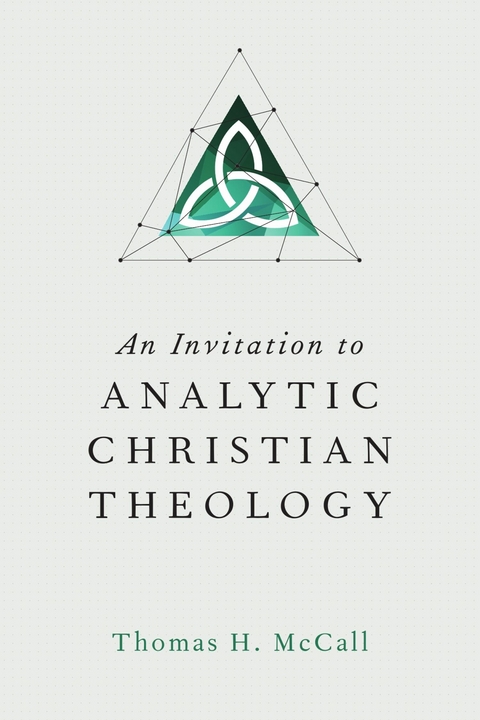
An Invitation to Analytic Christian Theology (eBook)
192 Seiten
IVP Academic (Verlag)
978-0-8308-9930-2 (ISBN)
Thomas H. McCall (PhD, Calvin Seminary) is professor of biblical and systematic theology and director of the Carl F. H. Henry Center for Theological Understanding at Trinity Evangelical Divinity School in Deerfield, Illinois. He is the author of Which Trinity? Whose Monotheism? and Forsaken: The Trinity and the Cross, and Why It Matters.
Thomas H. McCall (PhD, Calvin Seminary) is professor of biblical and systematic theology and director of the Carl F. H. Henry Center for Theological Understanding at Trinity Evangelical Divinity School in Deerfield, Illinois. He is the author of Which Trinity? Whose Monotheism? Philosophical and Systematic Theologians on the Metaphysics of Trinitarian Theology, Forsaken: The Trinity and the Cross, and Why It Matters and coeditor (with Michael C. Rea) of Philosophical and Theological Essays on the Trinity.
2
Analytic Theology and Christian Scripture
So listen to my last piece of advice: exegesis, exegesis, and yet more exegesis! Keep to the Word, to the Scripture that has been given to us.*
KARL BARTH
WHAT HATH JERUSALEM TO DO with Athens? What does modal analysis have to do with biblical exegesis? What does the Bible have to do with philosophical theology? In this chapter, I try to get clearer on the relation of analytic theology to the study of the Bible as Christian Scripture. First, I shall discuss the role and function of theological analysis as response to revelation. Here, after noting what seems to be a great gulf fixed between analytic theology and biblical studies, I shall clear away some misconceptions about “natural theology” and “perfect being theology.” Second, I shall consider the relation between analytic theology and claims about the “authority” of biblical theology. Third, through the use of an interesting case study I shall demonstrate how biblical theology and analytic theology may be not only complementary but also mutually enriching. Throughout, I shall proceed from the conviction that analytic theology—as Christian theology—should be faithful to Scripture and engaged with biblical scholarship.
Analytic Theology and the Response To Revelation
Philosophical analysis and biblical exegesis: The initial distance. Analytic theology is sometimes characterized as the ultimate exercise in “armchair theology”; some theologians harbor deep suspicions that it merely engages in some highfalutin and arcane discourse about God and the world that is just, well, made up. In other words, they worry that analytic theologians bypass and effectively ignore God’s own revelation as it occurs ultimately in the incarnation of the Holy Son and reliably in the Bible as Holy Scripture. Trading the glorious gift of divine revelation for the tangled mess of their own a priori theological musings, the best they can do is to wallow in their own irrelevant wonderings and wanderings. At worst, they commit conceptual idolatry.
Sometimes these suspicions are well-founded. Consider the judgment of J. L. Tomkinson when faced with biblically based objections to his proffered view of God and time: what the Bible says is simply “irrelevant to philosophical questions.”1 He continues by insisting that in the case of conflict between the conclusions of philosophical theology and the claims of revelation, “the problem . . . must always, insofar as philosophical theology is concerned, lie with the advocates of the revelation in question.” For if philosophical theology “leads to a conclusion which seems at odds with revelation, the former may claim the credentials of reason” in a way that revealed theology cannot.2 So in the case of a conflict between the claims of philosophical theology and the deliverances of revealed theology, there really is no contest: “reason” enjoys the presumption of victory over “revelation.” Much could be said about Tomkinson’s approach; while it is far from obvious that he is correct, there are good reasons to think that he is mistaken. As Thomas F. Torrance has argued, the mark of genuine rationality in any kind of valid scientific inquiry is to allow our approach to the subject matter to be shaped and reshaped by the reality as it is.3 If Torrance is correct, then we have good reason to be suspicious of Tomkinson’s claims.4 For if we have good reason to think that God has revealed himself (for the Christian, ultimately in the incarnation of the Son as Jesus the Christ and reliably in Holy Scripture), then we have very good reason to let that revelation correct our a priori conceptions of God’s being and actions.
Fortunately, however, Tomkinson’s approach is not at all representative of the vast majority of Christian analytic theology. Indeed, it seems both safe and important to point out that his view is exceptional enough that it serves better as a caricature than as an accurate characterization of analytic Christian theology. Still, though, there are important disciplinary differences between the kinds of work done by biblical scholars and the kinds of work done by philosophical theologians. And beyond the differences, there are remaining questions about the relation of analytic theology to historical-critical biblical studies and biblical theology.
Natural theology or revealed theology? Is analytic theology only a form of something called “natural theology”? And if so, is it not thus inherently and diametrically opposed to revealed theology? And just what is natural theology?
Theological opposition to natural theology is well known and widespread. As Plantinga notes in his discussion of the Reformed objection to natural theology, while “a few Reformed thinkers . . . endorse the theistic proofs,” for “the most part the Reformed attitude has ranged from tepid endorsement, through indifference, to suspicion, hostility, and outright accusations of blasphemy.”5 Karl Barth’s Nein! in debate with Emil Brunner is famous, and the echoes of it reverberated well into the following century. While many contemporary theologians (including some revisionist as well as traditional Protestants, along with many Catholic and Orthodox scholars) do not hold to “Barthian” commitments in theological method or reject just any theological enterprise deemed antithetical to Barthian constraints, many contemporary theologians in fact are sympathetic to Barth’s views and share his worries about natural theology. So is analytic theology committed to natural theology—and thus out of bounds for theologians of the house and lineage of Barth?
But what, more precisely, are we talking about when we talk about “natural theology”? Suppose we take natural theology to be simply what James F. Sennett and Douglas Groothuis describe when they say that it is “the attempt to provide rational justification for theism using only those sources of information available to all inquirers, namely, the data of empirical experience and the dictates of human reason . . . [a] defense of theism without recourse to purported special revelation.”6 In this sense, natural theology is what Plantinga calls “the attempt to prove or demonstrate the existence of God.”7 Taken this way, “natural theology” really is a philosophical project; as Sennett and Groothuis say, “the term ‘natural theology’ is actually a misnomer. The enterprise, so conceived, is an exercise in philosophical, not theological, inquiry.”8
Taken this way, philosophers and theologians alike have criticized the project of natural theology. Especially since David Hume’s Dialogues Concerning Natural Religion (and An Inquiry Concerning Human Understanding), philosophers have debated the merits and demerits of the various traditional arguments for the existence of God. In addition to the broader discussions, they have also debated the strengths and weaknesses of Hume’s own arguments—and here the verdict looks very weak for Hume’s case.9 But thus construed, what is the relation of analytic theology to natural theology? The answer, frankly, is that there isn’t much of one, and there isn’t necessarily one at all. Analytic theology, as I have characterized it here, simply is not committed to this type of exercise. Analytic theologians may be interested in natural theology, and they may find, say, the cosmological or teleological arguments to be sound. They may even think that such work is helpful or even obligatory in apologetics. Or they may not—they may think that Barth was entirely right or maybe even understated. The point here is that natural theology—construed in this way—is not essential to the project of analytic theology. Whatever its own philosophical merits and demerits, whatever its own theological strengths and liabilities, natural theology simply is beside the point. Further discussion of it only serves to foster confusion.
Suppose we take natural theology in a related but somewhat different sense. Suppose we take it to be something more like the attempt to gain some knowledge about the nature, character and actions of God apart from special revelation. So on this construal, when Charles Taliaferro says that natural theology “is the practice of philosophically reflecting on the existence and nature of God independent of real or apparent divine revelation or scripture,” what we are really interested in here is the “and nature of God” part.10 It is this element—this effort to learn something about God’s nature apart from God’s revelation in the incarnate Word and the written Word—that is most troubling to many theologians, and gives rise to the “suspicion, hostility, and outright accusations of blasphemy.” To some theologians, the relationship between revealed theology and natural theology can only rightly be described as a cage fight to the death. According to them, we are faced with the starkest of choices: either natural theology or revealed theology—and thus either arrogance and idolatry or humility and obedience. So if analytic theology is only a dressed-up version of natural theology, then so much the worse for analytic theology.
But is it true that analytic theology is only a dressed-up version of natural theology?...
| Erscheint lt. Verlag | 9.12.2015 |
|---|---|
| Verlagsort | Lisle |
| Sprache | englisch |
| Themenwelt | Geisteswissenschaften ► Religion / Theologie ► Christentum |
| Schlagworte | Analytic theology • Bible • Christian Philosophy • Christian theology • Compatibilism • Doctrine • global Christian theology • historical Ada • original sin • Philosophical theology • Philosophy • Philosophy of Religion • physicalist Christology • Scripture • Theology |
| ISBN-10 | 0-8308-9930-8 / 0830899308 |
| ISBN-13 | 978-0-8308-9930-2 / 9780830899302 |
| Informationen gemäß Produktsicherheitsverordnung (GPSR) | |
| Haben Sie eine Frage zum Produkt? |
 EPUB (Wasserzeichen)
DRM: Digitales Wasserzeichen
Dieses eBook enthält ein digitales Wasserzeichen und ist damit für Sie personalisiert. Bei einer missbräuchlichen Weitergabe des eBooks an Dritte ist eine Rückverfolgung an die Quelle möglich.
Dateiformat: EPUB (Electronic Publication)
EPUB ist ein offener Standard für eBooks und eignet sich besonders zur Darstellung von Belletristik und Sachbüchern. Der Fließtext wird dynamisch an die Display- und Schriftgröße angepasst. Auch für mobile Lesegeräte ist EPUB daher gut geeignet.
Systemvoraussetzungen:
PC/Mac: Mit einem PC oder Mac können Sie dieses eBook lesen. Sie benötigen dafür die kostenlose Software Adobe Digital Editions.
eReader: Dieses eBook kann mit (fast) allen eBook-Readern gelesen werden. Mit dem amazon-Kindle ist es aber nicht kompatibel.
Smartphone/Tablet: Egal ob Apple oder Android, dieses eBook können Sie lesen. Sie benötigen dafür eine kostenlose App.
Geräteliste und zusätzliche Hinweise
Buying eBooks from abroad
For tax law reasons we can sell eBooks just within Germany and Switzerland. Regrettably we cannot fulfill eBook-orders from other countries.
aus dem Bereich