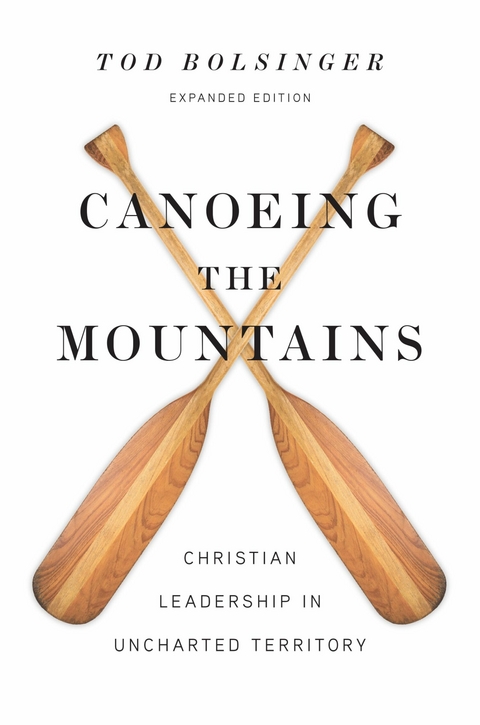
Canoeing the Mountains (eBook)
258 Seiten
IVP (Verlag)
978-0-8308-7387-6 (ISBN)
Tod Bolsinger (PhD, Fuller Theological Seminary) is a speaker, executive coach, former pastor, and author who serves as associate professor of leadership formation and senior fellow for the De Pree Center for Leadership at Fuller Seminary. He is the author of Canoeing the Mountains, which was named Outreach Magazine Resource of the Year in Pastoral Leadership, as well as the Christianity Today Award of Merit recipient It Takes a Church to Raise a Christian. For seventeen years, he was the senior pastor of San Clemente Presbyterian Church in San Clemente, California. A frequent speaker and consultant, he serves as an executive coach in transformational leadership.
Tod Bolsinger is the vice president for vocation and formation and teaches practical theology at Fuller Theological Seminary. He has also served as senior pastor of San Clemente Presbyterian Church and associate pastor of First Presbyterian Church of Hollywood.
- 1 -
Seminary Didn’t Prepare Me for This
If western societies have become post-Christian mission fields, how can traditional churches become then missionary churches?
Darrell Guder, “The Missiological Context”
Two Pastors Sit at a Bar . . .
One night after a long day of meetings, an older pastor let out a heavy sigh. He was nearing retirement, and we were working together on a project that was supposed to reorganize our entire denomination in order to help our church better minister in a changing world. And that changing world weighed on him. He remembered well how not that long ago life was different. He swirled his drink and said to me, “You know, when I began my ministry in a church in Alabama, I never worried about church growth or worship attendance or evangelism. Back then, if a man didn’t come to church on Sunday, his boss asked him about it at work on Monday.”
Sociologists and theologians refer to this recently passed period as Christendom, the seventeen-hundred-year-long era with Christianity at the privileged center of Western cultural life.1 Christendom gave us “blue laws” and the Ten Commandments in school. It gave us “under God” in the pledge of allegiance and exhortations to Bible reading in the national newspapers. (I have a copy of the Los Angeles Times from December 1963 that has stories on the Warren Commission, the nine-thousand-member Hollywood Presbyterian Church and a list of daily Bible readings for the upcoming week. Can you even imagine the Los Angeles Times exhorting people to read their Bibles today?) It was the day when every “city father” laid out the town square with the courthouse, the library and a First Church of _______ within the center of the city.
For most of us these days are long gone. (For some of us, that is good news indeed. Did you notice the reference to “man” in my friend’s statement?) When cities are now considering using eminent domain laws to replace churches with tax-revenue generating big-box stores, when Sundays are more about soccer and Starbucks than about Sabbath, when Christian student groups are getting derecognized on university campuses, when the fastest growing religious affiliation among young adults is “none,” when there is no moral consensus built on Christian tradition (even among Christians), when even a funeral in a conservative beach town is more likely to be a Hawaiian style “paddle out” than a gathering in a sanctuary, then Christendom as a marker of society has clearly passed.2
Over the last ten years I have had one church leader after another whisper to me the same frustrated confession: “Seminary didn’t train me for this. I don’t know if I can do it. I just don’t know . . .” A number of pastors are ready to throw in the towel. Studies show that if given a chance to do something else, most pastors would jump at it. Reportedly, upwards of fifteen hundred pastors leave the ministry every month.3
A couple of years ago I learned that three of my pastor friends around the country had resigned on the same day. There were no affairs, no scandals and no one was renouncing faith. But three good, experienced pastors turned in resignations and walked away. One left church ministry altogether. The details are as different as the pastors themselves, but the common thread is that they finally got worn down by trying to bring change to a church that was stuck and didn’t know what to do. Their churches were stuck and declining, stuck and clinging to the past, stuck and lurching to quick fixes, trying to find an easy answer for what were clearly bigger challenges. What all three churches had in common was that they were mostly blaming the pastor for how bad it felt to be so stuck.
“If only you could preach better!”
“If only you were more pastoral and caring!”
“If only our worship was more dynamic!”
“Please, pastor, do something!” (That is what we pay you for, isn’t it?)
And to make matters worse, the pastors don’t know what to do either. As a seminary vice president, I am now charged with confronting this reality head-on. Our graduates were not trained for this day. When I went to seminary, we were trained in the skills that were necessary for supporting faith in Christendom. When churches functioned primarily as vendors of religious services for a Christian culture, the primary leadership toolbox was
- teaching (for providing Christian education)
- liturgics (for leading Christian services)
- pastoral care (for offering Christian counsel and support)
In this changing world we need to add a new set of leadership tools. And this applies equally well to Christians serving in leadership beyond the parish. The challenges of a changing world come even more rapidly in business, education and nonprofit leadership. And while this book’s primary audience is congregational leaders, I have added some material specifically for Christian leaders in other contexts.
This is a guidebook for learning to lead in a world we weren’t prepared for. Our guides will be none other than the first American adventurers Meriwether Lewis and William Clark.
Lewis and Clark’s expedition to explore the newly acquired Louisiana Purchase was built on a completely false expectation. They believed, like everyone before them, that the unexplored west was exactly the same geography as the familiar east. This is the story of what they did when they discovered that they—and everyone else before them—had been wrong. And how instructive and inspiring that story can be to us today.
Using the story of Lewis and Clark’s expedition and applying the best insights from organizational leadership and missional theology, we will learn together what it means for Christians to lead when the journey goes “off the map.”
We will discuss and seek faithful responses to the following questions:
- How do we lead a congregation or an organization to be faithful to the mission God has put before us when the world has changed so radically?
- What are the tools, the mental models, the wise actions and competing commitments that require navigation?
- And mostly, what transformation does it demand of those of us who have been called to lead?
From Lewis and Clark we will learn that if we can adapt and adventure, we can thrive. That while leadership in uncharted territory requires both learning and loss, once we realize that the losses won’t kill us, they can teach us. And mostly, we will learn that to thrive off the map in an exciting and rapidly changing world means learning to let go, learn as we go and keep going no matter what.
As a seminary administrator, a professor of practical theology, an ordained minister, a consultant on organizational change and an executive coach for leaders, I have written this book with three purposes in mind:
- To reframe this moment of history for Christians in the west as an opportunity put before us by God for adventure, hope and discovery—all the while embracing the anxiety, fear and potential loss that comes from answering this call.
- To recover the calling for the church to be a truly missional movement that demands leadership that will take up the gauntlet of Guder’s charge: “If western societies have become post-Christian mission fields, how can traditional churches become then missionary churches?”4
- To discover—even more than the uncharted territory around us—the capacity for leadership within us.
This book is structured around five vital lessons that every leader of a Christian congregation or organization has to learn to lead in uncharted territory:
- Understanding uncharted territory: The world in front of you is nothing like the world behind you. In chapter one I share my personal encounter with the disorientation that comes from a changing world and the common experience that many Christian leaders face today. In chapter two we are introduced to Lewis and Clark and the unexpected challenges they faced. In chapter three we will learn a model for leadership in uncharted territory that will orient us for the terrain ahead.
- The on-the-map skill set: No one is going to follow you off the map unless they trust you on the map. Chapter four reminds us that there is plenty of work to be done—and credibility to be won—in the everyday experiences of administrating, teaching and caring for people. Indeed, without demonstrating technical competence on the map, a leader will never be given the chance to lead a true expedition off the map. Chapter five helps us understand that even competence is not enough without the personal congruence and character of a leader. Only when a leader is deeply trusted can he or she take people further than they imagined into the mission of God. Chapter six introduces the critical issue of the leader’s responsibility to shape a healthy organizational culture. Trust is not just a one-on-one relationship between a leader and follower, but the organizational air that allows a transforming adventure to be even possible.
- Leading off the map: In uncharted territory, adaptation is everything. In chapters seven to eleven we get to the heart of the book and the critical leadership...
| Erscheint lt. Verlag | 24.4.2018 |
|---|---|
| Verlagsort | Lisle |
| Sprache | englisch |
| Themenwelt | Geisteswissenschaften ► Religion / Theologie ► Christentum |
| Schlagworte | Adaptable • adaptive change • Business book • Change Management • Christian • Church • Developing Leaders • effective leadership • john maxwell • leading • navigating new territories • organization • Pastor • Pastoral Ministry • practical tools • transformational journey |
| ISBN-10 | 0-8308-7387-2 / 0830873872 |
| ISBN-13 | 978-0-8308-7387-6 / 9780830873876 |
| Informationen gemäß Produktsicherheitsverordnung (GPSR) | |
| Haben Sie eine Frage zum Produkt? |
 EPUB (Wasserzeichen)
DRM: Digitales Wasserzeichen
Dieses eBook enthält ein digitales Wasserzeichen und ist damit für Sie personalisiert. Bei einer missbräuchlichen Weitergabe des eBooks an Dritte ist eine Rückverfolgung an die Quelle möglich.
Dateiformat: EPUB (Electronic Publication)
EPUB ist ein offener Standard für eBooks und eignet sich besonders zur Darstellung von Belletristik und Sachbüchern. Der Fließtext wird dynamisch an die Display- und Schriftgröße angepasst. Auch für mobile Lesegeräte ist EPUB daher gut geeignet.
Systemvoraussetzungen:
PC/Mac: Mit einem PC oder Mac können Sie dieses eBook lesen. Sie benötigen dafür die kostenlose Software Adobe Digital Editions.
eReader: Dieses eBook kann mit (fast) allen eBook-Readern gelesen werden. Mit dem amazon-Kindle ist es aber nicht kompatibel.
Smartphone/Tablet: Egal ob Apple oder Android, dieses eBook können Sie lesen. Sie benötigen dafür eine kostenlose App.
Geräteliste und zusätzliche Hinweise
Buying eBooks from abroad
For tax law reasons we can sell eBooks just within Germany and Switzerland. Regrettably we cannot fulfill eBook-orders from other countries.
aus dem Bereich