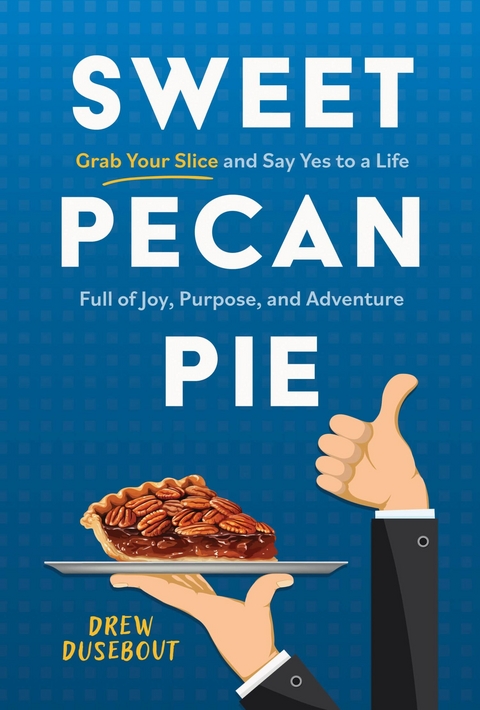
Sweet Pecan Pie (eBook)
211 Seiten
Ballast Books (Verlag)
978-1-964934-08-2 (ISBN)
Drew Dusebout has always had an entrepreneurial spirit. He ran a paper route as a young boy, started his own business selling cowboy hats as a teenager, was instrumental in building out a new niche in the financial services industry after graduating college, and co-founded a movement to rise up young people to help solve the world's water crisis as a parent. He has taken his passion to think out of the box and his love of adventure to promote change, serve, and lead in a variety of ways. Drew lives in Santa Barbara, California, with his wife, Vicki. He has three children and two grandchildren.
Drew Dusebout's grandmother-in-law never made the same pie more than once. Her sweet pecan pie was a little different each time, but it was always delicious. In Sweet Pecan Pie, Drew encourages you to discover the recipe for your best life. His stories will open your heart to experiences, adventures, and people you normally wouldn't consider. From orphanages in Ukraine to the jungles of Honduras to remote villages in Africa, Drew's life became sweeter each time he said "e;yes"e; to the opportunities provided. Instead of clinging to society's recipe for a good life, he found his own recipe. The best version of your life is like a delicious piece of pecan pie. Shared in a fun, whimsical vignette style with a bit of pop culture thrown in, Drew's writings will inspire you to experiment with your ingredients and have fun finding your perfect slice.
Chapter 3
So the last will be first, and the first will be last.
—Matthew 20:16
In the 1980s, there was a series of commercials that did a good job of finding catchy ways to connect with their audience. Some of these commercials featured a journeyman professional baseball player named Bob Uecker who became quite well known as an announcer for the Milwaukee Brewers and a sometimes actor who had a way of delivering short, funny witticisms that were easy to remember.
One of his most famous catchphrases came during a commercial in which he is in his seat at a baseball game preparing to watch the game and talking about how ex-big leaguers like him get special treatment when the usher informs him that he’s in the wrong seat. Uecker pompously remarks, “Oh, I must be in the front row.” The punchline is that Uecker’s seat was actually in the nosebleed section, the farthest seats away from the action as possible, where they pan to him sitting all by himself, yelling at the umpires. Since then, these back row seats have often been jokingly referred to as “Uecker seats” by sports fans everywhere.
***
While “I must be in the front row, oops, I am in the back row” has been a source of fun and mostly trivial conversation over the years, there’s a more serious side to this topic. At times, it seems as if the world is divided into the “haves” and the “have nots.” “A-listers” sit courtside, cut in line or skip lines altogether, and fly first class or alone with their sushi and pets while the rest of us are just happy to be there.
For most of my journey growing up, I sat in the “back row” and more recently have had both “back row” and “front row” experiences. If I am honest, I have to admit that the front row isn’t all bad, although I also think most of the time, the people in the back row are more interesting.
I have also learned, as time has gone on and I have become at least a little bit wiser, that seeking the front row at all costs doesn’t lead to happiness, and that too much “front row” living can be a dangerous thing.
There was an article in Vanity Fair written back in 2001 that provides a good illustration of the potential pitfalls of sitting in the “front row” for too long. The article highlights various socialites who frequented the island of Capri back in the day.
Capri, located in the Tyrrhenian Sea off the coast of southern Italy, is a small island (only about four square miles) and shoots out of the sea, with her limestone cliffs reaching heights of two thousand feet providing for a dramatic and unique setting. The island has always been home to the jet-setting crowd, a place where the yachts that dot the shoreline are measured by meters, not feet, and where the patrons are whisked to shore at night, taxied up the steep hills where they walk the cobblestone streets shopping for Gucci, Hermes, and Rolex before dining at fancy restaurants and then returning to their mansions on the water, ready to do the same thing the next day.
The article guides the reader through the history of Capri and shares about the lives of many of the famous people who made the island a summer home. While part of the article seduces us in a way that we wish we could be part of this privileged lifestyle, there is also an ominous tone to the stories about the dangers of living in decadence and without any real purpose.
There is a saying that has been around for years about the dangers of boredom, that “idle time is the devil’s playground,” and much of the story talks about the depravity that manifests itself in the lives of people who, on the surface, seem to have it all. The author paints this picture well and shares specific examples of the destruction that came with all the glamour in a way that is both funny and sad. The article ends with a quote from one of the characters from the story: “'Your brain go water, staying here too long,' she says. 'Too much paradise.'”
Too much “front row.”
***
When I was twelve and living in the suburbs outside of Seattle, a friend and I shared a paper route to make a few extra bucks. The main paper in our area was the Seattle Times, and this was back in the days when just about everyone got that paper delivered Monday through Friday along with the more robust Sunday edition. We were in charge of delivering the local paper, which was only printed on Tuesdays and Thursdays and had a much smaller audience: about half the homes took the paper while the other half did not.
Our route took us through some wooded areas and included a series of new tract homes, a scattering of farms that were still holding on now that suburbia had invaded, and some larger homes on Lake Washington where the really rich folks lived. We divided the route based on the time needed to deliver all the papers, and my first foray into the business world was off and running.
Unfortunately, delivering to only half the homes presented a challenge—how do we remember who gets the paper and who does not? Our first few early mornings were a bit of a disaster, as we had to stop and check the list of our customers every couple of homes, which resulted in us both being late for school.
We needed a better plan. Being creative young entrepreneurs, we opted to get a couple of cans of bright pink spray paint. We needed bright colors since we were delivering papers when it was still nearly dark, and figured we’d just put a small dot on the driveways of the homes that were getting the paper. Genius! Well . . . not so much, as our early Saturday morning ride to get a system in place was defeated by the size of our pink “markers” and the fact that people noticed— including the elderly Mrs. Adams, who had insomnia, caught us in the act, and promptly reported us to our boss, the district supervisor. Turpentine helped get the paint off, and all this extra work probably helped our muscle memory become more familiar with who actually did subscribe to the paper, but the whole thing was painful and certainly not the efficient endeavor we had hoped for.
This was back in the days when getting paid was done via in-person collections, so once a month, we would knock on doors, ask for our $2.50 or thereabouts, hand out a receipt, and mark “paid” in our ledger. Looking back, this sure was a lot of work for not much money, but hey, you’ve got to start somewhere and pay your dues, I guess.
The collection process forced us to actually interact with a fair number of adults and provided me with a view into how older folks behaved that most people my age did not have. Some folks were super nice and generous, rounding up our monthly charge to $3 or even $5 in some cases. Generally, our tips were about the same as our pay (or even a bit more at Christmas time), and we eventually came to count on them as well as learn the value of being polite and providing exceptional service sans the pink dots.
Not everyone was friendly, and some were thrifty, but all in all it was a decent experience—except for this one man. I still remember him to this day. Let’s call him Mr. Meanie because honestly that’s what he was—mean. He lived in a big house at the top of what felt like the world’s longest, steepest driveway. Mr. Meanie not only expected us to ride up the hill and put the paper on his porch but had a set of specific instructions on how the paper was folded and on which side of the door the paper needed to be. All this meant we had to get off our bikes and set the paper down in just the right way or be subject to his wrath and a formal complaint. I am not sure if OCD was a recognized thing back then, but Mr. Meanie clearly had some issues with order.
Collection time was also always a challenge with him. We would typically set out on our monthly collection task in the evenings around dinnertime or on Sunday afternoons when we would have the highest likelihood of finding people home. I swear he would see us coming and shut off all the lights or simply not answer the door. Getting what we were owed often required us riding up that driveway three to four times a month. Most of the time, he was without small bills, always pulling out a twenty and asking for $17.50 back, no tips ever forthcoming. And no way we could we bring him change later, either.
So, one Sunday afternoon, I’d had enough. He pushed me over the edge, and in my twelve-year-old brain, I wanted to get even—not in some sort of violent, go-to-jail kind of way, but in a way that would at least make me feel like I’d evened the score. Without spending too much time determining the optimum path of revenge, I settled on sneaking through the woods with my wrist rocket (think slingshot) and a smoke bomb. Fireworks were legal where I grew up, and you could buy a pack of six small smoke bombs in different colors that, once lit, would disperse colored smoke for thirty seconds or so and the Meanies would never be the wiser.
Harmless fun, or so I thought. Being a novice at this kind of thing, I probably put too much planning and misdirection into my journey over to the Meanies’ house. I mean, it wasn’t like I was navigating the streets of Beirut, avoiding spies in search of a hideout, or on my way to bank heist and checking for surveillance.
But there I was, looking over my shoulder on my trek over, a nervous wreck. I did all this planning to get there, but not much planning once I arrived at the large tree just outside the fence that surrounded their backyard. What do I do now? What if they are not home? How long do I wait? What if they are...
| Erscheint lt. Verlag | 16.7.2024 |
|---|---|
| Sprache | englisch |
| Themenwelt | Geisteswissenschaften ► Religion / Theologie ► Christentum |
| ISBN-10 | 1-964934-08-7 / 1964934087 |
| ISBN-13 | 978-1-964934-08-2 / 9781964934082 |
| Informationen gemäß Produktsicherheitsverordnung (GPSR) | |
| Haben Sie eine Frage zum Produkt? |
 EPUB (Ohne DRM)
Größe: 1,0 MB
Digital Rights Management: ohne DRM
Dieses eBook enthält kein DRM oder Kopierschutz. Eine Weitergabe an Dritte ist jedoch rechtlich nicht zulässig, weil Sie beim Kauf nur die Rechte an der persönlichen Nutzung erwerben.
Dateiformat: EPUB (Electronic Publication)
EPUB ist ein offener Standard für eBooks und eignet sich besonders zur Darstellung von Belletristik und Sachbüchern. Der Fließtext wird dynamisch an die Display- und Schriftgröße angepasst. Auch für mobile Lesegeräte ist EPUB daher gut geeignet.
Systemvoraussetzungen:
PC/Mac: Mit einem PC oder Mac können Sie dieses eBook lesen. Sie benötigen dafür die kostenlose Software Adobe Digital Editions.
eReader: Dieses eBook kann mit (fast) allen eBook-Readern gelesen werden. Mit dem amazon-Kindle ist es aber nicht kompatibel.
Smartphone/Tablet: Egal ob Apple oder Android, dieses eBook können Sie lesen. Sie benötigen dafür eine kostenlose App.
Geräteliste und zusätzliche Hinweise
Buying eBooks from abroad
For tax law reasons we can sell eBooks just within Germany and Switzerland. Regrettably we cannot fulfill eBook-orders from other countries.
aus dem Bereich