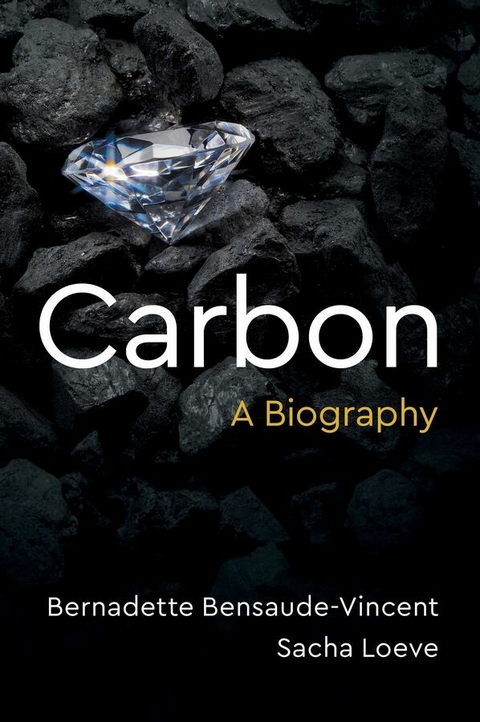
Carbon (eBook)
403 Seiten
John Wiley & Sons (Verlag)
978-1-5095-5921-3 (ISBN)
Carbon is much more than a chemical element: it is a polymorphic entity with many faces, at once natural, cultural and social. Ranging across ten million different compounds, carbon has as many personas in nature as it has roles in human life on earth. And yet it rarely makes the headlines as anything other than the villain of our fossil-based economy, feeding an addiction which is driving dangerous levels of consumption and international conflict and which, left unchecked, could lead to our demise as a species. But the impact of CO? on climate change only tells part of the story, and to demonize carbon as an element which will bring about the downfall of humanity is to reduce it to a pale shadow of itself.
In this major new history of carbon, Bernadette Bensaude-Vincent and Sacha Loeve show that this omnipresent element is at the root of countless histories and adventures through time, thanks to its extraordinary versatility. Carbon has a long and prestigious CV: its work and achievements extend far beyond the burning of fossil fuels. The fourth most abundant element in the universe and the second most abundant element in the human body, carbon is the chemical basis of all known life. Carbon chemistry has a long history, with applications ranging from jewellery to heating, underpinning developments in metallurgy, textiles, pharmaceuticals, electronics, nanoscience and green technologies.
A biography of carbon transgresses the boundaries between chemical and social existence, between nature and culture, forcing us to abandon the simplified image of carbon as the anti-hero of human civilization and enabling us to see instead the great diversity of carbon's modes of existence. With scientific precision and literary flair, Bensaude-Vincent and Loeve unravel the surprising ways in which carbon has shaped our world, showing how unrecognizable the earth would be without it. Uncovering the many hidden lives of carbon allows us to view our own with fresh eyes.
Bernadette Bensaude-Vincent is Professor Emeritus at Paris I Panthéon-Sorbonne University.
Sacha Loeve is Associate Professor in Philosophy of Science and Technology at the Jean Moulin University Lyon 3.
Carbon is much more than a chemical element: it is a polymorphic entity with many faces, at once natural, cultural and social. Ranging across ten million different compounds, carbon has as many personas in nature as it has roles in human life on earth. And yet it rarely makes the headlines as anything other than the villain of our fossil-based economy, feeding an addiction which is driving dangerous levels of consumption and international conflict and which, left unchecked, could lead to our demise as a species. But the impact of CO on climate change only tells part of the story, and to demonize carbon as an element which will bring about the downfall of humanity is to reduce it to a pale shadow of itself. In this major new history of carbon, Bernadette Bensaude-Vincent and Sacha Loeve show that this omnipresent element is at the root of countless histories and adventures through time, thanks to its extraordinary versatility. Carbon has a long and prestigious CV: its work and achievements extend far beyond the burning of fossil fuels. The fourth most abundant element in the universe and the second most abundant element in the human body, carbon is the chemical basis of all known life. Carbon chemistry has a long history, with applications ranging from jewellery to heating, underpinning developments in metallurgy, textiles, pharmaceuticals, electronics, nanoscience and green technologies. A biography of carbon transgresses the boundaries between chemical and social existence, between nature and culture, forcing us to abandon the simplified image of carbon as the anti-hero of human civilization and enabling us to see instead the great diversity of carbon s modes of existence. With scientific precision and literary flair, Bensaude-Vincent and Loeve unravel the surprising ways in which carbon has shaped our world, showing how unrecognizable the earth would be without it. Uncovering the many hidden lives of carbon allows us to view our own with fresh eyes.
Prologue
Why write a biography of carbon?
In public media as well as in climate change negotiations, carbon is in the spotlight. The talk is all about developing low-carbon or even zero-carbon levels, and ‘decarbonizing’ the economy and technologies alike. That verb has even made it into standard dictionaries. It seems that carbon is an enemy to be eliminated in an attempt to ensure a future for humankind. Of all the greenhouse gases responsible for global warming, it is carbon dioxide that is always being pointed at, put up for trial.
That an element as abundant, ubiquitous and familiar as carbon can become public enemy number one is not the least of the climate crisis paradoxes. Omnipresent in the media, carbon is, in fact, also omnipresent in our everyday environment. When we go back in time, we find carbon in all areas of human industry: high-tech carbons, ancient carbons, electrical carbons and even antiseptic carbons. Carbon fibres, prized for the strength and lightness they lend to the composite materials in which they are integrated, had already enjoyed industrial success with Edison’s and Swan’s first carbon filament light bulbs, obtained by carbonizing cotton and bamboo. Bitumen, a hydrocarbon containing 80% carbon formed from plankton slowly accumulating in sedimentary basins, was already used by the ancient Egyptians to dress roads, ships, canals, dams and reservoirs. Before the streets of London and Paris were sealed in around 1820, asphalt – a mixture of bitumen and aggregates – was used as a binder for the pigments of painters and engravers. Charcoal and bitumen have antiseptic properties that were well known to the ancients: the Phoenicians carbonized water barrels on commercial ships to preserve drinking water during their long sea voyages; the Egyptians treated dental cavities with a mixture of bitumen and clay. The alliance between humans and carbon has thus been going on for a long time, well before the industrial revolution.
Carbon’s curriculum vitae is prestigious. Its work and achievements range from stellar energy to terrestrial biology going by way of the chemical industry. Born in the stars, carbon catalyses the nuclear fusion reactions by which the sun converts hydrogen into helium.1 It is carbon, in fact, that makes the sun shine. The fourth most abundant element in the universe after hydrogen, helium and oxygen, it is also the second most abundant element, by mass, in the human body after oxygen. With carbon ‘our body … reaches as far as the stars’2 and from the stars to our bodies, because this element, which was present at the origin of our solar system, is also the chemical basis – the molecular skeleton – of all known life. Besides the common history we share with this familiar substance, carbon is also one of the most studied elements. Indeed, carbon chemistry has a long history, with applications ranging from jewellery to heating, going via metallurgy, textiles, pharmaceuticals, electronics and green technologies. There are currently more than ten million different carbon compounds, known or synthesized.
Carbon is a record-breaking winner of prizes. The Nobel Prizes in Chemistry awarded successively to Victor Grignard (1912), Otto Diels and Kurt Alder (1950) and Herbert Brown and Georg Wittig (1979) each in their own way celebrate carbon as a genius among chemicals. Today, these names are attached to the routine reactions that make up the basic toolbox of the organic chemist. The 1960 Nobel Prize in Chemistry awarded to Willard F. Libby honours carbon-14 used in archaeological dating. The 1996 Nobel Prize in Chemistry conferred on Robert F. Curl Jr, Sir Harold W. Kroto and Richard E. Smalley is in recognition of the discovery of fullerenes. A Norwegian prize, the Kavli in nanoscience, was awarded to Sumio Iijima’s work on nanotubes in 2008. In 2010, the Nobel Prize in Physics awarded to Andre Geim and Konstantin Novoselov celebrated graphene.
A fine list of achievements indeed. But is presenting the curriculum vitae of a chemical element anything more than a metaphor? It is certainly common to personify chemical elements for educational or communication purposes. Some science writers happily use this rhetorical device to enliven the periodic table. For example, in one of his bestsellers Sam Kean presents the periodic table as a storybook featuring characters who are in alliance or at war with each other. Kean emphasizes the contrast between the aggressiveness of oxygen, which bosses the other atoms, and the more friendly carbon, which has few concerns about forming bonds because it lacks four electrons to fill its outer layer and satisfy the octet rule.3 But our aim is not to popularize chemistry. We certainly want to tell stories about carbon, but we do not need to use the atomic structure of the elements to explain their behaviour in full.
Therefore, given that we want to use an appropriate narrative style for this biography, wouldn’t it be better to call a book centred on a single object a ‘monograph’? For while it is true that carbon is one of the building blocks of all living things, it is not alive and does not, strictly speaking, have a life of its own. Is not speaking of a ‘biography of carbon’ ignoring the limits of the living and the non-living? Worse still, does it not flout the Aristotelian distinction between two meanings for the word ‘life’: zoë (the general phenomenon of life characterized by growth and decay, life and death) and bios (the moral and political lives of individuals, the vita activa)?4
Transgressing these boundaries between biological and political existence, between nature and culture, is precisely what carbon forces us to do. For this natural element is, as such, a hero in our culture. If it is true that human civilization began in prehistoric times with fire, by its very name carbon – which derives from the Latin carbo (ember) and the Indo-European radical ker (to burn) – constitutes an interchange between nature and culture, a meeting point between natural history and cultural history. From the pictograms traced with charcoal on the walls of prehistoric caves to the promises of carbon nanotechnologies for the twenty-first century, humans seem to have signed a pact with carbon. Carbon is a hybrid entity belonging to nature and culture. In response to the planetary crisis, we have to give up the rigid view of chemical elements as abstract, discrete and inert molecular entities and consider them as the furniture of the world that makes the earth hospitable for billions of living things.5 Among all the elements on the periodic table, carbon is the most suited to broaden our view of chemical categories, and to reactivate them ‘as cosmological forces, as material things, as social forms, as forces and energies, as sacred entities, as experimental devices, as cultural tropes, as everyday stories, as epistemic objects’.6
So is it really a question of narrating the tribulations of an anti-hero, a villain, the evil genius who, in the form of fossil energy buried underground, would have seduced and then destroyed the human race? A biography of carbon could position it as a diabolical being that has made a pact with humans ever since they mastered fire. The history of humankind would thus be the story of the domestication of carbon, culminating in the industrial revolution, with the extraction of tonnes of carbon buried in the subsoil, choosing ‘fire engines’ and machines powered by coal or oil to make up the cohort of our innumerable ‘energy slaves’.7 Having extracted, burned and consumed gigantic volumes of coal, oil or hydrocarbon gas, humans are desperately seeking to put the devil back in the box, to sequester the carbon spilled into the atmosphere in order to breathe again.8 This grand narrative, full of mythical allusions – from Prometheus stealing fire to Faust’s pact with the devil – could serve as a moral lesson to denounce the hubris of technology and encourage the development of so-called ‘clean energy’.
But an edifying story for good little children does not do justice to the many faces of carbon. For carbon is polymorphic. In its elementary state alone (carbon and nothing else), it is capable of bonding with itself in multiple ways, adopting a structure that is sometimes crystalline (graphite, diamond, lonsdaleite), sometimes amorphous or nanostructured (vitreous carbon, carbon black, nanofoam) and sometimes even heterogeneous with varying degrees of order and disorder (charcoal, soot, coke). All these bodies are allotropes of carbon, from the Greek allos, ‘other’, and tropos, ‘manner’, multiple ways of being. Thus, from a chemical point of view, diamond and graphite are made up of identical carbon atoms. The only difference is the way they are bound.9 So, here carbon is the author of two bodies with quite contrasting properties and behaviours. Diamond is hard and translucent; graphite is brittle, fragile and opaque. Diamond is abrasive; graphite lubricating. Their optical and electronic properties are very different. Yet these diametrically opposed properties are all signatures of carbon. It’s a strange kind of thing.
Moreover, the carbon now designated as the villain poisoning our atmosphere also offers itself as a remedy. Think of the cleansing properties of activated charcoal. It’s a case of carbon versus carbon. But this element is...
| Erscheint lt. Verlag | 7.6.2024 |
|---|---|
| Übersetzer | Stephen Muecke |
| Sprache | englisch |
| Themenwelt | Geisteswissenschaften ► Philosophie ► Allgemeines / Lexika |
| Schlagworte | books about carbon • Books About Climate Change • carbon chemistry and science • carbon compounds • carbon dioxide process • carbon, graphene, graphite, coal, diamond, fossil fuel, environment, ecological collapse, climate change, global warming, extraction, carbon dioxide, carbon compounds, nanotubes, GWP (Global Warming Potential), Periodic Table, chemical elements, Nobel Prize, decarbonization, gas, atom, polymorphism, organic chemistry • carbon in the environment • chemical extraction • chemical science books • Chemie • Chemistry • ecological collapse • Fossil Fuels • Geschichte • Geschichte der Medizin u. Naturwissenschaften • Graphene • Graphite • GWP (Global Warming Potential) Nobel Prize • History • history of carbon • History of Chemistry • History of Science & Medicine • how does decarbonization work • how we use carbon in society • Kohlenstoff • nanotubes • Naturphilosophie • Organic Chemistry • Philosophie • Philosophie in den Naturwissenschaften • Philosophy • philosophy of science • reasons for global warming • what is a diamond • what is coal • what is decarbonization |
| ISBN-10 | 1-5095-5921-3 / 1509559213 |
| ISBN-13 | 978-1-5095-5921-3 / 9781509559213 |
| Informationen gemäß Produktsicherheitsverordnung (GPSR) | |
| Haben Sie eine Frage zum Produkt? |
 EPUB (Adobe DRM)
Kopierschutz: Adobe-DRM
Adobe-DRM ist ein Kopierschutz, der das eBook vor Mißbrauch schützen soll. Dabei wird das eBook bereits beim Download auf Ihre persönliche Adobe-ID autorisiert. Lesen können Sie das eBook dann nur auf den Geräten, welche ebenfalls auf Ihre Adobe-ID registriert sind.
Details zum Adobe-DRM
Dateiformat: EPUB (Electronic Publication)
EPUB ist ein offener Standard für eBooks und eignet sich besonders zur Darstellung von Belletristik und Sachbüchern. Der Fließtext wird dynamisch an die Display- und Schriftgröße angepasst. Auch für mobile Lesegeräte ist EPUB daher gut geeignet.
Systemvoraussetzungen:
PC/Mac: Mit einem PC oder Mac können Sie dieses eBook lesen. Sie benötigen eine
eReader: Dieses eBook kann mit (fast) allen eBook-Readern gelesen werden. Mit dem amazon-Kindle ist es aber nicht kompatibel.
Smartphone/Tablet: Egal ob Apple oder Android, dieses eBook können Sie lesen. Sie benötigen eine
Geräteliste und zusätzliche Hinweise
Buying eBooks from abroad
For tax law reasons we can sell eBooks just within Germany and Switzerland. Regrettably we cannot fulfill eBook-orders from other countries.
aus dem Bereich