


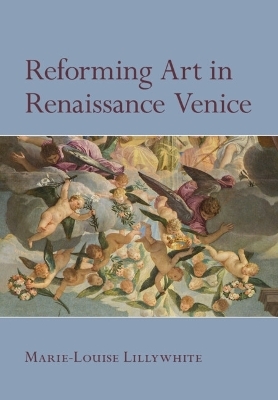
Reforming Art in Renaissance Venice
Seiten
2025
Cambridge University Press (Verlag)
978-1-009-55749-8 (ISBN)
Cambridge University Press (Verlag)
978-1-009-55749-8 (ISBN)
This book considers the impact of religious reform on the devotional art and architecture of sixteenth-century Venice. Interrogating early modern censorship, artistic liberty, notions of decorum tied to depictions of the body, and the role of sacred images in the shaping of local identity, it showcases a study through which to explore these themes.
The spiritual turmoil of the sixteenth century had a profound impact on religious life throughout Italy. Art and architecture were directly implicated in the seismic historical events of the age, as the Catholic Church countered Protestant iconoclasm through the embrace of sacred images as decreed by the Council of Trent in 1563. In this volume, Marie-Louise Lillywhite considers the impact of religious reform on the devotional art and architecture of sixteenth-century Venice. Interrogating early modern censorship, artistic liberty, notions of decorum tied to depictions of the body, and the role of sacred images in the shaping of local identity, she shows how Venice, a crossroads city exposed to a rich gamut of religious and artistic currents, serves as a fascinating case study through which to explore these themes. Her study reconstructs the conditions that enabled artistic invention to prevail and how artists became interpreters of spiritual values.
The spiritual turmoil of the sixteenth century had a profound impact on religious life throughout Italy. Art and architecture were directly implicated in the seismic historical events of the age, as the Catholic Church countered Protestant iconoclasm through the embrace of sacred images as decreed by the Council of Trent in 1563. In this volume, Marie-Louise Lillywhite considers the impact of religious reform on the devotional art and architecture of sixteenth-century Venice. Interrogating early modern censorship, artistic liberty, notions of decorum tied to depictions of the body, and the role of sacred images in the shaping of local identity, she shows how Venice, a crossroads city exposed to a rich gamut of religious and artistic currents, serves as a fascinating case study through which to explore these themes. Her study reconstructs the conditions that enabled artistic invention to prevail and how artists became interpreters of spiritual values.
Marie-Louise Lillywhite is the senior tutor of the Middlebury College Centre for Medieval and Renaissance Studies in Oxford, as well as a research associate at Keble College and a member of the History Faculty at the University of Oxford.
Acknowledgements; Introduction; Part I: 1. The appeal of the subversive: art and heresy (1520–1544); 2. Nakedness and the lascivious: the boundaries of decorum before and after the Council of Trent; 3. The limits of enforcement: artistic censorship in Venice; 4. A reform in quantity: patriarch Lorenzo Priuli's visitation; Part II: 5. The body of Christ; 6. Sanctity; 7. The afterlife; Conclusions; Bibliography; Index
| Erscheinungsdatum | 15.03.2025 |
|---|---|
| Zusatzinfo | Worked examples or Exercises |
| Verlagsort | Cambridge |
| Sprache | englisch |
| Maße | 189 x 105 mm |
| Gewicht | 1080 g |
| Themenwelt | Kunst / Musik / Theater ► Kunstgeschichte / Kunststile |
| Geschichte ► Allgemeine Geschichte ► Neuzeit (bis 1918) | |
| Geisteswissenschaften ► Geschichte ► Regional- / Ländergeschichte | |
| ISBN-10 | 1-009-55749-1 / 1009557491 |
| ISBN-13 | 978-1-009-55749-8 / 9781009557498 |
| Zustand | Neuware |
| Informationen gemäß Produktsicherheitsverordnung (GPSR) | |
| Haben Sie eine Frage zum Produkt? |
Mehr entdecken
aus dem Bereich

aus dem Bereich
Geschichte einer wilden Handlung
Buch | Hardcover (2024)
C.H.Beck (Verlag)
CHF 47,60


