


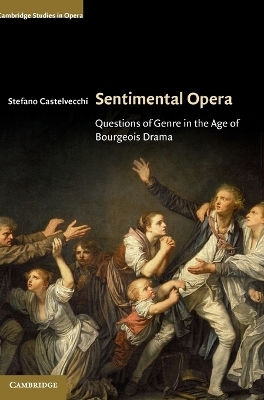
Sentimental Opera
Questions of Genre in the Age of Bourgeois Drama
Seiten
2013
Cambridge University Press (Verlag)
978-0-521-63214-0 (ISBN)
Cambridge University Press (Verlag)
978-0-521-63214-0 (ISBN)
Castelvecchi's book is an in-depth study of the relationship between opera and two major phenomena in eighteenth-century Europe - the cult of sensibility and the emergence of bourgeois drama - and offers a critical re-evaluation of the operatic genre system in the age of Mozart.
Sentimental Opera is a study of the relationship between opera and two major phenomena of eighteenth-century European culture - the cult of sensibility and the emergence of bourgeois drama. A thorough examination of social and cultural contexts helps to explain the success of operas such as Paisiello's Nina as well as the extreme emotional reactions of their audiences. Like their counterparts in drama, literature and painting, these works brought to the fore serious contemporary problems including the widespread execution of deserters, the treatment of the insane, and anxieties relative to social and familial roles. They also developed a specifically operatic version of the dominant language of sensibility. This wide-ranging study involves such major cultural figures as Goldoni, Diderot and Mozart, while refining our understanding of the theatrical genre system of their time.
Sentimental Opera is a study of the relationship between opera and two major phenomena of eighteenth-century European culture - the cult of sensibility and the emergence of bourgeois drama. A thorough examination of social and cultural contexts helps to explain the success of operas such as Paisiello's Nina as well as the extreme emotional reactions of their audiences. Like their counterparts in drama, literature and painting, these works brought to the fore serious contemporary problems including the widespread execution of deserters, the treatment of the insane, and anxieties relative to social and familial roles. They also developed a specifically operatic version of the dominant language of sensibility. This wide-ranging study involves such major cultural figures as Goldoni, Diderot and Mozart, while refining our understanding of the theatrical genre system of their time.
Stefano Castelvecchi is Lecturer in Music at the University of Cambridge and a Fellow of St John's College. He has published critical editions of works by Rossini and Verdi and various articles on eighteenth- and nineteenth-century Italian opera. His edition of Abramo Basevi's The Operas of Giuseppe Verdi (1859) is forthcoming.
Preface; A prologue on genre; 1. Pamela goes to the opera; 2. The emergence of bourgeois drama; 3. The codification of bourgeois drama; 4. Opera as drame; 5. Sensibility and the moral cure; 6. A sentimental opera; 7. Sentimental, anti-sentimental; 8. Avenues; Appendix: Bartolomeo Benincasa's preface to Il disertore (1784).
| Erscheint lt. Verlag | 24.10.2013 |
|---|---|
| Reihe/Serie | Cambridge Studies in Opera |
| Zusatzinfo | 17 Printed music items; 13 Halftones, unspecified; 13 Halftones, black and white |
| Verlagsort | Cambridge |
| Sprache | englisch |
| Maße | 182 x 252 mm |
| Gewicht | 770 g |
| Themenwelt | Kunst / Musik / Theater ► Musik ► Klassik / Oper / Musical |
| Geschichte ► Allgemeine Geschichte ► Neuzeit (bis 1918) | |
| Geisteswissenschaften ► Geschichte ► Regional- / Ländergeschichte | |
| Schlagworte | Cambridge Studies in Oral & Literate Culture |
| ISBN-10 | 0-521-63214-5 / 0521632145 |
| ISBN-13 | 978-0-521-63214-0 / 9780521632140 |
| Zustand | Neuware |
| Informationen gemäß Produktsicherheitsverordnung (GPSR) | |
| Haben Sie eine Frage zum Produkt? |
Mehr entdecken
aus dem Bereich

aus dem Bereich
Geschichte einer wilden Handlung
Buch | Hardcover (2024)
C.H.Beck (Verlag)
CHF 47,60


