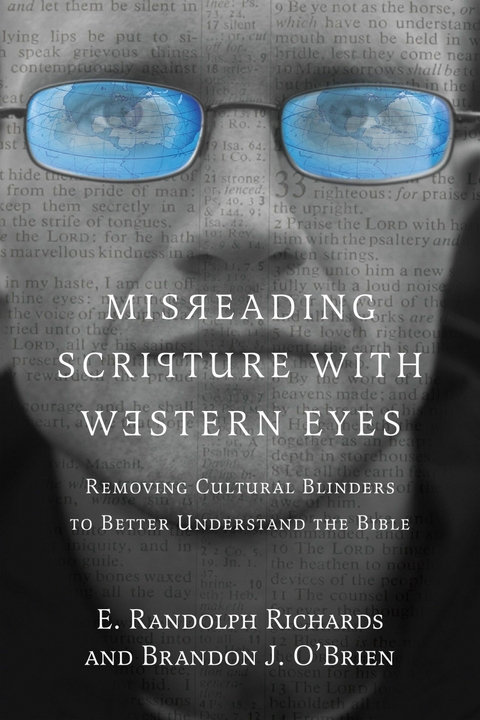
Misreading Scripture with Western Eyes (eBook)
295 Seiten
IVP Books (Verlag)
978-0-8308-6347-1 (ISBN)
E. Randolph Richards (PhD, Southwestern Baptist Theological Seminary) is provost and professor of biblical studies in the School of Ministry at Palm Beach Atlantic University. His many books include Misreading Scripture with Western Eyes, Rediscovering Jesus, Rediscovering Paul, The Story of Israel, and Paul and First-Century Letter Writing.
Over 150,000 Copies Sold Worldwide!Understand Scripture on Its Own TermsWhat was clear to the original readers of Scripture is not always clear to us. Because of the cultural distance between the biblical world and our contemporary setting, we often bring modern Western biases to the text. For example:- When Western readers hear Paul exhorting women to "e;dress modestly,"e; we automatically think in terms of sexual modesty. But most women in that culture would never wear racy clothing. The context suggests that Paul is likely more concerned about economic modesty that Christian women not flaunt their wealth through expensive clothes, braided hair, and gold jewelry. - As Westerners, we tend to give much attention to avoiding vices and not much to developing virtues. We tend to think that virtuous acts are spontaneous. But what went without saying in Paul's day was that it is not enough to remove vices; you must acquire virtues to replace them with, just like changing clothes (Col. 3:12). - Western individualism leads us to assume that Mary and Joseph traveled alone to Bethlehem. What went without saying was that they were likely accompanied by a large entourage of extended family. Biblical scholars Brandon O'Brien and Randy Richards shed light on the ways that Western readers often misunderstand the cultural dynamics of the Bible. They identify nine key areas where modern Westerners have significantly different assumptions about what might be going on in a text. Drawing on their own cross-cultural experience in global mission, O'Brien and Richards show how better self-awareness and understanding of cultural differences in language, time, and social mores allow us to see the Bible in fresh and unexpected ways. Learn to read Scripture as a member of the global body of Christ with Misreading Scripture with Western Eyes.
Brandon J. O'Brien (PhD, Trinity Evangelical Divinity School) is assistant professor of Christian theology at Ouachita Baptist University and director of OBU at New Life Church in Conway, Arkansas. He is coauthor, with E. Randolph Richards, of Misreading Scripture with Western Eyes and Paul Behaving Badly, as well as the author of The Strategically Small Church. A senior editor for Leadership Journal, O?Brien has published in Christianity Today, Relevant, and the Out of Ur blog, and has been interviewed by and quoted in USA Today and other national newspapers. E. Randolph Richards (PhD, Southwestern Baptist Theological Seminary) is dean and professor of biblical studies in the School of Ministry at Palm Beach Atlantic University. He is a popular speaker and has authored and coauthored dozens of books and articles, including Paul Behaving Badly, A Little Book for New Bible Scholars, Rediscovering Jesus, Misreading Scripture with Western Eyes, Rediscovering Paul, The Story of Israel, and Paul and First-Century Letter Writing. Early on in their ministry he and his wife Stacia were appointed as missionaries to east Indonesia, where he taught for eight years at an Indonesian seminary. Missions remain on the hearts of Randy and Stacia. Randy leads mission trips and conducts missionary training workshops and regularly leads tours of the Holy Land, Turkey, Greece, and Italy. He has served as interim pastor of numerous churches and is currently a teaching pastor. He and Stacia reside in Palm Beach, Florida.
Introduction
Coming to Terms with Our Cultural Blinders
On a warm, clear afternoon in the summer of 2002, we stood among the few visible stones that remain of the ancient city of Laodicea. Randy was the professor and Brandon a student in a class earning biblical studies credit by walking for several weeks “In the Footsteps of Paul” through Turkey and Greece. While we were in the neighborhood, we also visited the cities that were home to the seven churches in the Revelation of John. Laodicea was one of these. Of that now-ruined city, the risen Lord had said, “I know your deeds, that you are neither cold nor hot. I wish you were either one or the other! So, because you are lukewarm—neither hot nor cold—I am about to spit you out of my mouth” (Rev 3:15-16).
I (Brandon) heard plenty of sermons on this short passage growing up. My religious leaders generally interpreted the words hot, cold and lukewarm as designations of spiritual commitment. Eugene Peterson calls this the “Laodicean spectrum of spirituality.”[1] This interpretation suggests that Jesus wants us to be hot with spiritual zeal but that unfortunately many of us, like the Laodiceans, are lukewarm. We believe in Jesus, but we fail to take our faith seriously enough. This will not do, since Jesus would prefer that we were altogether cold—lost—than lukewarm in the faith. I never understood why this was the case, but since the meaning of the text seemed plain, I strove to keep the gospel fires burning.
In the summer of 2002, however, standing there among the then-unexcavated ruins of Laodicea, another interpretation of that famous passage presented itself. Several miles northwest of Laodicea, perched atop a small mountain, is a city called Hierapolis. At the base of Hierapolis is an extraordinary geological formation produced by the natural hot springs that surface around the city. Even today, the city is known for its steaming mineral baths. Over the centuries, the subterranean springs have created a snow-white calcium deposit known in Turkish as Pamukkale, or “cotton castle,” that cascades down the slopes like ice. From our vantage point in Laodicea, Hierapolis gleamed white like a freshly powdered ski slope.
About the same distance from Laodicea in the opposite direction is Colossae. The city was not yet excavated in 2002, so we couldn’t see it; but it is almost certain that in the first century, you could have seen Colossae from Laodicea. Paul’s colleague Epaphras worked in Colossae, as well as in Laodicea and Hierapolis (Col 4:13). It was a less notable city than Laodicea, but it had one thing Laodicea didn’t: a cold, freshwater spring. In fact, it was water—or the lack thereof—that set Laodicea apart. Unlike its neighbors, Laodicea had no springs at all. It had to import its water via aqueduct from elsewhere: hot mineral water from Hierapolis or fresh cold water from Colossae. The trouble was, by the time the water from either city made it to Laodicea, it had lost the qualities that made it remarkable. The hot water was no longer hot; the cold water was no longer cold. The Laodiceans were left with all the lukewarm water they could drink. Surely they wished their water was one or the other—either hot or cold. There isn’t much use for lukewarm water.
I suspect that the meaning of the Lord’s warning was clear to the Laodiceans. He wished his people were hot (like the salubrious waters of Hierapolis) or cold (like the refreshing waters of Colossae). Instead, their discipleship was unremarkable.
The point of this story is that where we stand influences how we read—and ultimately apply—the Bible. In the revivalist traditions of North American Christianity, the text reads as a warning against nominal Christian commitment. Eugene Peterson explains what this interpretation demanded of the religious leaders of his youth (and mine): “High on every pastor’s agenda was keeping people ‘on fire’ for Jesus. Worship in general and the sermon in particular were bellows for blowing the smoldering embers into a blaze.”[2] “Hot” (committed) was best, but “cold” (lost) was preferable to “lukewarm” (nominal), because it was honest! From the marble streets of Laodicea, hot and cold are equally acceptable. In both places and times, the meaning may seem plain, even though the interpretations are plainly different. In whatever place and whatever age people read the Bible, we instinctively draw from our own cultural context to make sense of what we’re reading.
The Foreign Land of Scripture
Christians always and everywhere have believed that the Bible is the Word of God. God spoke in the past, “through the prophets at many times and in various ways,” and most clearly by his Son (Heb 1:1). By the Holy Spirit, God continues to speak to his people through the Scriptures. It is important that Christ’s church retain this conviction, even as it poses certain challenges for interpretation. We can easily forget that Scripture is a foreign land and that reading the Bible is a crosscultural experience. To open the Word of God is to step into a strange world where things are very unlike our own. Most of us don’t speak the languages. We don’t know the geography or the customs or what behaviors are considered rude or polite. And yet we hardly notice. For many of us, the Bible is more familiar than any other book. We may have parts of it memorized. And because we believe that the Bible is God’s Word to us, no matter where on the planet or when in history we read it, we tend to read Scripture in our own when and where, in a way that makes sense on our terms. We believe the Bible has something to say to us today. We read the words, “you are . . . neither hot nor cold” to mean what they mean to us: that you are neither spiritually hot or spiritually cold. As we will see, it is a better method to speak of what the passage meant to the original hearers, and then to ask how that applies to us. Another way to say this is that all Bible reading is necessarily contextual. There is no purely objective biblical interpretation. This is not postmodern relativism. We believe truth is truth. But there’s no way around the fact that our cultural and historical contexts supply us with habits of mind that lead us to read the Bible differently than Christians in other cultural and historical contexts.
One of our goals in this book is to remind (or convince!) you of the crosscultural nature of biblical interpretation. We will do that by helping you become more aware of cultural differences that separate us from the foreign land of Scripture.[3] You are probably familiar with the language of worldview. Many people talk about the differences between a Christian and a secular worldview. The matter is actually more complicated than that. Worldview, which includes cultural values and other things we assume are true, can be visualized as an iceberg. The majority of our worldview, like the majority of an iceberg, is below the water line. The part we notice—what we wear, eat, say and consciously believe—is really only the visible tip. The majority of these powerful, shaping influences lurks below the surface, out of plain sight. More significantly, the massive underwater section is the part that sinks ships!
Another way to say this is that the most powerful cultural values are those that go without being said. It is very hard to know what goes without being said in another culture. But often we are not even aware of what goes without being said in our own culture. This is why misunderstanding and misinterpretation happen. When a passage of Scripture appears to leave out a piece of the puzzle because something went without being said, we instinctively fill in the gap with a piece from our own culture—usually a piece that goes without being said. When we miss what went without being said for them and substitute what goes without being said for us, we are at risk of misreading Scripture.
Sound complicated? An example will help. When Paul writes about the role of women in ministry in 1 Timothy, he argues that a woman is not allowed “to teach or to assume authority over a man” because “Adam was formed first, then Eve” (1 Tim 2:12-13). The argument may strike us as strange, since Paul’s point hinges on the implications of being first. But what difference does birth order make in an issue such as who is eligible to serve in ministry? To answer that question, we instinctively provide a bit of information that goes without being said in our context; we read into Paul’s argument what first means to us. For us, first is better. We express this cultural value in lots of ways: “No one remembers who finishes second,” or “Second place is the first loser” or “If you are not the lead dog, the view never changes.” We have a strong cultural value that first is preferred, more deserving and better qualified. What goes without being said for us—and thus what we read Paul to be saying—is, “Adam was first, and thus better, than Eve.” That is, by virtue of being “formed first,” men should be pastors because they are more deserving of the office or better qualified than women.
In Paul’s day, however, something quite different went without being said. The law of the primogeniture stated that the firstborn child received a larger inheritance, and with it greater responsibility, than all other children—not because he or she was preferred or more deserving or better qualified in any way, but merely because she...
| Erscheint lt. Verlag | 31.7.2012 |
|---|---|
| Verlagsort | Lisle |
| Sprache | englisch |
| Themenwelt | Religion / Theologie ► Christentum ► Bibelausgaben / Bibelkommentare |
| Religion / Theologie ► Christentum ► Kirchengeschichte | |
| Schlagworte | Ancient Near East • Bias • bible explained • Biblical Interpretation • Christian Missions • Collectivism • crosscultural • cultural context of the bible • Ethnicity • Global mission • Honor • Individualism • Middle Eastern culture • misunderstand • Race • Shame • Western thought |
| ISBN-10 | 0-8308-6347-8 / 0830863478 |
| ISBN-13 | 978-0-8308-6347-1 / 9780830863471 |
| Informationen gemäß Produktsicherheitsverordnung (GPSR) | |
| Haben Sie eine Frage zum Produkt? |
 EPUB (Adobe DRM)
Kopierschutz: Adobe-DRM
Adobe-DRM ist ein Kopierschutz, der das eBook vor Mißbrauch schützen soll. Dabei wird das eBook bereits beim Download auf Ihre persönliche Adobe-ID autorisiert. Lesen können Sie das eBook dann nur auf den Geräten, welche ebenfalls auf Ihre Adobe-ID registriert sind.
Details zum Adobe-DRM
Dateiformat: EPUB (Electronic Publication)
EPUB ist ein offener Standard für eBooks und eignet sich besonders zur Darstellung von Belletristik und Sachbüchern. Der Fließtext wird dynamisch an die Display- und Schriftgröße angepasst. Auch für mobile Lesegeräte ist EPUB daher gut geeignet.
Systemvoraussetzungen:
PC/Mac: Mit einem PC oder Mac können Sie dieses eBook lesen. Sie benötigen eine
eReader: Dieses eBook kann mit (fast) allen eBook-Readern gelesen werden. Mit dem amazon-Kindle ist es aber nicht kompatibel.
Smartphone/Tablet: Egal ob Apple oder Android, dieses eBook können Sie lesen. Sie benötigen eine
Geräteliste und zusätzliche Hinweise
Buying eBooks from abroad
For tax law reasons we can sell eBooks just within Germany and Switzerland. Regrettably we cannot fulfill eBook-orders from other countries.
aus dem Bereich