


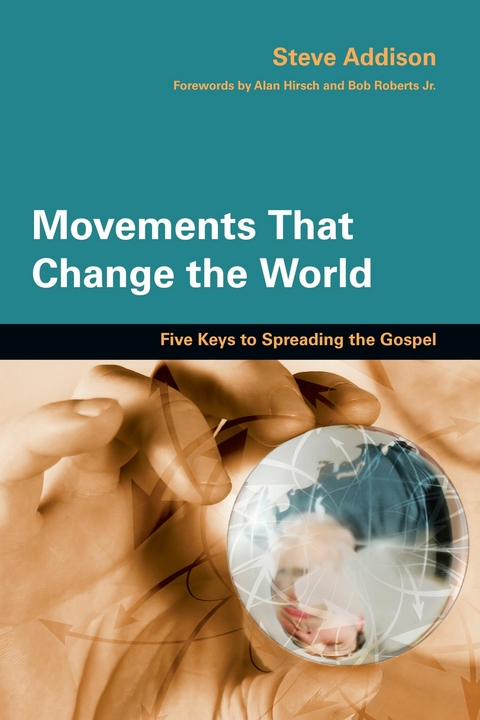
Movements That Change the World (eBook)
191 Seiten
IVP (Verlag)
978-0-8308-6860-5 (ISBN)
Steve Addison serves as Australian director of Church Resource Ministries. He travels the world regularly as part of his calling to spark church-planting movements--everywhere.
Steve Addison (DMin, Fuller Theological Seminary) has a calling to fuel movements that multiply disciples and churches—everywhere. He and his wife Michelle lead MOVE, an Australia-based mission agency dedicated to making disciples and multiplying churches around the world. Steve began his research into Christian movements in the late 1980s while serving as a church planter in Melbourne, Australia, and he is the author of Movements That Change the World: Five Keys to Spreading the Gospel and What Jesus Started: Joining the Movement, Changing the World. Alan Hirsch is the founding Director of Forge Mission Training Network. He is the co-founder of shapevine.com, an international forum for engaging with world transforming ideas. He leads Future Travelers, a learning journey applying missional-incarnational approaches to established churches and is an active participant in The Tribe of LA, a Jesus community among artists and creatives in Los Angeles.Known for his innovative approach to mission, Hirsch is a teacher and key mission strategist for churches across the western world. His popular book The Shaping of Things to Come (with Michael Frost) is widely considered to be a seminal text on mission. Alan's recent book The Forgotten Ways, has quickly become a key reference for missional thinking, particularly as it relates to movements. His book ReJesus is a radical restatement about the role that Jesus plays in defining missional movements. Untamed, his latest book (with his wife Debra) is about missional discipleship for a missional church. His experience in leadership includes leading a local church movement among the marginalized as well as heading up the Mission and Revitalization work of his denomination. Hirsch is an adjunct professor at Fuller Seminary and lectures frequently throughout Australia, Europe, and the U.S.
Patrick
I, Patrick, a sinner, unlearned, resident in Ireland, declare myself to be a bishop. Most assuredly I believe that what I am I have received from God. And so I live among barbarians, a stranger and exile for the love of God. He is witness that this is so.
Patrick, in a letter to Coroticus
When Alaric and his army of Visigoths marched into Rome to loot and plunder in A.D. 410, it was as though the world had ended.[1] It had been eight hundred years since an enemy last breached the defenses of Rome—the Eternal City, the heart and soul of the greatest empire in history.
The sack of Rome sent a shock wave throughout the Empire. Yet it was hardly noticed on the Empire’s fringes—except perhaps by the Irish pirates who for years had been taking advantage of the withdrawal of the Roman navy to attack the west coast of Britain.
Patrick was sixteen years old when Irish raiders stormed his village in Roman Britain.[2] Until that day he had lived a privileged life. He was born into the British landowning aristocracy. His grandfather was a priest, and his father was a magistrate and church leader. The life of a Roman magistrate was one of honor and privilege. The position was hereditary; one day Patrick would rule as part of Roman nobility in Britain. The raiders seized him, along with servants from his father’s estate, and returned across the sea to the pagan land of Ireland, where they sold him into slavery. The year was A.D. 405.
For the next six years Patrick lived the lonely and hard life of a slave, working as a shepherd. Isolation, hunger and cold brought him misery, and misery taught him humility. God worked powerfully in Patrick’s suffering to remake him from the inside out. He freed Patrick from dependence on wealth and his place in society. God rescued Patrick from himself and made his heart captive to the love of Christ.
According to Patrick, before his abduction he did not believe in the living God. As a slave, Patrick came to see the hand of God in his troubles. God broke through his defenses, and Patrick faced his unbelief and pride. Later he described how he turned to God, who he realized had been watching over him all the time. He became aware of God’s protection, and he discovered that God loved him as a father loves his son.
Outwardly nothing changed for Patrick; he was still a captive in a harsh foreign land, but he saw life differently. The land of his captivity had become the land of his freedom in God. The slave of men had become a son of God.
The love and fear of God grew in him. Patrick learned to pray continually as he worked. At night he stayed out in the forests and on the mountains to pray. He would rise before dawn to pray in the icy coldness of the Irish winter. This was no burden to him but a delight; the Spirit was burning in him.
One night God spoke to him in a dream and revealed that there was a ship waiting to take him home. There was one problem—two hundred miles of dangerous territory lay between him and the coast. Patrick made his escape and began the long journey home as a runaway slave.
The details are sketchy, but he reached the ship and eventually made it back to his family and resumed the life he once had in Britain. Perhaps he looked forward to inheriting his father’s position in society and all the privileges that went with it. But God, who is the initiator in this story, had other plans for Patrick.
Patrick woke one night to the voices of the people he had known in Ireland crying out, “We beg you, come and walk with us again!” Their cry pierced his heart. God was calling him to return—and he did.
In time, despite his limited education and experience, he was ordained as a priest and bishop. Later Patrick faced opposition to his authority from church leaders, but he believed that it was God who had appointed him, an uneducated sinner, to be a missionary bishop to the Irish.
When Patrick returned to Ireland, it had been four hundred years since Christ commanded his disciples to go to the nations, yet the gospel was largely contained within the borders of the Roman Empire.[3] God took the initiative to transform a teenager with an inherited faith into an apostle compelled by the Spirit to take the gospel to the ends of the earth. The shepherd-boy slave had become the slave of Christ and apostle to Ireland.
Patrick’s troubles had prepared him well for his mission. Through them he had become devoted to Christ and the gospel. His heart longed to reach the “barbarians” beyond the borders of civilization. His lack of formal training contributed to his openness to new and effective methods.
In contrast, the church of the Roman Empire was not interested in taking the gospel beyond the borders of Greco-Roman civilization. Romans regarded the tribes outside the Empire, such as the Celts, the Goths and the Huns, as barbarians. The religious world of the Irish Celts was inhabited by a bewildering array of gods, goddesses, and spirits of the sky, earth and water; the Celts also believed in the magical powers of ancestors and divine animals.[4] For the church of the Roman Empire, these pagan barbarians were beyond the missionary concern of God.
Patrick, however, saw the need and opportunity to reach these Irish barbarians. He traveled throughout Ireland to remote and dangerous places to preach, baptize converts and ordain clergy for the new churches. From nobles to slaves, the Irish were ready to hear and obey the gospel. Thousands of them responded to Patrick’s preaching and turned from their pagan idols to serve the living God. Many of the converts took up Patrick’s challenge to join his missionary band.
Steadily the gospel worked its power through the Irish tribal society. Patrick embraced the best of Celtic culture and redeemed it to serve the gospel. He fought those aspects of Irish culture that did not conform to the gospel. He ended the slave trade, and under the gospel’s influence, murder and tribal warfare decreased. In place of a warrior society, Patrick provided a living alternative, showing the Irish that it was possible to be brave—to expect every day to be murdered, betrayed, enslaved—and yet to be people of peace with no fear of death because of the promises of an almighty God.[5]
Patrick faced fierce opposition. He had to contend with the magic of the Druids (the powerful priestly caste of Celtic society), and he faced the violence of local chieftains. On one occasion, newly baptized Christians were attacked by British raiders from the west coast of Patrick’s homeland. The men were slaughtered, and the women and children were kidnapped, some of them still wearing their baptismal robes.
Just as distressing was the opposition from other church leaders. Patrick’s writings make it clear that influential sections of the church disapproved of him, despite his role in the conversion of much of Ireland.[6] Patrick’s worst critics were the bishops in Britain. Not interested themselves in taking the gospel to the Irish, they may have initially tolerated the appointment of such a poorly educated novice; but as the Christian faith spread throughout Ireland some church leaders questioned whether Patrick was the right person to lead such a successful and potentially lucrative ministry.[7]
Patrick was deeply conscious that his authority to preach the gospel came from God, but he was also painfully aware of his limitations and of his many critics. He was embarrassed by his lack of formal theological training and the poor quality of his Latin. His writings do not reveal the training of a scholar, but they do reveal the heart of a man compelled by the love of Christ, led by the Spirit and guided by the Scriptures.[8]
Patrick gave the Irish the gift of non-Roman Christianity. Since the conversion of Emperor Constantine in A.D. 312, Christianity had been closely identified with Roman culture and power. Yet Patrick liberated Ireland without the backing of imperial power. Instead he lived and communicated the gospel in ways that connected and resonated deeply with Irish hopes and concerns. He taught the Irish that they could become followers of Christ without having to become like Romans.
Patrick made church structures serve his mission. The church of the Roman Empire was based around the cities where the local bishop was supreme. The Irish were a rural and tribal people. Unlike the civilized Romans, they had no settled towns, roads, currency, written law, government bureaucracy or taxation. Irish society was decentralized and organized around tribes led by local “kings.”[9] So Patrick decentralized the church.
The Roman system was based on the diocese and the bishop. The life of the Celtic church revolved around the monastery, which was led by an abbot. The abbots selected the bishops, and the bishops were dependent on them.
Patrick’s mobile missionary bands closely followed the example of Jesus and Paul, but the Roman church leaders did not approve. Patrick responded to his critics through his writings as best he could with his limited literary skills, but he did not let them stop him. Not only was his ministry at stake, but also the missionary movement that was about to be unleashed throughout Britain and Europe.
The Celtic missionary movement was not a highly organized or centrally controlled operation. Under Patrick’s influence, wave after wave of Irish youth flooded into monastic life. Most monasteries began in remote places when...
| Erscheint lt. Verlag | 17.4.2011 |
|---|---|
| Vorwort | Alan Hirsch, Bob Roberts Jr. |
| Verlagsort | Lisle |
| Sprache | englisch |
| Themenwelt | Geschichte ► Teilgebiete der Geschichte ► Religionsgeschichte |
| Religion / Theologie ► Christentum ► Kirchengeschichte | |
| Schlagworte | become a Christian • Christian Faith • Evangelism • ministry • share the gospel • Share Your Faith |
| ISBN-10 | 0-8308-6860-7 / 0830868607 |
| ISBN-13 | 978-0-8308-6860-5 / 9780830868605 |
| Informationen gemäß Produktsicherheitsverordnung (GPSR) | |
| Haben Sie eine Frage zum Produkt? |
 EPUB (Wasserzeichen)
DRM: Digitales Wasserzeichen
Dieses eBook enthält ein digitales Wasserzeichen und ist damit für Sie personalisiert. Bei einer missbräuchlichen Weitergabe des eBooks an Dritte ist eine Rückverfolgung an die Quelle möglich.
Dateiformat: EPUB (Electronic Publication)
EPUB ist ein offener Standard für eBooks und eignet sich besonders zur Darstellung von Belletristik und Sachbüchern. Der Fließtext wird dynamisch an die Display- und Schriftgröße angepasst. Auch für mobile Lesegeräte ist EPUB daher gut geeignet.
Systemvoraussetzungen:
PC/Mac: Mit einem PC oder Mac können Sie dieses eBook lesen. Sie benötigen dafür die kostenlose Software Adobe Digital Editions.
eReader: Dieses eBook kann mit (fast) allen eBook-Readern gelesen werden. Mit dem amazon-Kindle ist es aber nicht kompatibel.
Smartphone/Tablet: Egal ob Apple oder Android, dieses eBook können Sie lesen. Sie benötigen dafür eine kostenlose App.
Geräteliste und zusätzliche Hinweise
Buying eBooks from abroad
For tax law reasons we can sell eBooks just within Germany and Switzerland. Regrettably we cannot fulfill eBook-orders from other countries.


