Chris Smith is editor of The Englewood Review of Books and a member of the Englewood Christian Church community on the urban Near Eastside of Indianapolis.
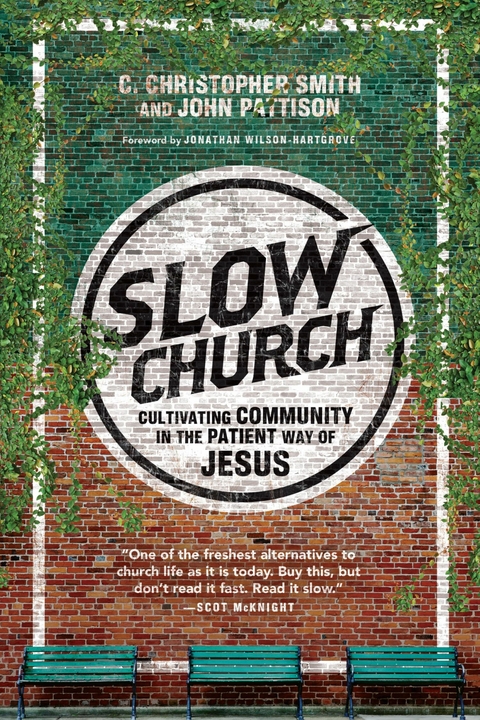
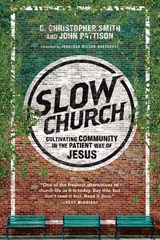
Readers' Choice Award WinnerBest Books About the Church from Byron Borger, Hearts and Minds BookstoreFast food. Fast cars. Fast and furious. Fast forward. Fast . . . church?The church is often idealized (or demonized) as the last bastion of a bygone era, dragging our feet as we're pulled into new moralities and new spiritualities. We guard our doctrine and our piety with great vigilance. But we often fail to notice how quickly we're capitulating, in the structures and practices of our churches, to a culture of unreflective speed, dehumanizing efficiency and dis-integrating isolationism. In the beginning, the church ate together, traveled together and shared in all facets of life. Centered as they were on Jesus, these seemingly mundane activities took on their own significance in the mission of God. In Slow Church, Chris Smith and John Pattison invite us to leave franchise faith behind and enter into the ecology, economy and ethics of the kingdom of God, where people know each other well and love one another as Christ loved the church.
C. Christopher Smith is editor of The Englewood Review of Books and a member of the Englewood Christian Church community on the urban Near Eastside of Indianapolis. He is the coauthor of Slow Church.Chris's writing has appeared in Books and Culture, Sojourners, The Christian Century and Indiana Green Living. Jonathan Wilson-Hartgrove (M.Div., Duke Divinity School) is director of the School for Conversion in Durham, North Carolina, where he is a member of the Rutba House new monastic community. He is the author of To Baghdad and Beyond and coauthor of Inhabiting the Church: Biblical Wisdom for a New Monasticism. He is also the coeditor of School(s) for Conversion: 12 Marks of a New Monasticism. Catch up with him at newmonasticism.org. John Pattison is an author, community advocate, grant writer and nonprofit consultant who leads The Resourceful Community, a blog that connects community leaders to the resources of community flourishing. He is the coauthor of Slow Church and Besides the Bible: 100 Books that Have, Should, or Will Create Christian Culture.Formerly the managing editor of CONSPIRE Magazine and deputy editor of the Burnside Writers Collective, Pattison's essays, articles and reviews have appeared in Relevant, Books Culture and the Englewood Review of Books. He is also a voting member of the National Book Critics Circle. He lives with his wife Kate and their two daughters in Oregon's Mid-Willamette Valley.
1
A Theological Vision for Slow Church
We are impatient, anxious to see the whole picture, but God lets us see things slowly, quietly. The Church [has] to learn how to wait.
Pope Francis
One modern poet described clichés as “poetry that won.” Is there any better example of that than these famous lines from William Shakespeare’s play As You Like It? “All the world’s a stage / And all the men and women merely players / They have their exits and their entrances.” This trope has become so familiar that we can lose sight of the profound truths it contains. But this metaphor—the world as a singular drama in which all creation is engaged—is foundational to the theology of Slow Church.
To say that creation is a drama is to imply that it is an enactment, a combination of saying and doing that encompasses God, humanity and even nonhumanity (the creaturely world). As Kevin Vanhoozer has written, in the drama of creation, “God and humanity are alternately actor and audience. Better: life is human-divine interactive theatre, and theology involves both what God has said and done for the world and what we must say and do in grateful response.”1
The biblical narrative is the story of the whole creation, from the beginning through the present to the end—and yet it’s not so much a script that we mechanically act out but rather a story that serves to form us into the people we need to be. The dramas we’re most familiar with, on stage or screen, are based on scripts that tell actors what to say and do. But there is another kind of drama—improvisation.
Improvisation is based on the spontaneous interactions between the players. Though all scripted dramas leave some room for the unscripted, in improv, actors are given only a scenario, a basic plotline or a few props as a starting point from which to construct a scene and enact a story. Improv can be gut-bustingly funny or painfully awkward, but either way, one can never tell the turns it will take or where it will end up.
In her memoir Bossypants, the comedian and writer Tina Fey talks about “the rules of improvisation that will change your life and reduce belly fat.” Her first rule of improvisation is to always agree with your improv partner. The second rule of improv is to say not just yes but “YES, AND.” “It’s your responsibility to contribute,” Fey writes. “Always make sure you’re adding something to the discussion. Your initiations are worthwhile.” Reflecting on Scripture as improv, Fey’s words remind us that no one is a passive observer in the biblical drama. Later, Fey gives another rule of improv: “THERE ARE NO MISTAKES, only opportunities,” which could be reappropriated theologically as an allusion to God’s eschatological reconciliation of all things.2
Scripture is less like the movie of the week and more like improvisation. It provides a basic plotline and then gives our churches, the actors in this drama, extraordinary freedom and creative opportunity. In his book Scripture and the Authority of God, N. T. Wright describes the history of creation as a drama in five acts:
Act One: Creation
Act Two: The Fall
Act Three: Israel
Act Four: Jesus
Act Five: The Church
The implications of this are profound, if for no other reason than that it undermines our cultural impulse to be consumers and spectators rather than faithful participants in the unwritten fifth act of God’s play. Wright says, “We must act in an appropriate manner for this moment in the story; this will be in direct continuity with the previous acts (we are not free to jump suddenly to another narrative, a different play altogether), but such continuity also implies discontinuity, a moment where genuinely new things can and do happen.”3
The enactment of Scripture has astonishing formative power. The deeper our engagement with the story, the better our improvisation will be. “Improvisation in the theatre,” says pastor and theologian Sam Wells, “is a practice through which actors develop trust in themselves and one another in order that they may conduct unscripted dramas without fear.”4 Similarly, Wells says that it is within the people of God—a community of trust—that we learn to live into the looming unknown of the future. The people of God are thus a sort of acting troupe that is attentive to and engaged with the scriptural story, for the purposes of building trust and learning to improvise the scriptural plotline more faithfully in the future.
The Patient Character of God
All around us we see the “huge spontaneous upheaval of the entire human race” that Thomas Merton talked about, a revolution he rightly predicted would be manifested in desperation, cynicism, violence, self-contradiction, fear and hope, doubt and belief, creation and destruction, and “obsessive attachments to images, idols, slogans, programs that only dull the general anguish for a moment until it bursts out everywhere.”5 In the midst of the frantic, churning, disturbed and roiling shallow waters of postmodernity, Slow Church seeks to anchor itself in the deep, still waters of a remarkably patient yet radically immanent God. This isn’t escapism. Rather, it is part and parcel of living as the peculiar people of God. As someone once said, we’re in the world but not of the world, so we can be for the world.
In everything, Slow Church looks ahead to the eschatological redemption that is the climax of the central drama of the world. Slow Church takes the long view, examining all thought and culture, every ideology and assumption, all action and reaction by the messianic light of the last day.6 Paradoxically, taking the long view allows us to be truly attentive to the details of the here and now. It all matters. Nothing is wasted.
Scripture illuminates characteristics of both God’s nature and human nature that contribute to the slowness of our enacting of the scriptural story together. Let’s consider first the nature of God.
God is transforming and reconciling the world. But unlike human revolutionaries who demand instant and total change, God is not impatient. The arc of the universe bends toward the full reconciliation of all creation, but—“Come, Lord Jesus!”—that arc is long. Jesus’ parables in Matthew 13 of the leavened dough and the mustard seed remind us that God’s transformation comes slowly, working outward from the place where the change begins. In an age when instant gratification reigns supreme, the lesson of these parables is provocative and surprisingly insistent—but this seems to be the way God usually works in the world. As A.W. Tozer said, “The faith of Christ offers no button to push for quick service. The new order must wait the Lord’s own time.”
God’s patience flows from God’s love for creation. It’s no accident that the first characteristic of love Paul mentions in 1 Corinthians 13 is patience. Indeed, since the earliest years of the church, many important theologians—including Tertullian and Origen—have reframed the biblical story through the lens of the patience of God. Adam and Eve sinned brashly, but God was patient. For centuries, God waited out the rebellion of humanity before calling Abraham and beginning in him the work of gathering a set-apart people. God tarried for forty years with the Israelites in the wilderness before leading them into the Promised Land. God patiently waited through the era of Israel’s many kings—some rebellious against God, others less so—and sent prophets to redirect people back to God and God’s unfolding story. Though we tend to gloss over it in our anticipation of the birth of Christ, the genealogy of Jesus in Matthew 1 is a testimony to God’s patient communion with the people of God. And the history of the church is marked by many of the same characteristics as the history of Israel: lots of human rebellion, scattered pockets of human faithfulness, and all the while, God’s deep and unwavering patience.
When church fathers like Tertullian spoke of God’s patience using the Latin word patientia, they had in mind something more than just waiting, the way we typically understand patience today. Their use of this word is more akin to the term “longsuffering” used by translators of the King James Version in verses like Numbers 14:18 (“The LORD is longsuffering, and of great mercy, forgiving iniquity and transgression”) and when describing the fruits of the Spirit in Galatians 5:22. God is ever faithful to the divine nature and mission in the world, even preferring to be humiliated and to suffer than to deviate from the work of love and reconciliation. This longsuffering is best exemplified for us in the earthly ministry of Jesus from beginning (his temptations in the wilderness) to end (his arrest and crucifixion). The character of God thus stands in sharp contrast to the modern era’s idolatrous affair with efficiency, which is driven by the conviction that the end justifies the means—or, in the famous words of Malcolm X, that some vital ends should be pursued “by any means necessary.”
We’ll explore the concept of patientia in more depth in chapter four. For now, though, as we begin to reflect on the slowness of God’s work in the world, it’s important to be mindful that our calling into the abundant life of Slow Church begins with the love, patience and longsuffering of God.
God Desires Collaboration with...
| Erscheint lt. Verlag | 6.5.2014 |
|---|---|
| Vorwort | Jonathan Wilson-Hartgrove |
| Verlagsort | Lisle |
| Sprache | englisch |
| Themenwelt | Religion / Theologie ► Christentum ► Kirchengeschichte |
| Religion / Theologie ► Christentum ► Pastoraltheologie | |
| Schlagworte | An Unhurried Leader • Being church • Christian • christian living • Church • Church Growth • Community • Conversation • Culture • ecology of the Kingdom • economy of creation • Efficiency • Efficient • Engage • Fast Food • God • growth • in the world but not of it • Kingdom ethics • Local • Local Church • ministry • missional • Movement • neighborhood • particular • Pastor • Pastoral Resources • Patience • Pause • Place • quality • Quantity • rooted • Scripture • slow down • Slow Food • Sociology • Speed • take time • The New Parish • Theology • Vision • WAIT |
| ISBN-10 | 0-8308-9595-7 / 0830895957 |
| ISBN-13 | 978-0-8308-9595-3 / 9780830895953 |
| Informationen gemäß Produktsicherheitsverordnung (GPSR) | |
| Haben Sie eine Frage zum Produkt? |
 EPUB (Adobe DRM)
Kopierschutz: Adobe-DRM
Adobe-DRM ist ein Kopierschutz, der das eBook vor Mißbrauch schützen soll. Dabei wird das eBook bereits beim Download auf Ihre persönliche Adobe-ID autorisiert. Lesen können Sie das eBook dann nur auf den Geräten, welche ebenfalls auf Ihre Adobe-ID registriert sind.
Details zum Adobe-DRM
Dateiformat: EPUB (Electronic Publication)
EPUB ist ein offener Standard für eBooks und eignet sich besonders zur Darstellung von Belletristik und Sachbüchern. Der Fließtext wird dynamisch an die Display- und Schriftgröße angepasst. Auch für mobile Lesegeräte ist EPUB daher gut geeignet.
Systemvoraussetzungen:
PC/Mac: Mit einem PC oder Mac können Sie dieses eBook lesen. Sie benötigen eine
eReader: Dieses eBook kann mit (fast) allen eBook-Readern gelesen werden. Mit dem amazon-Kindle ist es aber nicht kompatibel.
Smartphone/Tablet: Egal ob Apple oder Android, dieses eBook können Sie lesen. Sie benötigen eine
Geräteliste und zusätzliche Hinweise
Buying eBooks from abroad
For tax law reasons we can sell eBooks just within Germany and Switzerland. Regrettably we cannot fulfill eBook-orders from other countries.
aus dem Bereich