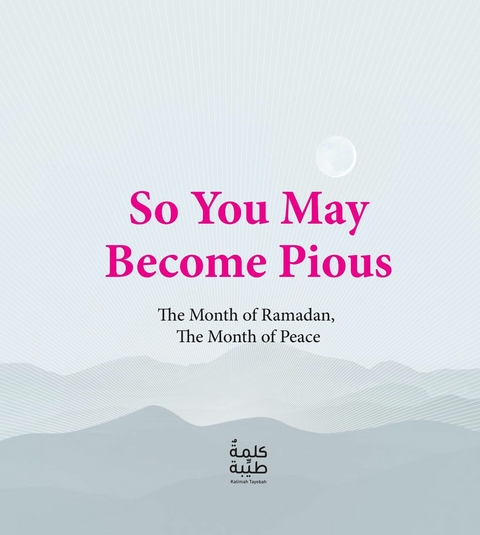
So You May Become Pious (eBook)
548 Seiten
Sila S.A.L. (Verlag)
978-4-7793-4288-2 (ISBN)
Kalimah Tayebah seeks through its distinctive publications to plant the seed of purity in hearts among individuals and fill them with love, peace, and faith, so that people can live in harmony with one another, creating balanced societies where love, tolerance, and forgiveness prevail. Kalimah Tayebah addresses all segments of society through these diverse publications, which focus on building a correct belief system free from extremism, promoting Prophetic ethics in society, and connecting what happens around one's life through the Beautiful Names of Allah-all conveyed in a smooth, engaging, and contemporary style.
Kalimah Tayebah seeks through its distinctive publications to plant the seed of purity in hearts among individuals and fill them with love, peace, and faith, so that people can live in harmony with one another, creating balanced societies where love, tolerance, and forgiveness prevail. Kalimah Tayebah addresses all segments of society through these diverse publications, which focus on building a correct belief system free from extremism, promoting Prophetic ethics in society, and connecting what happens around one's life through the Beautiful Names of Allah—all conveyed in a smooth, engaging, and contemporary style.
Q. Why did Allah SWT prescribe fasting for us?
A. The purpose of fasting is to achieve piety as Allah - سُبْحٰانَه وَتعالىٰ - indicated in the holy Quran in (O Believers, fasting has been prescribed for you, just as it was prescribed for those before you, so that you may reach piety).2
Piety is the state your reach when you avoid what Allah - سُبْحٰانَه وَتعالىٰ - has forbidden and you do what He has commanded, and when you take the Prophetic Virtues as model and when you break away from bad morals. Allah - سُبْحٰانَه وَتعالىٰ - has ordained us to fast so we may reach the rank of the pious.
Therefore, if those four purposes are not served during the holy month of Ramadan, then we would have lost the main meaning of fasting.
The Prophet - صَلَّى اللهُ عَلَيْهِ وسَلَّمَ - said: “He who does not abandon falsehood and evil action, Allah has no need that he abstains from food and drink”.3
In fact, the true purpose of fasting in Ramadan is to correct one’s path and make meaningful change. This can be achieved through repentance and mending one’s character that has been spoiled by sins, and return to the righteous path of Allah - سُبْحٰانَه وَتعالىٰ -.
(So you may reach piety) means so that you may elevate in the ranks of piety one year after another.
Allah - سُبْحٰانَه وَتعالىٰ - has also said: (The most noble of you in Allah’s sight is the one who is most pious).4And the Prophet - صَلَّى اللهُ عَلَيْهِ وسَلَّمَ - said: “there is no merit for an Arab over a non-Arab, or for a non-Arab over an Arab except with piety”.5
Q. What is the difference between fasting and the other acts of worship such as prayer, alms (zakat) and pilgrimage?
A. Most of the acts of worship involve performing certain actions such as praying or paying alms or performing pilgrimage. However, fasting is the only act of worship defined by concepts of abandoning and abstinence.
Fasting is abstaining rather than doing, therefore the question is: what are we going to abstain from during the month of Ramadan, and not what are we going to do during the month of Ramadan. The more we abandon sins, the more our worship is beneficial, and the more we abandon bad morals, the more the worship is accepted.
Abdullah Ibn Omar may Allah be pleased with him said: you may pray until your backs bend and you may fast until you become frail, you will only be accepted when your devoutness prevents you from committing sins6. The honored ancestors warned from unlawful money, and Ibn Al Mubarak even said: Returning a suspected Dirham is more beloved to me than donating a hundred thousand7.
Very often, our self finds it more difficult to abandon a sin than to perform an act of worship. For example, some people who are on bad or non-talking terms with others find it easier to travel for Umra, to pray 20 rak’as of Taraweeh in the mosque throughout the Holy Month of Ramadan, or even to complete several readings of the Holy Quran, rather than forgiving the person they fought with or to pardon any wrong they did or to visit him after a period of disruption.
Q. What Allah - سُبْحٰانَه وَتعالىٰ - means in the Hadith Qudsi: “All of the deeds of the son of Adam is his, except for the fasting, it is for Me and I reward for it”.8
A. Abu Huraira - رَضِيَ اللهُ عَنْهُ - said: The Prophet - صَلَّى اللهُ عَلَيْهِ وسَلَّمَ - said: “All of the deeds of the son of Adam is multiplied: the good deed receiving tenfold to seven hundredfold reward, with the exception of fasting, it is done for My sake and I reward for it as one abandons food and desire for Me.9
In order to understand this hadith, we ought to understand the meaning of love.
What are the signs of love?
The most important sign of love is sacrifice; it means that you give up on what you love and choose what your beloved wants or loves, while feeling happy because you entered happiness to your beloved’s heart.
To Allah - سُبْحٰانَه وَتعالىٰ - belongs the utmost example of perfection, that is the example of a mother, she loves her children and sacrifices her happiness for theirs and her comfort for theirs. She would abstain from eating to feed her children, as her happiness to see them eating is greater than the pleasure of eating herself.
The Hadith Qudsi tells us: “All acts of the son of Adam are his, a good deed received tenfold and some seven hundredfold in reward”, meaning that every good deed is intended by the son of Adam for a reward from Allah - سُبْحٰانَه وَتعالىٰ -, except for fasting, which is observed solely for the love of Allah. In fact, fasting entails that you leave what you like for what Allah - سُبْحٰانَه وَتعالىٰ - likes, as in the Hadith Qudsi: he abandons his pleasures and food for Me”.
Ibn Atallah Al Sakandari said: when you love something you become a servant to it (meaning a follower), and Allah - سُبْحٰانَه وَتعالىٰ - does not like that you become servant to other than Him”.
The loving person becomes obedient to his beloved, and the sign of love is that you abandon what your self likes just to win His Love and enter in His Grace. In this context we may mention the poetry line:
Where are the loving ones for whom became easy
To exert oneself for the precious and the valuable
In fact, whomever aims for reward is given the reward from afar, and whomever abandons the desires for the sake of Allah, enters the doors of proximity with the beloved ones.
The sign of the love of Allah is the following of his Prophet - صَلَّى اللهُ عَلَيْهِ وسَلَّمَ -: (Say, if you love Allah follow me and Allah will love you)10. The Prophet - صَلَّى اللهُ عَلَيْهِ وسَلَّمَ - loved his Lord so much that his pleasure and desire became to follow what Allah - سُبْحٰانَه وَتعالىٰ - wants and loves. The prophet - صَلَّى اللهُ عَلَيْهِ وسَلَّمَ - said: “None of you truly believes until his desires are subservient to that which I have brought”.11
Q. What is the reward for fasting and why?
A. In the Hadith Qudsi, Allah - سُبْحٰانَه وَتعالىٰ - said: All acts of the son of Adam is multiplied, a good deed for ten and up to seven hundred times- but Allah - سُبْحٰانَه وَتعالىٰ - added: except for fasting, it is for Me and I reward it, he abandons his desire and his food for My sake”. This hadith is a clear sign that the genuine fasting is not measured by the actual value of the deed itself or by the multiplication of its rewards, it is actually rewarded with the Love of Allah - سُبْحٰانَه وَتعالىٰ -, Allah - سُبْحٰانَه وَتعالىٰ - will love you and will be pleased with you, and will bless you with His proximity.
In this context applies the saying: Oh my Lord, he who has lost you has found nothing, and he who has found you has lost nothing.
Here is an example that clarifies the difference between the ones rewarded by Allah, even with multiplied rewards, and the ones who won Allah - سُبْحٰانَه وَتعالىٰ -.
A rich man sought one day to console a hundred orphans by granting one wish to each one of them, no matter what that wish was. He contacted the orphanage and asked the manager to invite one hundred orphans aged between five and eight years old. He stood with them and asked his assistant to note down the wishes.
The first one asked for a bicycle, the second for a car, the third for new clothes, the fourth for an education scholarship, the twenty first for a new watch, the twenty second for a new and comfortable bed, and the seventieth said: I want you to sponsor me and to love me like one of your own children in every aspect, during your life and after your passing. The man answered: how about I give you all of what your friends asked for to answer your request? The child said, no I do not want any of that, I do not need clothes or cars or bicycles, I want to become as beloved to you as your own children, and that you treat me accordingly.
The man nodded with approval, as he had committed to grant the wishes of all these orphans, and then remembered the meaning of the Prophet’s hadith - صَلَّى اللهُ عَلَيْهِ وسَلَّمَ -: “I and the guardian of the orphan will be in Heaven like these two, and he drew his index and middle finger close together”.12
In the end, each of the orphan was granted the wish, but this particular child won the donor himself, his love and care, got the toys and the best education, until he got employed and married, and...
| Erscheint lt. Verlag | 2.4.2024 |
|---|---|
| Verlagsort | London |
| Sprache | englisch |
| Themenwelt | Geisteswissenschaften ► Religion / Theologie ► Islam |
| Schlagworte | best islamic books • duaa in ramadan • fasting in islam • Islamic books • islamic knowledge • İslamic Practices • islamic self-help • Islamic spirituality • islamic supplications • islamic teachings • meaning of ramadan • muslim lifestyle in ramadan • purpose of fasting • ramadan supplications • الصيام في رمضان • صوم رمضان • لماذا نصوم • معنى الصوم • معنى الصيام |
| ISBN-10 | 4-7793-4288-0 / 4779342880 |
| ISBN-13 | 978-4-7793-4288-2 / 9784779342882 |
| Informationen gemäß Produktsicherheitsverordnung (GPSR) | |
| Haben Sie eine Frage zum Produkt? |
 EPUB (Wasserzeichen)
DRM: Digitales Wasserzeichen
Dieses eBook enthält ein digitales Wasserzeichen und ist damit für Sie personalisiert. Bei einer missbräuchlichen Weitergabe des eBooks an Dritte ist eine Rückverfolgung an die Quelle möglich.
Dateiformat: EPUB (Electronic Publication)
EPUB ist ein offener Standard für eBooks und eignet sich besonders zur Darstellung von Belletristik und Sachbüchern. Der Fließtext wird dynamisch an die Display- und Schriftgröße angepasst. Auch für mobile Lesegeräte ist EPUB daher gut geeignet.
Systemvoraussetzungen:
PC/Mac: Mit einem PC oder Mac können Sie dieses eBook lesen. Sie benötigen dafür die kostenlose Software Adobe Digital Editions.
eReader: Dieses eBook kann mit (fast) allen eBook-Readern gelesen werden. Mit dem amazon-Kindle ist es aber nicht kompatibel.
Smartphone/Tablet: Egal ob Apple oder Android, dieses eBook können Sie lesen. Sie benötigen dafür eine kostenlose App.
Geräteliste und zusätzliche Hinweise
Buying eBooks from abroad
For tax law reasons we can sell eBooks just within Germany and Switzerland. Regrettably we cannot fulfill eBook-orders from other countries.
aus dem Bereich