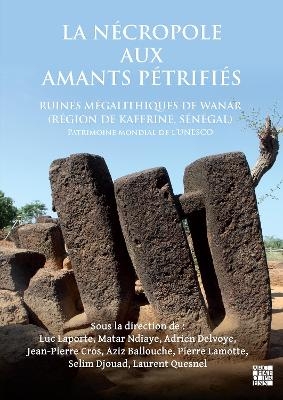
La nécropole aux amants petrifies. Ruines mégalithiques de Wanar (Région de Kaffrine, Sénégal)
Archaeopress Archaeology
978-1-80327-765-3 (ISBN)
This collective work reports on the studies and archaeological work carried out at the megalithic ruined necropolis of Wanar, Senegal, between 2008 and 2017. Along with Sine Ngayene in Senegal, and Wassu and Ker Batch in Gambia, the Wanar sanctuary is one of four sites classified as UNESCO World Heritage Sites in 2006. The first part sets out the general framework for the study of paleoenvironments as well as historical and archaeological data, and concludes with a brief summary of megaliths in Africa.
The second part reports on all the observations made, starting with a presentation of the Wanar site in the context of human settlements along the Bao Bolon valley, followed by an account of the main study methods used. This is followed by a detailed presentation of the six monuments studied, three to the north of the necropolis with short, squat monoliths, and three to the south with narrow, elongated monoliths, built between the 11th and 13th centuries AD. The sanctuary then took the form of a village with stone houses, dedicated to the dead and, in the context of deferred funerals, in three stages as in many traditional funeral rites still practiced today in West Africa.
Paradigm shifts in the state of knowledge about the megaliths of Senegal and Gambia call for a careful re-reading of previous work, which is the subject of the third and final section. The monograph on the work at the Wanar site is therefore an important milestone in the advancement of our knowledge of protohistoric societies and megalith builders in West Africa.
Luc Laporte is Research Director at CNRS (France). He is a specialist of the Neolithic period in Europe, and on the subject of megaliths in general, and is the author of more than 140 scientific articles in international journals. He has written a book on the megaliths of western France and edited several reference collective works on the megaliths of Western Europe and Africa megaliths, for the Neolithic and Protohistoric periods. His field works focused mostly on the study of reference sites such as the tumulus C of Péré in Prissé-la-Charrière (France) and the World Heritage megalithic site of Wanar (Senegal), but also in East Africa (Djibouti) and South America (Argentina, Peru). He has been teaching at the Universities of Rennes for more than twenty years, and his expertise is regularly sought by various national or international institutions (UNESCO, National Geographic, CNRA, ANR, Fondation de France, etc.).
Partie I. Introduction
1. Evolution du milieu naturel au Sénégal, et en Afrique de l’ouest (500-1500 AD) – A. Ballouche, M. Stern
2. Histoire précoloniale du Sénégal (500-1500 AD) – Mamadou Fall
3. Archéologie, protohistoire et monuments funéraires du Sénégal – M. Ndiaye
4. Mégalithes en Afrique de l’Ouest – L. Laporte
Partie II. La nécropole mégalithique de Wanar (Sénégal)
1. Une dualité exacerbée au sein d’un ensemble monumental exceptionnel
Des ruines dans la vallée
Présentation du site archéologique de Wanar
Méthodologies mises en oeuvre pour l’étude du site archéologique de Wanar
2. Cercles mégalithiques aux monolithes étroits et allongés
Le monument I : unicité d’un cercle double
Le monument II : les deux font la paire ?
Le monument XIX : isolé et singulier
Au sud de la nécropole de Wanar
3. Cercles mégalithiques aux monolithes courts et trapus
Le monument XX : deux lignes de pierres frontales, comme un prolongement
Le monument XVIII et ses pierres bifides, à l’emblème d’un patrimoine inestimable
Le monument XIV : petit mais costaud
De larges décapages aux abords des monuments XIII et XV, et autres ruines mégalithiques aux monolithes courts et trapus
Au nord de la nécropole de Wanar
4. Premiers éléments de synthèse, pour la nécropole de Wanar
Paléoenvironnements et dynamique des paysages au cours
Pratiques funéraires
Les arts du feu
Conclusion
Partie III. Mégalithes du Sénégal et de la Gambie
1. Monde des vivants et des morts : un espace cérémoniel et monumental
Architectures – Luc Laporte, C. Camerlynck, V. Mathé, P. Boulinguiez, A. Camus, P. Ndiaye
Pratiques sépulcrales – Jean-Paul Cros et Luc Laporte
Variabilité des pratiques sépulcrales par type de monument – Laporte
2. Une dualité pétrifiée pour l’éternité : les pierres en lyre
Poterie, culte et gémelléïté – J. Rivallain
Représentations – L. Laporte, A. Delvoye
3. Le commun et le sacré : questions d’identités
Des traditions potières aux pratiques symboliques dans l’Afrique de l’ouest médiévale – A. Delvoye
Des bijoux et des armes – P. Lamotte
4. Bâtisseurs de mégalithes aux temps de l’empire du Ghana – Laporte et al.
Conclusion – L. Laporte et M. Ndiaye
Bibliographie
Liste des auteurs
| Erscheint lt. Verlag | 9.5.2024 |
|---|---|
| Zusatzinfo | Colour illustrations throughout |
| Verlagsort | Oxford |
| Sprache | französisch |
| Maße | 210 x 297 mm |
| Gewicht | 3220 g |
| Themenwelt | Geisteswissenschaften ► Archäologie |
| Geschichte ► Allgemeine Geschichte ► Vor- und Frühgeschichte | |
| ISBN-10 | 1-80327-765-3 / 1803277653 |
| ISBN-13 | 978-1-80327-765-3 / 9781803277653 |
| Zustand | Neuware |
| Informationen gemäß Produktsicherheitsverordnung (GPSR) | |
| Haben Sie eine Frage zum Produkt? |
aus dem Bereich