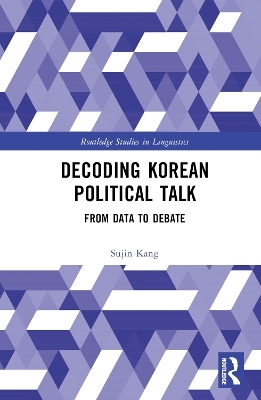
Decoding Korean Political Talk
Routledge (Verlag)
978-1-032-73726-3 (ISBN)
This book offers an illuminating exploration into the complex world of political communication in South Korea from 2016 to 2021.
Through an in-depth analysis of 34 political conversations totalling over 275 hours, this book presents a groundbreaking interdisciplinary study combining quantitative and qualitative methods. It delves into the intricate design and strategic use of questions and answers in political dialogue, shedding light on the underlying rhetoric, strategy, and power dynamics. By examining the seismic shifts in South Korea's political landscape, including a major political scandal, the impeachment of the president, North–South relations, and the COVID-19 pandemic, this work presents a unique perspective on how political conversations shape, and are shaped by, societal and global events. It is a vital contribution to the study of Korean linguistics, offering tools and frameworks for analyzing political dialogue in a political setting.
An indispensable resource for scholars and students in the fields of linguistics, political science, communication studies, and Asian studies, as well as political enthusiasts and professionals engaged in diplomatic and governmental sectors. It offers readers insights into the nuanced strategies of political discourse, enhancing their understanding of how language shapes politics and vice versa.
Sujin Kang is an AI prompt engineer based in South Korea. She holds both a PhD and MA in Korean Linguistics from the University of Hawaii at Manoa. Specializing in interactional linguistics and conversation analysis, her expertise lies at the intersection of language and technology. Presently, her work involves engaging with large language models to enhance and refine the dynamics of AI-to-human interaction.
Table of Contents
Preface
Introduction
Chapter 1. Background
1. Historical Backdrop of Korean Politics and Political Talk
Context 2016–2021: Influences on Political Landscape
2016 President Park Geun-hye’s Impeachment and Political Hearing
2017 Presidential Election
2. Theoretical Foundations
2.1 Interactional Linguistics and Conversation Analysis
2.2. Previous CA Research: Language Dynamics in Institutional Settings
2.3. Previous Research on Korean Political Talk
2.4 Interrogative Structures in Korean Language
Part I. Setting the Stage
Chapter 2. The Power of Big Data Analytics: Collection, Understanding, and Analysis
1. The Benefits of Big Data Analytics
2. The Data
3. Counting Questions and Answers: Criteria and Analysis
4. A Hybrid Approach
5. Analytical Procedure
Chapter 3. Understanding Questions and Answers
1. Questions
1.1 Types of Questions and Their Social Actions
2. Answers
2.1 Response Design: Preferred and Dispreferred Responses
2.2 Repair
Part II. Findings
Chapter 4. Revelations From Big Data Analytics: Decoding Patterns and Insights
1. Decoding Political Discourse: A Text Mining Approach
1.1 The significance of Parts of Speech (POS)
1.2 The Prevalence of Verbs, Nouns, Adjectives, and Adverbs
2. Semantic Network Analysis
3. Sentiment Analysis
4. Exploring Questions: Grammatical Items for Forming Questions
4.1 Overt Interrogative Sentence Endings
4.2 Q-Words
4.3 Declarative Sentence Endings
5. Types of Questions and Their Frequency of Distribution
Chapter 5. Questions and Their Responses
1. Introduction
Section 1. Major Questions and Their Answers
5.1 Type A: Positive Polar Questions
5.2 The Most Frequent Polar Questions, -c(i)yo
5.3 Type B: Wh-Questions
5.4. Type C: Negative Questions
5.5 Conclusion
Section 2. Minor Questions and Their Answers
5.6 Type D: Rhetorical Questions
5.7 Type E: Declarative Questions
5.8 Type F: Alternative Questions
5.9 Conclusion
Chapter 6. Conclusion
1. Findings
2. Limitations and Further Studies
Appendix A: Transcription Conventions
Appendix B: Abbreviations
Index
| Erscheinungsdatum | 18.09.2024 |
|---|---|
| Reihe/Serie | Routledge Studies in Linguistics |
| Zusatzinfo | 12 Tables, black and white; 27 Line drawings, black and white; 15 Halftones, black and white; 42 Illustrations, black and white |
| Verlagsort | London |
| Sprache | englisch |
| Maße | 156 x 234 mm |
| Gewicht | 650 g |
| Themenwelt | Geisteswissenschaften ► Sprach- / Literaturwissenschaft ► Anglistik / Amerikanistik |
| Geisteswissenschaften ► Sprach- / Literaturwissenschaft ► Literaturwissenschaft | |
| Geisteswissenschaften ► Sprach- / Literaturwissenschaft ► Sprachwissenschaft | |
| Sozialwissenschaften ► Politik / Verwaltung | |
| Sozialwissenschaften ► Soziologie ► Spezielle Soziologien | |
| ISBN-10 | 1-032-73726-3 / 1032737263 |
| ISBN-13 | 978-1-032-73726-3 / 9781032737263 |
| Zustand | Neuware |
| Informationen gemäß Produktsicherheitsverordnung (GPSR) | |
| Haben Sie eine Frage zum Produkt? |
aus dem Bereich