


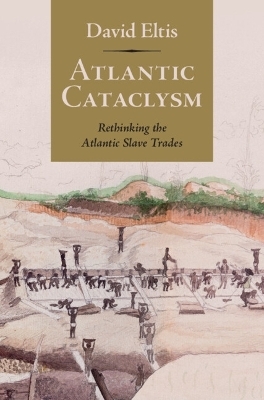
Atlantic Cataclysm
Rethinking the Atlantic Slave Trades
Seiten
2025
Cambridge University Press (Verlag)
978-1-009-51897-0 (ISBN)
Cambridge University Press (Verlag)
978-1-009-51897-0 (ISBN)
The book offers a new interpretation of why the slave trades (transatlantic as well as intra-American) began and ended, questioning the established narratives. A comprehensive and major work for scholars and students that should transform our assessment of the history of the Atlantic World.
In this comprehensive work, David Eltis offers a two-thousand-year perspective on the trafficking of people, and boldly intervenes in the expansive discussions about slavery in the last half-century. Using new and underexplored data made available by slavevoyages.org, Eltis offers compelling explanations of why the slave trades began and why they ended, and in the process debunks long-held assumptions, including how bilateral rather than triangular voyages were the norm, and how the Portuguese rather than the British were the leading slave traders. Eltis argues that two-thirds of all enslaved people ended up in the Iberian Americas, where exports were most valuable throughout the slave trade era, and not in the Caribbean or the US. Tracing the mass involvement of people in the slave trade business from all parts of the Atlantic World, Eltis also examines the agency of Africans and their experiences in the aftermath of liberation.
In this comprehensive work, David Eltis offers a two-thousand-year perspective on the trafficking of people, and boldly intervenes in the expansive discussions about slavery in the last half-century. Using new and underexplored data made available by slavevoyages.org, Eltis offers compelling explanations of why the slave trades began and why they ended, and in the process debunks long-held assumptions, including how bilateral rather than triangular voyages were the norm, and how the Portuguese rather than the British were the leading slave traders. Eltis argues that two-thirds of all enslaved people ended up in the Iberian Americas, where exports were most valuable throughout the slave trade era, and not in the Caribbean or the US. Tracing the mass involvement of people in the slave trade business from all parts of the Atlantic World, Eltis also examines the agency of Africans and their experiences in the aftermath of liberation.
David Eltis is Professor Emeritus at Emory University and the University of British Columbia. He is a founding member of www.slavevoyages.org, a publicly accessible transatlantic slave trade database. His three sole authored books have won twelve prizes, including the Frederick Douglass Prize.
Preface; 1. Atlantic slave trading and world history; 2. The Americas and Atlantic slave trading: the Iberians and the rest; 3. Europe and Atlantic slave trading; 4. The Portuguese system; 5. Africa, Africans, and the slave trade; 6. Abolition: metropolitan reservations, peripheral pressure; 7. Freedom?; Conclusion; Index.
| Erscheinungsdatum | 04.04.2025 |
|---|---|
| Zusatzinfo | Worked examples or Exercises |
| Verlagsort | Cambridge |
| Sprache | englisch |
| Maße | 162 x 236 mm |
| Gewicht | 730 g |
| Themenwelt | Geisteswissenschaften ► Geschichte ► Allgemeine Geschichte |
| Geisteswissenschaften ► Geschichte ► Regional- / Ländergeschichte | |
| ISBN-10 | 1-009-51897-6 / 1009518976 |
| ISBN-13 | 978-1-009-51897-0 / 9781009518970 |
| Zustand | Neuware |
| Informationen gemäß Produktsicherheitsverordnung (GPSR) | |
| Haben Sie eine Frage zum Produkt? |
Mehr entdecken
aus dem Bereich



aus dem Bereich
eine Reise um die Welt zu außergewöhnlichen Persönlichkeiten, …
Buch | Softcover (2023)
Piper (Verlag)
CHF 25,20
Eine wahre Geschichte von Schiffbruch, Mord und Meuterei
Buch | Hardcover (2024)
C.Bertelsmann (Verlag)
CHF 34,95


