


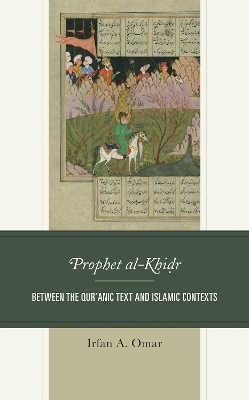
Prophet al-Khidr
Between the Qur'anic Text and Islamic Contexts
Seiten
2024
Lexington Books (Verlag)
978-1-4985-9593-3 (ISBN)
Lexington Books (Verlag)
978-1-4985-9593-3 (ISBN)
This work situates the Qur’anic story of Moses’ meeting with Khiḍr (Sūrat al-Kahf, 18:60-82) in an ever-expanding network of intercultural and interreligious ideas about knowledge, humility, and spiritual excellence, where Moses and Khiḍr are seen as representing the ẓāhir (exoteric) and the bāṭin (esoteric), respectively.
The Qur’anic verses 18:60–82 in Surat al-Kahf present the story of Khi?r and Moses as a lesson on the modalities of being and of knowing. Traditionally, the story is seen from a variety of vantage points that include historical, textual, literary, and allegorical, each of which is framed differently depending on the religio-cultural context. This book, in addition to examining the theological sources, traces the story’s mythical, mystical, and popular interpretations engendered by the Qur’anic story. The author argues that the story’s major contribution is its ability to communicate the importance of cultivating humility—a fundamental goal for any person of faith. Despite his importance in the Qur’an, Moses is not the main hero in this story; instead, he is used to point to an even higher truth pertaining to the spiritual dimensions of faith. This book suggests that Khi?r’s Qur’anic story symbolizes these truths by providing a perspective on the tension between materiality and spirituality, the ?ahir (exoteric) and the ba?in (esoteric), and human and divine forms of knowledge. Additionally, in this work, the Khi?r narrative is viewed as a source of nourishment for theories that speak to the intersectionality between Islam and other religious traditions.
The Qur’anic verses 18:60–82 in Surat al-Kahf present the story of Khi?r and Moses as a lesson on the modalities of being and of knowing. Traditionally, the story is seen from a variety of vantage points that include historical, textual, literary, and allegorical, each of which is framed differently depending on the religio-cultural context. This book, in addition to examining the theological sources, traces the story’s mythical, mystical, and popular interpretations engendered by the Qur’anic story. The author argues that the story’s major contribution is its ability to communicate the importance of cultivating humility—a fundamental goal for any person of faith. Despite his importance in the Qur’an, Moses is not the main hero in this story; instead, he is used to point to an even higher truth pertaining to the spiritual dimensions of faith. This book suggests that Khi?r’s Qur’anic story symbolizes these truths by providing a perspective on the tension between materiality and spirituality, the ?ahir (exoteric) and the ba?in (esoteric), and human and divine forms of knowledge. Additionally, in this work, the Khi?r narrative is viewed as a source of nourishment for theories that speak to the intersectionality between Islam and other religious traditions.
Irfan A. Omar is associate professor in the Department of Theology at Marquette University.
Introduction
Chapter 1: The Origins and Meanings of the Khi?r Story
Chapter 2: Khi?r in Muslim Sources and Traditions of Piety
Chapter 3: Khi?r in Sufism
Chapter 4: Khi?r in Folklore
Chapter 5: Khi?r in Mu?ammad Iqbal’s Poetry
Conclusion
Works Cited
Index
| Erscheinungsdatum | 02.04.2024 |
|---|---|
| Sprache | englisch |
| Maße | 150 x 228 mm |
| Gewicht | 249 g |
| Themenwelt | Geisteswissenschaften ► Religion / Theologie ► Islam |
| ISBN-10 | 1-4985-9593-6 / 1498595936 |
| ISBN-13 | 978-1-4985-9593-3 / 9781498595933 |
| Zustand | Neuware |
| Informationen gemäß Produktsicherheitsverordnung (GPSR) | |
| Haben Sie eine Frage zum Produkt? |
Mehr entdecken
aus dem Bereich


aus dem Bereich


