


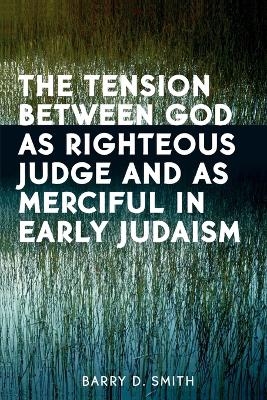
The Tension Between God as Righteous Judge and as Merciful in Early Judaism
Seiten
2005
University Press of America (Verlag)
978-0-7618-3088-7 (ISBN)
University Press of America (Verlag)
978-0-7618-3088-7 (ISBN)
In recent years, the scholarly consensus has emerged that early Judaism should no longer be classified as a religion of legalistic works-righteousness, but defined primarily by God's covenant with Israel. In this work, it is argued, instead, that there is actually a tension in early Judaism between God as righteous judge and as merciful.
In recent years, the scholarly consensus has emerged that early Judaism should no longer be classified as a religion of legalistic works on righteousness, but rather defined primarily by God's covenant with Israel. In this work, it is argued, instead, that there is actually a tension in early Judaism between God as righteous judge and as merciful. As E. Sjöberg maintained in his Gott und Sünder im palästinischen Judentum, in the sources used for a reconstruction of early Judaism, there are two mutually exclusive ways in which God is said to relate to human beings. First, God as righteous judge deals with human beings as they deserve. They are assumed to be morally free and responsible, and God judges and recompenses them in history and eschatologically. Not only are the wicked punished for their sins, but the righteous are also rewarded for their obedience. And second, God as merciful does not deal with human beings as they deserve. Rather, he removes the guilt resulting from disobedience to the Law, sometimes on the simple condition of repentance. This means that a person can escape the consequences of disobedience. The understanding of God in the sources vacillates between God as righteous judge and God as merciful, without coming down definitively on one side to the exclusion of the other.
In recent years, the scholarly consensus has emerged that early Judaism should no longer be classified as a religion of legalistic works on righteousness, but rather defined primarily by God's covenant with Israel. In this work, it is argued, instead, that there is actually a tension in early Judaism between God as righteous judge and as merciful. As E. Sjöberg maintained in his Gott und Sünder im palästinischen Judentum, in the sources used for a reconstruction of early Judaism, there are two mutually exclusive ways in which God is said to relate to human beings. First, God as righteous judge deals with human beings as they deserve. They are assumed to be morally free and responsible, and God judges and recompenses them in history and eschatologically. Not only are the wicked punished for their sins, but the righteous are also rewarded for their obedience. And second, God as merciful does not deal with human beings as they deserve. Rather, he removes the guilt resulting from disobedience to the Law, sometimes on the simple condition of repentance. This means that a person can escape the consequences of disobedience. The understanding of God in the sources vacillates between God as righteous judge and God as merciful, without coming down definitively on one side to the exclusion of the other.
Barry D. Smith is Associate Professor of Religious Studies and Philosophy at Atlantic Baptist University, Moncton, New Brunswick, Canada. Professor Smith holds a Ph.D. in Religious Studies from McMaster University.
Chapter 1 Preface
Chapter 2 Abbreviations
Chapter 3 Introduction
Chapter 4 God as Righteous Judge and as Merciful in Non-Sectarian Literature from Second-Temple Period
Chapter 5 God as Righteous Judge and as Merciful in Qumran Sectarian Literature
Chapter 6 Early Rabbinic Literature
Chapter 7 Conclusion
Chapter 8 Bibliography
Chapter 9 Index of References
Chapter 10 Author Biographical Sketch
| Erscheint lt. Verlag | 4.6.2005 |
|---|---|
| Verlagsort | Lanham, MD |
| Sprache | englisch |
| Maße | 161 x 226 mm |
| Gewicht | 594 g |
| Themenwelt | Sonstiges ► Geschenkbücher |
| Geisteswissenschaften ► Religion / Theologie ► Judentum | |
| ISBN-10 | 0-7618-3088-X / 076183088X |
| ISBN-13 | 978-0-7618-3088-7 / 9780761830887 |
| Zustand | Neuware |
| Informationen gemäß Produktsicherheitsverordnung (GPSR) | |
| Haben Sie eine Frage zum Produkt? |
Mehr entdecken
aus dem Bereich

aus dem Bereich


