


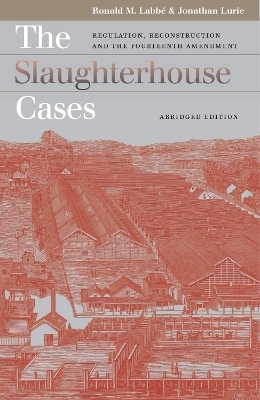
The Slaughterhouse Cases
Regulation, Reconstruction, and the Fourteenth Amendment
Seiten
2005
|
Abridged Edition
University Press of Kansas (Verlag)
978-0-7006-1409-7 (ISBN)
University Press of Kansas (Verlag)
978-0-7006-1409-7 (ISBN)
The Fourteenth Amendment to the Constitution, ratified in 1868, sought to protect the rights of the newly freed slaves; but its first important test - centered on a vitriolic dispute among the white butchers of mid-Reconstruction New Orleans - did not arise until five years later. This is a guide to one of the US Supreme Court's most famous cases.
The Fourteenth Amendment to the Constitution, ratified in 1868, sought to protect the rights of the newly freed slaves; but its first important test did not arise until five years later. That test centered on a vitriolic dispute among the white butchers of mid-Reconstruction New Orleans. The rough-and-tumble world of nineteenth-century New Orleans was a sanitation nightmare, with the city's slaughterhouses dumping animal remains into local backwaters. When Louisiana authorized a monopoly slaughterhouse to bring about sanitation reform, many independent butchers felt disenfranchised. Framing their case as an infringement of rights protected by the new amendment, they flooded the lower courts with nearly 300 suits. The surviving cases that reached the U.S. Supreme Court pitted the butchers' right to labor against the state's ""police power"" to regulate public health. The result was a controversial decision that for the first time addressed the meaning and import of the Fourteenth Amendment. Speaking for the majority in the Court's 5-4 decision, Justice Samuel F. Miller upheld the state's actions as a fair use of its ""police power."" He also argued that the Fourteenth Amendment was intended exclusively as a means of protecting and redressing the suffering of former slaves. The result was a very restricted interpretation of the amendment's ""privileges and immunities,"" ""due process,"" and ""equal protection"" clauses. In striking contrast, the minority, led by Justices Stephen Field and Joseph Bradley, claimed that the Fourteenth Amendment had been intended to apply to all Americans, not just former slaves, and therefore protected the butchers' right to labor in their chosen profession. Engagingly written and concisely crafted for students and general readers, this newly abridged edition provides a very accessible guide to one of the Supreme Court's most famous cases.
The Fourteenth Amendment to the Constitution, ratified in 1868, sought to protect the rights of the newly freed slaves; but its first important test did not arise until five years later. That test centered on a vitriolic dispute among the white butchers of mid-Reconstruction New Orleans. The rough-and-tumble world of nineteenth-century New Orleans was a sanitation nightmare, with the city's slaughterhouses dumping animal remains into local backwaters. When Louisiana authorized a monopoly slaughterhouse to bring about sanitation reform, many independent butchers felt disenfranchised. Framing their case as an infringement of rights protected by the new amendment, they flooded the lower courts with nearly 300 suits. The surviving cases that reached the U.S. Supreme Court pitted the butchers' right to labor against the state's ""police power"" to regulate public health. The result was a controversial decision that for the first time addressed the meaning and import of the Fourteenth Amendment. Speaking for the majority in the Court's 5-4 decision, Justice Samuel F. Miller upheld the state's actions as a fair use of its ""police power."" He also argued that the Fourteenth Amendment was intended exclusively as a means of protecting and redressing the suffering of former slaves. The result was a very restricted interpretation of the amendment's ""privileges and immunities,"" ""due process,"" and ""equal protection"" clauses. In striking contrast, the minority, led by Justices Stephen Field and Joseph Bradley, claimed that the Fourteenth Amendment had been intended to apply to all Americans, not just former slaves, and therefore protected the butchers' right to labor in their chosen profession. Engagingly written and concisely crafted for students and general readers, this newly abridged edition provides a very accessible guide to one of the Supreme Court's most famous cases.
Ronald M. Labbe is professor emeritus of political science at the University of Louisiana at Lafayette. Jonathan Lurie is professor of history and adjunct professor of law at Rutgers University. Labbe and Lurie received the prestigious Scribes Book Award given by the American Society for Legal Writers for the original edition of this book.
| Erscheint lt. Verlag | 31.10.2005 |
|---|---|
| Reihe/Serie | Landmark Law Cases and American Society |
| Verlagsort | Kansas |
| Sprache | englisch |
| Maße | 154 x 216 mm |
| Gewicht | 300 g |
| Themenwelt | Geschichte ► Allgemeine Geschichte ► Neuzeit (bis 1918) |
| Geisteswissenschaften ► Geschichte ► Regional- / Ländergeschichte | |
| Recht / Steuern ► EU / Internationales Recht | |
| Recht / Steuern ► Öffentliches Recht | |
| Sozialwissenschaften ► Politik / Verwaltung ► Staat / Verwaltung | |
| ISBN-10 | 0-7006-1409-5 / 0700614095 |
| ISBN-13 | 978-0-7006-1409-7 / 9780700614097 |
| Zustand | Neuware |
| Informationen gemäß Produktsicherheitsverordnung (GPSR) | |
| Haben Sie eine Frage zum Produkt? |
Mehr entdecken
aus dem Bereich


aus dem Bereich
Geschichte einer wilden Handlung
Buch | Hardcover (2024)
C.H.Beck (Verlag)
CHF 47,60


