


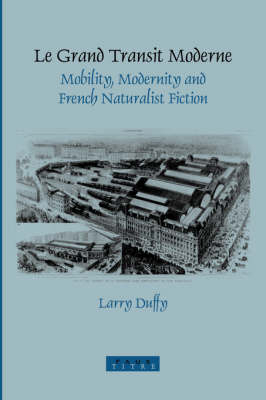
Le Grand Transit Moderne
Mobility, Modernity and French Naturalist Fiction
Seiten
2005
Editions Rodopi B.V. (Verlag)
978-90-420-1815-0 (ISBN)
Editions Rodopi B.V. (Verlag)
978-90-420-1815-0 (ISBN)
- Keine Verlagsinformationen verfügbar
- Artikel merken
Exploring the fictional responses to the changing transport and urban infrastructure of nineteenth-century France, this book argues that networks of movement constitute a privileged subject for representation. It also examines literary representations of conceptualisations of movement, principally in works by Flaubert, Zola, and Maupassant.
This book explores fictional responses to the changing transport and urban infrastructure of nineteenth-century France, arguing that networks of movement (and an accompanying ‘culture of networks’) which had become firmly established by the time of the Second Empire constitute a privileged subject for representation, and that naturalist fiction in particular is that representation’s privileged form. Contextualizing the study’s critical focus by way of a brief historical outline of the development of infrastructural networks in nineteenth-century France and a delineation of the problematical parameters of French naturalism, Duffy examines literary representations of new forms and conceptualisations of movement, principally in works by Flaubert, Zola, and Maupassant. Other authors discussed include the Goncourt brothers, Huysmans, Baudelaire and Claretie. Literary texts are examined alongside a range of related scientific, sociological and medical texts. What emerges strikingly from consideration of these works and the discourses they – often subversively – incorporate, is that movement, central to nineteenth-century industrial society’s view of itself, is frequently perceived and presented self-deludingly in the idealised metaphorical terms of smoothly-functioning systems of perpetual motion, and that naturalist fiction, by exploiting to their full potential the same metaphors in its narratives, challenges this ‘anti-entropic’ vision.
This book explores fictional responses to the changing transport and urban infrastructure of nineteenth-century France, arguing that networks of movement (and an accompanying ‘culture of networks’) which had become firmly established by the time of the Second Empire constitute a privileged subject for representation, and that naturalist fiction in particular is that representation’s privileged form. Contextualizing the study’s critical focus by way of a brief historical outline of the development of infrastructural networks in nineteenth-century France and a delineation of the problematical parameters of French naturalism, Duffy examines literary representations of new forms and conceptualisations of movement, principally in works by Flaubert, Zola, and Maupassant. Other authors discussed include the Goncourt brothers, Huysmans, Baudelaire and Claretie. Literary texts are examined alongside a range of related scientific, sociological and medical texts. What emerges strikingly from consideration of these works and the discourses they – often subversively – incorporate, is that movement, central to nineteenth-century industrial society’s view of itself, is frequently perceived and presented self-deludingly in the idealised metaphorical terms of smoothly-functioning systems of perpetual motion, and that naturalist fiction, by exploiting to their full potential the same metaphors in its narratives, challenges this ‘anti-entropic’ vision.
Acknowledgments
Author’s Note
Introduction: ‘Le Grand Transit Moderne’
Chapter 1 A Complex Kind of Training : L’Éducation sentimentale, Modernity, and the Changing Phenomenology of Motion
Chapter 2 An Evolutionary Naturalist Intertext: The Traffic Jam as Exemplary Taxonomic Motif
Chapter 3 Haussmannization, Circulation and the Ideal City of Au Bonheur des Dames
Chapter 4 Convulsions, Détraquement and the Circulus: Zola’s Dehystericisation of Prostitution
Chapter 5 Beyond the Pressure Principle: Bestialisation, Anthropomorphism and the ‘Thermodynamic’ Death Instinct in Naturalist Fiction
Chapter 6 Maupassant, Doxa and the Banalisation of Modern Travel
Conclusion: ‘Ce Parasite Supplémentaire’
Bibliography
Index
| Reihe/Serie | Faux Titre ; 260 |
|---|---|
| Verlagsort | Leiden |
| Sprache | englisch; französisch |
| Maße | 150 x 220 mm |
| Gewicht | 555 g |
| Themenwelt | Geisteswissenschaften ► Sprach- / Literaturwissenschaft ► Anglistik / Amerikanistik |
| Geisteswissenschaften ► Sprach- / Literaturwissenschaft ► Literaturgeschichte | |
| Geisteswissenschaften ► Sprach- / Literaturwissenschaft ► Literaturwissenschaft | |
| ISBN-10 | 90-420-1815-1 / 9042018151 |
| ISBN-13 | 978-90-420-1815-0 / 9789042018150 |
| Zustand | Neuware |
| Informationen gemäß Produktsicherheitsverordnung (GPSR) | |
| Haben Sie eine Frage zum Produkt? |
Mehr entdecken
aus dem Bereich


aus dem Bereich
Poetik eines sozialen Urteils
Buch | Hardcover (2023)
De Gruyter (Verlag)
CHF 83,90


