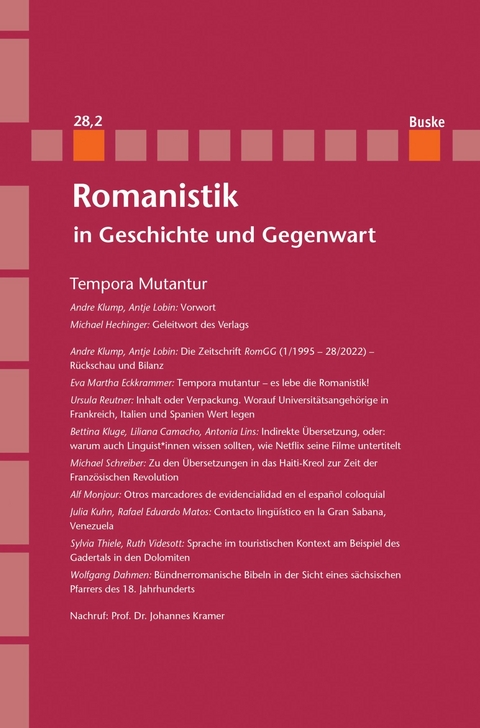
Romanistik in Geschichte und Gegenwart Jahrgang 28 Heft 2 (eBook)
112 Seiten
Helmut Buske Verlag
978-3-96769-418-5 (ISBN)
Hechinger, Michael: Geleitwort des Verlags.
Klump, Andre; Lobin, Antje: Die Zeitschrift RomGG (1/1995 – 28/2022) – Rückschau und Bilanz.
Eckkrammer, Eva Martha: Tempora mutantur – es lebe die Romanistik!.
La réforme de Bologne a profondément modifié la romanistique, ne serait-ce qu'en raison de la nécessité d'atteindre en peu de temps un niveau très élevé dans plusieurs langues, car un tel niveau est indispensable pour les orientations scientifiques de la discipline, à savoir la linguistique, la littérature, la culture, les sciences des médias et la didactique. En même temps, l'activité scientifique internationale semble contraindre la discipline à des changements, notamment en ce qui concerne l'utilisation de différentes langues scientifiques et une discipline au coeur de laquelle se trouve la comparaison depuis sa création. L'article explore, sur fond de défis actuels, différentes possibilités d'adaptation et d'actualisation et conclut positivement que l'actualité et la capacité d'adaptation des études romanes restent intactes.
Reutner, Ursula: Inhalt oder Verpackung. Worauf Universitätsangehörige in Frankreich, Italien und Spanien Wert legen.
Content or packaging? The article examines which of the two is more important to scholars in their academic writing. It is based on the results of a survey of linguists working in France, Italy, and Spain. According to their statements, style plays a fundamental role for them: most of them report making a stylistic distinction between their oral and written communication, and some also reveal having sought stylistic models in their teachers at the beginning of their careers. Almost all state that they pay attention to stylistic issues while editing and set aside a period for stylistic revision after having finished. Although semantic precision tends to be weighted higher than aesthetics and elegance, pure content is not all that matters to them. Particularly in Italy, many of the surveyed also see academics as artists of their language. The value attributed to packaging is especially pronounced in Italy and Spain, while clearness is weighted somewhat higher in France. Overall, style is gaining importance if defined as an internationally accepted wording and organization of knowledge. In times of artificial intelligence and standardized procedures for being accepted by international journals, this style can easily be produced and is not insignificant in the dissemination of one's research. At the same time, however, style varies less between authors and is, therefore, losing its importance if defined as an individual feature, including idiosyncrasies.
Kluge, Bettina; Camacho, Liliana; Lins, Antonia: Indirekte Übersetzung, oder: warum auch Linguist*innen wissen sollten, wie Netflix seine Filme untertitelt.
La traducción indirecta es una práctica milenaria y común, aunque muy tabuizada. En vez de traducir directamente de la lengua de partida a la lengua meta, se interpone una lengua de relevo o pivote. Esta práctica permite traducciones entre lenguas aún si escasean personas con competencias adecuadas de traducción, o también al haberse perdido la obra original – y obviamente, esta práctica puede ahorrar tanto tiempo como dinero. Sin embargo, las desventajas son claras: se multiplica el peligro de perder el sentido lingüístico original. En este artículo, tratamos la traducción indirecta de productos audiovisuales, cuyo uso ha aumentado considerablemente en los últimos años, sobre todo debido al éxito de las plataformas de streaming, tal como Netflix, Amazon y Disney+. El siguiente artículo esboza, en primer lugar, la práctica de la traducción indirecta en el caso especial de la subtitulación. Es necesario abordar brevemente otras tendencias en la práctica contemporánea de la traducción audiovisual (TAV), como la introducción de plantillas.
| Erscheint lt. Verlag | 5.3.2024 |
|---|---|
| Reihe/Serie | Romanistik in Geschichte und Gegenwart |
| Co-Autor | Andre Klump, Antje Lobin, Eva Martha Eckkrammer, Ursula Reutner, Bettina Kluge, Liliana Camacho, Antonia Lins, Michael Schreiber, Alf Monjour, Julia Kuhn, Rafael Eduardo Matos, Sylvia Thiele, Ruth Videsott, Wolfgang Dahmen |
| Verlagsort | Hamburg |
| Sprache | deutsch |
| Themenwelt | Geisteswissenschaften ► Sprach- / Literaturwissenschaft ► Romanistik |
| Schlagworte | Französisch • Romania • Romanistik • Spanisch |
| ISBN-10 | 3-96769-418-6 / 3967694186 |
| ISBN-13 | 978-3-96769-418-5 / 9783967694185 |
| Informationen gemäß Produktsicherheitsverordnung (GPSR) | |
| Haben Sie eine Frage zum Produkt? |
 PDF (Wasserzeichen)
DRM: Digitales Wasserzeichen
Dieses eBook enthält ein digitales Wasserzeichen und ist damit für Sie personalisiert. Bei einer missbräuchlichen Weitergabe des eBooks an Dritte ist eine Rückverfolgung an die Quelle möglich.
Dateiformat: PDF (Portable Document Format)
Mit einem festen Seitenlayout eignet sich die PDF besonders für Fachbücher mit Spalten, Tabellen und Abbildungen. Eine PDF kann auf fast allen Geräten angezeigt werden, ist aber für kleine Displays (Smartphone, eReader) nur eingeschränkt geeignet.
Systemvoraussetzungen:
PC/Mac: Mit einem PC oder Mac können Sie dieses eBook lesen. Sie benötigen dafür einen PDF-Viewer - z.B. den Adobe Reader oder Adobe Digital Editions.
eReader: Dieses eBook kann mit (fast) allen eBook-Readern gelesen werden. Mit dem amazon-Kindle ist es aber nicht kompatibel.
Smartphone/Tablet: Egal ob Apple oder Android, dieses eBook können Sie lesen. Sie benötigen dafür einen PDF-Viewer - z.B. die kostenlose Adobe Digital Editions-App.
Buying eBooks from abroad
For tax law reasons we can sell eBooks just within Germany and Switzerland. Regrettably we cannot fulfill eBook-orders from other countries.
aus dem Bereich