


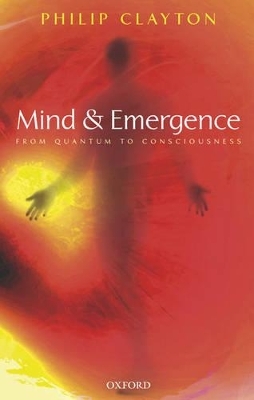
Mind and Emergence
From Quantum to Consciousness
Seiten
2004
Oxford University Press (Verlag)
978-0-19-927252-5 (ISBN)
Oxford University Press (Verlag)
978-0-19-927252-5 (ISBN)
- Titel ist leider vergriffen;
keine Neuauflage - Artikel merken
Clayton introduces the non-expert to emergence theory. Emergence is based on the recognition that the world continually produces new patterns, new structures, and new types of causal forces. He discusses if a transcendent force is luring the natural world toward higher forms of existence, or if natural forces are producing more complex phenomena.
Strong claims have been made for emergence as a new paradigm for understanding science, consciousness, and religion. Tracing the past history and current definitions of the concept, Clayton assesses the case for emergent phenomena in the natural world and their significance for philosophy and theology. Complex emergent phenomena require irreducible levels of explanation in physics, chemistry and biology. This pattern of emergence suggests a new approach to the problem of consciousness, which is neither reducible to brain states nor proof of a mental substance or soul. Although emergence does not entail classical theism, it is compatible with a variety of religious positions. Clayton concludes with a defence of emergentist panentheism and a Christian constructive theology consistent with the new sciences of emergence.
Strong claims have been made for emergence as a new paradigm for understanding science, consciousness, and religion. Tracing the past history and current definitions of the concept, Clayton assesses the case for emergent phenomena in the natural world and their significance for philosophy and theology. Complex emergent phenomena require irreducible levels of explanation in physics, chemistry and biology. This pattern of emergence suggests a new approach to the problem of consciousness, which is neither reducible to brain states nor proof of a mental substance or soul. Although emergence does not entail classical theism, it is compatible with a variety of religious positions. Clayton concludes with a defence of emergentist panentheism and a Christian constructive theology consistent with the new sciences of emergence.
Philip Clayton is Ingraham Professor, Claremont School of Theology; Professor of Philosophy and of Religion, Claremont Graduate University.
1. From Reduction to Emergence; 2. Defining Emergence; 3. Emergence in the Natural Sciences; 4. Emergence and Mind; 5. Emergence and Transcendence
| Erscheint lt. Verlag | 1.11.2004 |
|---|---|
| Zusatzinfo | numerous line drawings |
| Verlagsort | Oxford |
| Sprache | englisch |
| Gewicht | 414 g |
| Themenwelt | Geisteswissenschaften ► Philosophie ► Philosophie der Neuzeit |
| Geisteswissenschaften ► Psychologie ► Allgemeine Psychologie | |
| Geisteswissenschaften ► Psychologie ► Verhaltenstherapie | |
| ISBN-10 | 0-19-927252-2 / 0199272522 |
| ISBN-13 | 978-0-19-927252-5 / 9780199272525 |
| Zustand | Neuware |
| Informationen gemäß Produktsicherheitsverordnung (GPSR) | |
| Haben Sie eine Frage zum Produkt? |
Mehr entdecken
aus dem Bereich



aus dem Bereich
ein Dialog mit Simone Weil
Buch | Softcover (2025)
Matthes & Seitz Berlin (Verlag)
CHF 19,55


