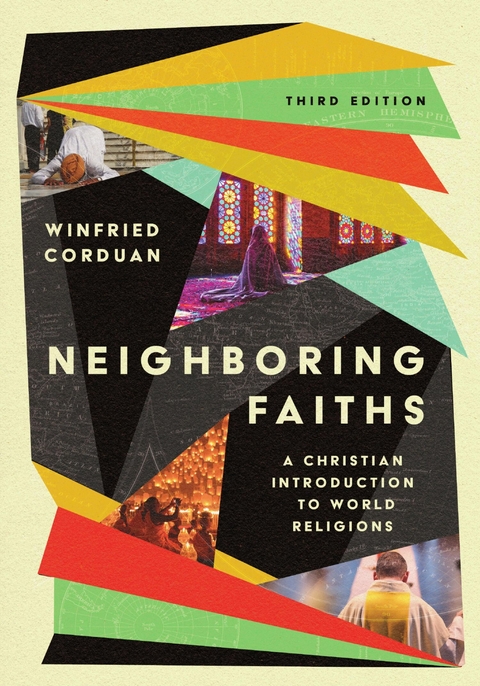
Winfried Corduan (Ph.D., Rice University) is professor of philosophy and religion at Taylor University, Upland, Indiana. He has led many undergraduate tours focusing on the lived religious traditions of various parts of the world and is the author of the textbook on world religions Neighboring Faiths.
World religions are not merely abstract sets of doctrinal beliefs. They are embodied worldviews and practices lived out by real people around us. Encounters with these neighboring faiths often challenge our own beliefs and traditions, making us think more deeply about our faith commitments. For all who want to understand the religious faiths of their neighbors, Winfried Corduan offers an introduction to the religions of the world. This classic text covers major as well as lesser known religions, including Judaism, Islam, Zoroastrianism, African traditional religions, Native American religion, Hinduism, Buddhism, Jainism, Sikhism, Baha'i, Chinese popular religion, and Shinto and Japanese religions. Neighboring Faiths emphasizes not just formal religious teachings but also how each religion is practiced in daily life. Dozens of photographs, charts, and maps help illustrate how the faiths have developed and how they're lived out today. Corduan offers specific insights into what to expect from encounters with adherents of each religion and suggestions for how Christians can engage them in constructive dialogue. Each chapter offers lists of key points, ideas for term papers, and recommended resources to help students, instructors, and small groups go deeper.This third edition has been updated and revised throughout. The chapter on militant Islam is significantly revised to address more recent events and issues, and questions for reflection and discussion have been added to each chapter. Neighboring Faiths is an indispensable guide for Christians seeking an informed, empathetic perspective on different religions and the people who practice them.
Winfried Corduan (PhD, Rice University) is professor emeritus of philosophy and religion at Taylor University. He has led many undergraduate tours focusing on the lived religious traditions of various parts of the world. He is the author of several books, including Reasonable Faith: Basic Christian Apologetics, A Tapestry of Faiths, and Pocket Guide to World Religions.
1
RELIGION
Study and Practice
World Population: 8 billion1
Professing Christians: 2.4 billion
Religious Non-Christians: 3.7 billion
SPENCER AND GILLEN
Figure 1.1. W. Baldwin Spencer
Figure 1.2. Frank J. Gillen
In 1899 two Australian explorers, W. Baldwin Spencer and Frank J. Gillen, published a book about their encounter with the Arrernte, a tribe in Australia, whose culture they considered to be so underdeveloped that they did not even have a religion.2 Many scholars were delighted to hear of their alleged discovery. They used it as evidence for the idea that religion is one of many aspects of human culture that evolved alongside material and intellectual growth. In order to evaluate Spencer and Gillen’s supposed discovery, we must first be clear on what we mean by religion.
WHAT IS RELIGION?
This introductory chapter will explore the meaning of religion in general and certain common aspects of religion. It raises the question of how religion originated by looking at two broad options: (1) religion as a part of human culture that evolved from the belief in ghosts and spirits and (2) religion based on the belief in one God who created the world and revealed himself. It will also identify a few attributes that seem to recur in many religious societies.
We can picture a Friday afternoon prayer service in a mosque—the house of worship of Islam. The men of the community have assembled and are sitting in loose rows on the rug-covered floor in front of a pulpit from which an imam preaches instructions on how to live a life that is pleasing to God. A number of women, though fewer than men, are sitting on a balcony, out of view of the men. At the end of the sermon all believers stand up, forming exact rows that face the niche at the front of the hall that points in the direction of Mecca. In unison they go through the prescribed postures of standing, bowing, and prostrating themselves as they recite their prayer of devotion. This picture confirms the common notion that religion focuses on the worship of God.
Now let us picture a Japanese Zen master addressing a group of American college students on a field trip. “Look beyond words and ideas,” he tells them. “Lay aside what you think you know about God; it can only mislead you. Accept life as it is. When it rains, I get wet. When I am hungry, I eat.” Is this religion?
Mary, an American college student, is not affiliated with any organized religion; in fact, she blames religion for much of what is wrong with the world today. But she is full of high ideals and has committed her life to the service of humanity. After graduation she plans to spend a few years in the Peace Corps and then reside in a poverty-stricken area of America where she can assist disadvantaged people in learning to lead a better life. In order to carry out this task to its fullest, Mary is already limiting her own personal belongings and is not planning to get married or raise a family. Could it be that, despite her assertion to the contrary, she is really practicing a religion?
Figure 1.3. Muslim prayer is directed to one God, a straightforward understanding of religion
You don’t have to be able to give a precise definition for a word to use it correctly and make yourself understood. Dictionaries typically provide several numbered meanings for a term, and religion is no exception. This fact does not mean that we do not have a fairly good idea of what people mean when they use the word “religion.” Our minds may immediately turn to ideas such as worship, gods, rituals, or ethics. It is extremely unlikely that anyone would associate religion with baseball, roast beef, or the classification of insects. However, in a case such as this one, when the very application of the term is disputed, it becomes necessary to delineate some boundaries to its meaning.
For example, a definition focusing on gods, spirits, and the supernatural may be too narrow. There are forms of Buddhism and Jainism (chapters ten and eleven, respectively) whose scriptures are downright hostile to the idea of a Creator God. Yet are we prepared to deny that Buddhism is a religion? I think not. One simple reason is that most people who call themselves Buddhists do, in fact, engage in activities that we would call “worship” or “veneration,” regardless of what the more abstractly inclined leadership may say. And even Zen, although it ultimately wants to go beyond gods and spirits, accepts them as populating the world from which we must liberate ourselves (see the section on Zen in chapter ten). What we call a religion in those cases is a large framework of beliefs that gives a person’s life meaning and purpose. Both Buddhism and Jainism, regardless of the relevance of spirit beings in their practice, still promote a certain view of the world and the human person’s place in it. So, a tentative definition could be, A religion is a set of core values or beliefs that provides meaning and coherence to a person’s life.
But is it legitimate to turn this assessment around and say that whenever people are committed to a set of core values that give their life meaning, they are practicing a religion? If so, then Mary, the woman who is devoting her life to the service of others, could conceivably be considered as an example of someone practicing a humanistic religion. However, a member of an organized crime group may also follow some values, albeit very different ones: money, domination, power, and so forth. Surely, we don’t want to call observing the standards of organized crime a “religion.” It does not follow from the fact that religion supplies core values that wherever there are core values, there must be a religion.
In order to qualify as religious, the core values may not just be a part of everyday life, such as accumulating a lot of money, even if they are an important part of someone’s life. I consider it to be important that I brush my teeth every day, but that fact does not make me an adherent of a tooth-brushing religion. Someone may focus his entire life on the pursuit of wealth, but metaphors notwithstanding, that fact does not imply that earning a lot of money is his religion; in fact, it would be rejected by many people as contrary to religion. Whatever the core values of everyday life may be, they cannot give meaning to life if they are just a part of life itself. In order to qualify as religious, the values originate beyond the details of ordinary life.
The feature of religion that directs us beyond the mundane is called transcendence. Transcendence can come to us in many different ways, through supernatural agencies or through metaphysical principles (for example, the “greatest good” or the “first cause”), an ideal, a place, or an awareness, to mention just some of the possibilities. Thus, the definition could become, A religion is a system of beliefs that directs a person toward transcendence and, thus, provides meaning and coherence to a person’s life.
And yet, this definition may still need refining. Let us return to Mary, our idealistic person, who is dedicating her life to the service of humanity. By her own statement, she does not want to be classified as religious, though, in the way that people talk today, she might be willing to accept the notion that, even though she is not religious, she exhibits a certain amount of “spirituality.”
Not too long ago, one would have been hard pressed to try to make such a distinction plausible. Doesn’t one have to be religious in order to be spiritual? How can it be possible to have faith without belonging to one of the traditional faiths? But those questions are no longer irrelevant, let alone meaningless. At least in a Western, English-speaking context, this distinction has become important. I remember not too long ago seeing an interview with a well-known actress on television, in which she declared that she was not religious, but that she believed in a deep spirituality, which became especially apparent to her as she gazed into the eyes of animals. (This book will not try to make sense out of such observations.)
So, to become a little bit more technical, what could be the difference between religion and “spirituality”? The answer is that religion also involves some external features, no matter how small, which have meaning only for the sake of the religious belief and would be unnecessary in other contexts. This factor is called the cultus of the religion. For example, contemporary Protestant Christianity in the United States is associated with a specific cultus. In general, believers gather on Sunday morning in especially designated buildings, sit on chairs or benches (rather than kneel), sing special songs either out of hymnals or as projected on a screen, pray with their eyes closed, and listen to a professional minister speak about a passage in their holy book, the Bible. These items are not meant to be obligatory or an exhaustive description, but they are typical for the American Protestant Christian cultus. The point is that religion comes with a cultus, whereas spirituality, as used today, is a purely...
| Erscheint lt. Verlag | 30.4.2024 |
|---|---|
| Verlagsort | Lisle |
| Sprache | englisch |
| Themenwelt | Geisteswissenschaften ► Religion / Theologie ► Christentum |
| Schlagworte | Apologetics • Baha'i • Buddhism • Chinese • Chinese popular religion • Christianity • Evangelism • Global • Hinduism • Interfaith • interfaith dialogu • Interreligious dialogue • Islam • Jainism • Judaism • Native American • Native American Religion • Practice • Professor • Religious Studies • school • Shinto • Sikhism • Student • Studies • Study • Survey • Textbook • World religions • Worldview • Zoroastrianism |
| ISBN-10 | 1-5140-0272-8 / 1514002728 |
| ISBN-13 | 978-1-5140-0272-8 / 9781514002728 |
| Informationen gemäß Produktsicherheitsverordnung (GPSR) | |
| Haben Sie eine Frage zum Produkt? |
 EPUB (Adobe DRM)
Kopierschutz: Adobe-DRM
Adobe-DRM ist ein Kopierschutz, der das eBook vor Mißbrauch schützen soll. Dabei wird das eBook bereits beim Download auf Ihre persönliche Adobe-ID autorisiert. Lesen können Sie das eBook dann nur auf den Geräten, welche ebenfalls auf Ihre Adobe-ID registriert sind.
Details zum Adobe-DRM
Dateiformat: EPUB (Electronic Publication)
EPUB ist ein offener Standard für eBooks und eignet sich besonders zur Darstellung von Belletristik und Sachbüchern. Der Fließtext wird dynamisch an die Display- und Schriftgröße angepasst. Auch für mobile Lesegeräte ist EPUB daher gut geeignet.
Systemvoraussetzungen:
PC/Mac: Mit einem PC oder Mac können Sie dieses eBook lesen. Sie benötigen eine
eReader: Dieses eBook kann mit (fast) allen eBook-Readern gelesen werden. Mit dem amazon-Kindle ist es aber nicht kompatibel.
Smartphone/Tablet: Egal ob Apple oder Android, dieses eBook können Sie lesen. Sie benötigen eine
Geräteliste und zusätzliche Hinweise
Buying eBooks from abroad
For tax law reasons we can sell eBooks just within Germany and Switzerland. Regrettably we cannot fulfill eBook-orders from other countries.
aus dem Bereich