


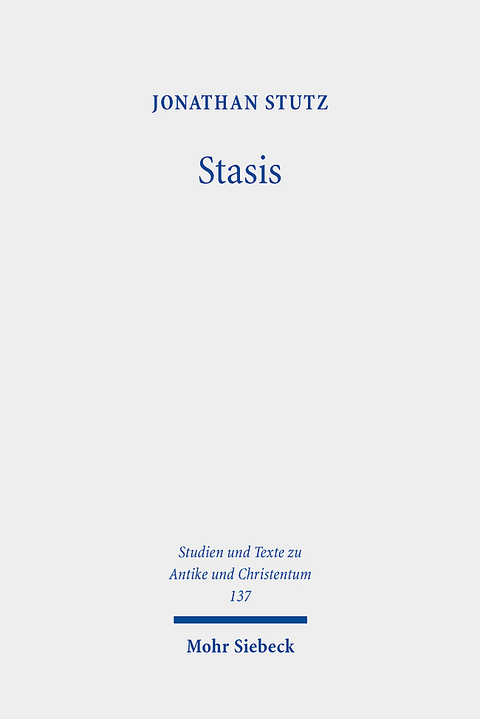
Stasis
Crowd Violence and Religious-Political Discourses in Late Antiquity
Seiten
Ausgehend von der Beobachtung, dass Gewaltepisoden gerade durch ihre mediale Darstellung und Diskursivierung historisch nachwirken, analysiert Jonathan Stutz die vielschichtigen Wechselwirkungen zwischen Rhetorik und Gewalt im frühen Christentum. Bekannte religiöse und politische Konflikte des vierten Jahrhunderts werden dabei mit Blick auf bestimmte rhetorische Praktiken und literarische Gattungen besprochen und neu beleuchtet.
Building on the premise that episodes of violence also manifest through texts and narratives that originated within specific communicative settings, Jonathan Stutz explores the manifold interconnections between (religious) violence and late antique rhetoric. By focusing the fourth century in particular, he addresses a period of time that was marked by profound political transformations and religious conflicts. The author delves into various examples where manifestations of collective violence became the object of strategies of legitimation and de-legitimation, as well as of moral and theological discourses. Throughout the different chapters, he examines how orations, homilies, letters, and polemical treatises provided a platform for emperors, rhetors, and Christian church leaders in their aim to define their own role and that of their interlocutors within the conflicts they witnessed.
Building on the premise that episodes of violence also manifest through texts and narratives that originated within specific communicative settings, Jonathan Stutz explores the manifold interconnections between (religious) violence and late antique rhetoric. By focusing the fourth century in particular, he addresses a period of time that was marked by profound political transformations and religious conflicts. The author delves into various examples where manifestations of collective violence became the object of strategies of legitimation and de-legitimation, as well as of moral and theological discourses. Throughout the different chapters, he examines how orations, homilies, letters, and polemical treatises provided a platform for emperors, rhetors, and Christian church leaders in their aim to define their own role and that of their interlocutors within the conflicts they witnessed.
Born 1986; 2016 PhD; Assistant at the Faculty for Protestant Theology at the Ludwig-Maximilians Universität in Munich; Visiting Professor at the department for Ancient Christianity at the Faculty of Theology at the Humboldt-Universität in Berlin.
| Erscheinungsdatum | 09.07.2024 |
|---|---|
| Reihe/Serie | Studien und Texte zu Antike und Christentum / Studies and Texts in Antiquity and Christianity |
| Verlagsort | Tübingen |
| Sprache | englisch |
| Maße | 156 x 233 mm |
| Gewicht | 236 g |
| Themenwelt | Religion / Theologie ► Christentum ► Kirchengeschichte |
| Schlagworte | Ancient Rhetoric • episcopal authority • Religious violence • Roman emperor |
| ISBN-10 | 3-16-162637-0 / 3161626370 |
| ISBN-13 | 978-3-16-162637-1 / 9783161626371 |
| Zustand | Neuware |
| Informationen gemäß Produktsicherheitsverordnung (GPSR) | |
| Haben Sie eine Frage zum Produkt? |
Mehr entdecken
aus dem Bereich

aus dem Bereich
eine andere Geschichte der Papststadt
Buch | Softcover (2024)
C.H.Beck (Verlag)
CHF 25,20
die Macht des Dunklen in unserer Zeit und wie wir ihr entgegentreten
Buch | Hardcover (2025)
Verlag Herder
CHF 27,90


