


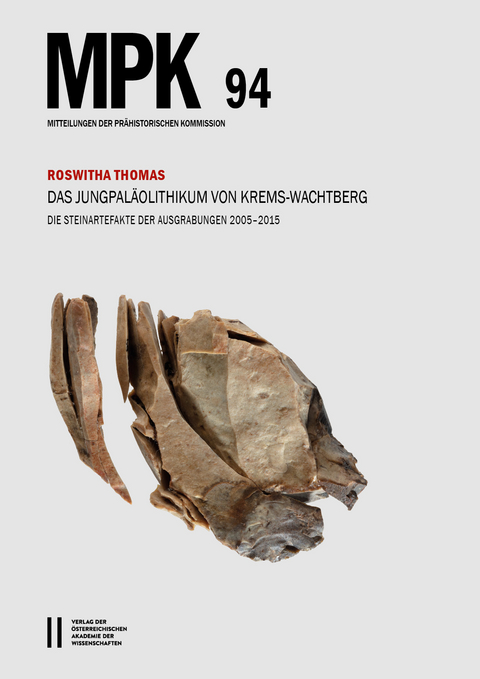
Das Jungpaläolithikum von Krems-Wachtberg
Die Steinartefakte der Ausgrabungen 2005—2015. Mit Beiträgen von Michael Brandl, Thomas Einwögerer und Ulrich Simon
Seiten
2024
Verlag der österreichischen Akademie der Wissenschaften
978-3-7001-9238-1 (ISBN)
Verlag der österreichischen Akademie der Wissenschaften
978-3-7001-9238-1 (ISBN)
- Titel nicht im Sortiment
- Artikel merken
The site of Krems-Wachtberg is one of the most important Palaeolithic open-air sites in Central Europe. Particularly noteworthy are the unique infant burials, as well as a complex multiphase hearth and various pits that characterise the well-preserved occupation horizon. The first volume of the final publication on the Gravettian site Krems-Wachtberg 2005-2015 presents the results of the examination of more than 44000 lithic artefacts.
The work focuses on the characterisation of the raw materials and their provenance, as well as techno-morphological analyses of the blanks and the modified tools. The lithic assemblage is evaluated according to its relevance for Krems-Wachtberg itself and correlated with materials from the wider archaeological landscape, i.e. other Paleolithic sites. Selected refittings and the spatial distribution of various stone artefacts are the foundation for reconstructing settlement structures, activities and formation processes of particular layers. The present work will allow future comparative studies with other Upper Paleolithic lithic assemblages.
Der Fundplatz Krems-Wachtberg zählt zu den bedeutendsten paläolithischen Freilandstationen Zentraleuropas. Die Bedeutung des Platzes beruht vor allem auf den einzigartigen Säuglingsbestattungen – einer Doppelbestattung von neugeborenen Zwillingen und einer Einzelbestattung – sowie dem gut erhaltenen Begehungshorizont mit einer zentral gelegenen, mehrphasigen Feuerstelle und verschiedenen Gruben. Diese Befunde sind Teil eines in situ-Horizontes innerhalb des mehrschichtigen Hauptfundhorizontes, dem Archäologischen Horizont AH 4, und können mit einem Alter von rund 33.000 Jahren ins ältere Gravettien datiert werden.
Der erste Band der Abschlusspublikation zum gravettienzeitlichen Fundplatz Krems-Wachtberg 2005–2015 ist der Gesamtvorlage der mehr als 44.000 lithischen Artefakte gewidmet, die sowohl die geschlagene als auch die nicht geschlagene Steinindustrie umfasst.
Schwerpunkte der Arbeit liegen auf der Bestimmung der Rohmaterialien und ihrer Provenienz, der Auswertung von techno-morphologischen Analysen der Grundformen (z. B. Kerne, Klingen, Abschläge und Präparationsformen) und der Werkzeuge (z. B. Kratzer, Stichel und Rückenmesser). Das lithische Inventar wird fundplatzintern verglichen und in Beziehung zu seinem archäologischen Umfeld gesetzt. Ausgesuchte Zusammenpassungen und verschiedene räumliche Verteilungen der Steinartefakte bilden die Grundlage für die Rekonstruktion von Siedlungsstrukturen, Siedlungsaktivitäten und die Fundschichtgenese. Ein ausführlicher Tafelteil unterstützt diese Darlegungen mit zahlreichen Zeichnungen und Fotos der Artefakte sowie ausgewählter Zusammenpassungen. Mikroskopische Fotos der vorkommenden Rohstoffe ergänzen diese Gesamtvorlage.
Die vorliegende Arbeit ermöglicht künftige vergleichende Untersuchungen mit anderen jungpaläolithischen Steininventaren. The site of Krems-Wachtberg is one of the most important Palaeolithic open-air sites in Central Europe. Particularly noteworthy are the unique infant burials, a double burial of newborn twins and a single burial, as well as a centrally located, multiphase hearth and various pits that characterise the well-preserved occupation horizon. These features are part of an in situ horizon within the multi-layered main find horizon, the Archaeological Horizon AH 4, and can be dated to the older Gravettian with an age of c. 33,000 years.
The first volume of the final publication on the Gravettian site Krems-Wachtberg 2005–2015 presents the results of the examination of more than 44,000 lithic artefacts, which includes both the “chipped” and the “unchipped stone industry”.
This book focuses on the characterisation of the raw materials and their provenance, as well as techno-morphological analyses of the blanks (e.g. cores, blades, flakes and preparations) and the modified tools (e.g. scrapers, burins and backed bladelets). The lithic assemblage is evaluated according to its relevance for Krems-Wachtberg itself and correlated with materials from the wider archaeological landscape, i.e. other Palaeolithic sites. Selected refittings and the spatial distribution of various stone artefacts are the foundation for reconstructing settlement structures, activities and formation processes of particular layers. A comprehensive plate section supports these explanations with numerous drawings and photos of the artefacts as well as selected refittings. Microscopic photos of the raw materials present complete this overall template.
The results of this study will enable future comparative investigations with other Upper Palaeolithic lithic assemblages.
The work focuses on the characterisation of the raw materials and their provenance, as well as techno-morphological analyses of the blanks and the modified tools. The lithic assemblage is evaluated according to its relevance for Krems-Wachtberg itself and correlated with materials from the wider archaeological landscape, i.e. other Paleolithic sites. Selected refittings and the spatial distribution of various stone artefacts are the foundation for reconstructing settlement structures, activities and formation processes of particular layers. The present work will allow future comparative studies with other Upper Paleolithic lithic assemblages.
Der Fundplatz Krems-Wachtberg zählt zu den bedeutendsten paläolithischen Freilandstationen Zentraleuropas. Die Bedeutung des Platzes beruht vor allem auf den einzigartigen Säuglingsbestattungen – einer Doppelbestattung von neugeborenen Zwillingen und einer Einzelbestattung – sowie dem gut erhaltenen Begehungshorizont mit einer zentral gelegenen, mehrphasigen Feuerstelle und verschiedenen Gruben. Diese Befunde sind Teil eines in situ-Horizontes innerhalb des mehrschichtigen Hauptfundhorizontes, dem Archäologischen Horizont AH 4, und können mit einem Alter von rund 33.000 Jahren ins ältere Gravettien datiert werden.
Der erste Band der Abschlusspublikation zum gravettienzeitlichen Fundplatz Krems-Wachtberg 2005–2015 ist der Gesamtvorlage der mehr als 44.000 lithischen Artefakte gewidmet, die sowohl die geschlagene als auch die nicht geschlagene Steinindustrie umfasst.
Schwerpunkte der Arbeit liegen auf der Bestimmung der Rohmaterialien und ihrer Provenienz, der Auswertung von techno-morphologischen Analysen der Grundformen (z. B. Kerne, Klingen, Abschläge und Präparationsformen) und der Werkzeuge (z. B. Kratzer, Stichel und Rückenmesser). Das lithische Inventar wird fundplatzintern verglichen und in Beziehung zu seinem archäologischen Umfeld gesetzt. Ausgesuchte Zusammenpassungen und verschiedene räumliche Verteilungen der Steinartefakte bilden die Grundlage für die Rekonstruktion von Siedlungsstrukturen, Siedlungsaktivitäten und die Fundschichtgenese. Ein ausführlicher Tafelteil unterstützt diese Darlegungen mit zahlreichen Zeichnungen und Fotos der Artefakte sowie ausgewählter Zusammenpassungen. Mikroskopische Fotos der vorkommenden Rohstoffe ergänzen diese Gesamtvorlage.
Die vorliegende Arbeit ermöglicht künftige vergleichende Untersuchungen mit anderen jungpaläolithischen Steininventaren. The site of Krems-Wachtberg is one of the most important Palaeolithic open-air sites in Central Europe. Particularly noteworthy are the unique infant burials, a double burial of newborn twins and a single burial, as well as a centrally located, multiphase hearth and various pits that characterise the well-preserved occupation horizon. These features are part of an in situ horizon within the multi-layered main find horizon, the Archaeological Horizon AH 4, and can be dated to the older Gravettian with an age of c. 33,000 years.
The first volume of the final publication on the Gravettian site Krems-Wachtberg 2005–2015 presents the results of the examination of more than 44,000 lithic artefacts, which includes both the “chipped” and the “unchipped stone industry”.
This book focuses on the characterisation of the raw materials and their provenance, as well as techno-morphological analyses of the blanks (e.g. cores, blades, flakes and preparations) and the modified tools (e.g. scrapers, burins and backed bladelets). The lithic assemblage is evaluated according to its relevance for Krems-Wachtberg itself and correlated with materials from the wider archaeological landscape, i.e. other Palaeolithic sites. Selected refittings and the spatial distribution of various stone artefacts are the foundation for reconstructing settlement structures, activities and formation processes of particular layers. A comprehensive plate section supports these explanations with numerous drawings and photos of the artefacts as well as selected refittings. Microscopic photos of the raw materials present complete this overall template.
The results of this study will enable future comparative investigations with other Upper Palaeolithic lithic assemblages.
ist wissenschaftliche Mitarbeiterin am Österreichischen Archäologischen Institut der ÖAW
https://onix.oeaw.ac.at/Inhaltsverzeichnis/9783700192381_Inhaltsverzeichnis.pdf
| Erscheinungsdatum | 21.02.2024 |
|---|---|
| Reihe/Serie | Mitteilungen der Prähistorischen Kommission ; 94 |
| Verlagsort | Wien |
| Sprache | deutsch |
| Maße | 210 x 297 mm |
| Gewicht | 1080 g |
| Einbandart | Englisch Broschur |
| Themenwelt | Sachbuch/Ratgeber ► Geschichte / Politik ► Vor- und Frühgeschichte / Antike |
| Geisteswissenschaften ► Archäologie | |
| Schlagworte | Archäologie • Geoarchäologie • geschlagene Steinindustrie • Gesteinsanalytik • Gravettien • Jungpaläolithikum • Krems-Wachtberg • Mikromorphologie • Mitteilungen der Prähistorischen Kommission • Morphologie • MPK • nicht geschlagene Steinindustrie • Pavlovien • Rohmaterialökonomie • Roswitha Thomas • Steinartefakte • Technologie • Ur- und Frühgeschichte |
| ISBN-10 | 3-7001-9238-X / 370019238X |
| ISBN-13 | 978-3-7001-9238-1 / 9783700192381 |
| Zustand | Neuware |
| Informationen gemäß Produktsicherheitsverordnung (GPSR) | |
| Haben Sie eine Frage zum Produkt? |
Mehr entdecken
aus dem Bereich
aus dem Bereich
der Weg zum Homo sapiens
Buch | Softcover (2025)
C.H.Beck (Verlag)
CHF 16,80


