
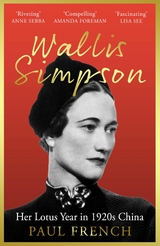
Wallis Simpson (eBook)
288 Seiten
Elliott & Thompson (Verlag)
9781783968190 (ISBN)
Paul French was born in London and lived and worked in Shanghai for many years. His book Midnight in Peking was a New York Times bestseller and a BBC Radio 4 Book of the Week. He received the Mystery Writers' of America Edgar award for Best Fact Crime and a Crime Writers' Association (UK) Dagger award for nonfiction. His most recent book, City of Devils: A Shanghai Noir, received much praise with The Economist calling him a 'champion storyteller'. Both Midnight in Peking and City of Devils are currently in development for film.
INTRODUCTION
The many biographies of Wallis Simpson have tended to focus almost exclusively on the love affair that forced the constitutional crisis of the abdication of King Edward VIII in December 1936 and the challenging years of exile for the Duke and Duchess of Windsor that followed. The earlier part of Wallis’s life, her first disastrous marriage to Commander Win Spencer, her escape from that relationship, and the pivotal year she spent in China across 1924 and 1925 have been the subject of much rumor but relatively little close study. Her Lotus Year reveals a different Wallis Simpson from the one so often presented.
Early-twentieth-century Chinese history is complicated and undeniably confusing, while rarely being the province of royal historians. And so Wallis’s China sojourn of the mid-1920s tends to be noted solely in terms of salacious gossip and innuendo rather than her actual experiences of the country. Many nefarious stories surrounding her China sojourn emerged around the time of the threatened abdication a dozen years after Wallis had left China. They formed the substance of what would come to be known as the “China Dossier.” The elite ruling clique of the English Establishment, including the then government of Prime Minister Stanley Baldwin and the British intelligence services, sought to use Wallis Simpson’s time in China to denigrate her moral character, making prurient and baseless assertions. These were given weight by the prevailing Sinophobic narratives in British society that associated single white women in the Far East with sexual impropriety and were designed specifically to derail her relationship with King Edward VIII.
In the first half of the twentieth century, images of the “heathen Chinee,” the fleshpots of the Far East, the “Yellow Peril,” and “white slavery” east of Suez were rampant. The notion that sojourners in the East somehow jettisoned their moral compasses as soon as they stepped ashore reached the common reader and cinemagoer through countless plays, short stories, novels, and films. Travelers in the East, especially white women, went bad out there, if they weren’t already prone to moral rot and therefore attracted to the Orient in the first place.
With this image of China so prevalent in the imagination of audiences on both sides of the Atlantic, it was easy for the British Establishment to perpetrate the rumors of Wallis’s supposed descent into (take your pick of any or all of the suggested rumors) prostitution, opium addiction and dope dealing, modeling for pornographic photographs, fronting for a gambling syndicate, endless love affairs (mostly with married men), lesbianism, living as a “kept woman,” drunkenness, sexual ménages à trois, exotic massage techniques to encourage ejaculation, and (perhaps most famously and endlessly repeated to this day on a thousand websites fascinated by Wallis) her supposed technique, learned in a low Chinese brothel of course, of the “Shanghai Grip.”
The rumors were used to blacken Wallis’s name in London society. Originally, the insinuations were proffered to offer some explanation (as opposed to any notion of character, style, sophistication, or fashion sense) for Edward VIII’s obsession with her. A justification for her hold over him. The lurid rumors hung around Wallis like a bad smell for the rest of her life and continue to be recycled in the tabloid press today. Crucially, however, it seems that while the gossip circulated wildly among the upper echelons of British society, Queen Mary, the then Prince Albert (later King George VI after the abdication) and his wife, Elizabeth (later better known as the Queen Mother), senior government ministers, the clergy, and so on—nobody ever actually read a physical copy or held an actual document in their hands. In fact, nobody has ever seen the purported document. Richard Aldrich and Rory Cormac’s book The Secret Royals: Spying and the Crown, from Victoria to Diana claims that Edward VIII’s close confidant and royal insider Kenneth de Courcy knew the “document” was “totally false.” The authors conclude that the dossier did not exist. Further to that, the top civil servant of his day and private secretary to three prime ministers (Chamberlain, Churchill, and Attlee), Jock Colville, had never come across the dossier.* When word of the dossier eventually reached Wallis, she understood the allegations to be “venom, venom, VENOM.”†
Her Lotus Year offers a very different account of Wallis’s time in China from the version suggested by the rumors put about by the purported China Dossier. Having written about China and the country’s convulsive interwar history between the world wars for a quarter century, I became intrigued by the fact that Wallis Simpson had spent time in China in the mid-1920s. I began to trace her footsteps, discovering her experiences of Hong Kong’s Kowloon district, Canton’s Shameen Island, the Shanghai Bund, or Peking’s ancient hutongs. I was struck by the events she would have witnessed, given what a chaotic, uncertain, and often dangerous period it was in China’s history. I would find myself in places I knew she had once stayed—Shanghai’s Palace Hotel, the old building of the Grand Hôtel de Pékin, the traditional hutong lane where she lived with friends. At these random moments, Wallis’s China sojourn would come within reach.
Rather than the rumors and allegations, casually repeated and to any China historian obviously false, the journey she took across the country in such perilous times was revealing of a fast-disappearing world of cosmopolitan glamour, political intrigue, and unashamed colonial excess. This I discovered was what was truly formative in shaping the Wallis Simpson the world would come to recognize, and far more fascinating than the tawdry rumors put about by the China Dossier.
In the summer of 1924, Mrs. Wallis Warfield Spencer, having just turned twenty-eight years of age, boarded a United States Navy transport ship bound for Hong Kong. She was traveling to the Far East in the hope she could save her failing marriage. Her husband, US Navy pilot Earl Winfield “Win” Spencer Jr., was an abusive drunk with a temper, and their marriage had been troubled for some years before he was posted east to serve with the US South China Patrol. He begged her to follow him; he swore he’d given up the booze; her family urged her to try to repair the relationship. So she went . . .
After a seemingly idyllic reunion in Hong Kong, Win soon slipped back into his old ways—drinking to excess and abusing his wife verbally, emotionally, and physically. At this point, Wallis decided to leave him. Her Lotus Year tells the story of what happened next.
Wallis left Win and Hong Kong for the cosmopolitan delights of 1920s Shanghai, where she effectively began her life over. From there, she journeyed to Peking, where she immediately became entranced with the ancient Chinese capital. She was to stay in China for approximately a year.
It was a period Wallis herself later referred to longingly as her “Lotus Year,” invoking the lotus-eaters of Greek mythology, Homer’s Odyssey, and Alfred, Lord Tennyson’s poem. Homer describes the lotus-eaters, a tribe encountered by Odysseus during his return from Troy, as having become “forgetful of their homeward way.” Pleasantly marooned on an island, in an altered state and isolated from the rest of the world, they live a life of indolence and peaceful apathy, free of practical concerns.
Let us swear an oath, and keep it with an equal mind,
In the hollow Lotos-land to live and lie reclined
On the hills like Gods together, careless of mankind.
(Alfred, Lord Tennyson, “The Lotos-Eaters,” 1832)
This was how Wallis viewed her China sojourn. It was a year that would affect her in significant ways. She discovered she could mix easily in sophisticated international company, where the conversation was immeasurably more interesting than the middle-class Baltimore dining rooms or drab US naval base society she had known previously. Over the course of her stay, she would develop a lifelong appreciation of traditional Chinese style and aesthetics, developing the exquisite taste for which she became renowned.
An adventurous, curious, active, and independent woman, she traveled across the country during a time of great political turmoil in China. In the power vacuums that followed the collapse of the 267-year-old Qing dynasty and the problematic emergence of the first Chinese Republic, warlord battles threatened to plunge China into full-blown civil war. These self-proclaimed leaders of large armies controlling vast swaths of territory skirmished and fought for power all around her as she moved from Hong Kong north to Shanghai and then farther north and inland to Peking. Even though she remained largely in the safe confines of the International Settlements in Hong Kong, Canton, Shanghai, and Peking, disease, natural disaster, and banditry were never far away. She made lifelong friends and enjoyed a genuine love affair.
Wallis was aware of the chaos engulfing China, the revolution of Dr. Sun Yat-sen, the violent jockeying for position among the warlords, just as she was aware that most of her time in China was spent in a form of privileged isolation from the confusion and mayhem outside the enclaves of colonial Hong Kong, the foreign treaty...
| Erscheint lt. Verlag | 14.11.2024 |
|---|---|
| Verlagsort | London |
| Sprache | englisch |
| Themenwelt | Literatur ► Biografien / Erfahrungsberichte |
| Geisteswissenschaften ► Geschichte ► Hilfswissenschaften | |
| Geisteswissenschaften ► Sprach- / Literaturwissenschaft ► Literaturwissenschaft | |
| Schlagworte | 1920s • 20th century history • Adrian Philips • American Duchess • behind closed door • Biography • British Government • British royal family • Charles III • China • Chinese history • City of Devils • Civil War • Crown in Criss • David Mitchell • Diplomacy • Divorce • Dossier • Duchess of Windsor • Far East • Fashion • Glenconner • Hardman • History • Icon • king charles • King Edward VIII • King Who Had to Go • Lady Colin Campbell • lady in waiting • Larman • Lownie • Megan Markle • Might in Peking • Monarchy • morton • Netflix • Orientalism • Pasternak • Paul French • Prince Harry • Princess Diana • Queen Elizabeth • queen mother • royalty • scandal • Scobie • Sebba • That Woman • The Crown • Traitor King • Unruly • Wallis in Love • Wallis Simpson • Wickers |
| ISBN-13 | 9781783968190 / 9781783968190 |
| Informationen gemäß Produktsicherheitsverordnung (GPSR) | |
| Haben Sie eine Frage zum Produkt? |
 EPUB (Wasserzeichen)
DRM: Digitales Wasserzeichen
Dieses eBook enthält ein digitales Wasserzeichen und ist damit für Sie personalisiert. Bei einer missbräuchlichen Weitergabe des eBooks an Dritte ist eine Rückverfolgung an die Quelle möglich.
Dateiformat: EPUB (Electronic Publication)
EPUB ist ein offener Standard für eBooks und eignet sich besonders zur Darstellung von Belletristik und Sachbüchern. Der Fließtext wird dynamisch an die Display- und Schriftgröße angepasst. Auch für mobile Lesegeräte ist EPUB daher gut geeignet.
Systemvoraussetzungen:
PC/Mac: Mit einem PC oder Mac können Sie dieses eBook lesen. Sie benötigen dafür die kostenlose Software Adobe Digital Editions.
eReader: Dieses eBook kann mit (fast) allen eBook-Readern gelesen werden. Mit dem amazon-Kindle ist es aber nicht kompatibel.
Smartphone/Tablet: Egal ob Apple oder Android, dieses eBook können Sie lesen. Sie benötigen dafür eine kostenlose App.
Geräteliste und zusätzliche Hinweise
Buying eBooks from abroad
For tax law reasons we can sell eBooks just within Germany and Switzerland. Regrettably we cannot fulfill eBook-orders from other countries.
aus dem Bereich