


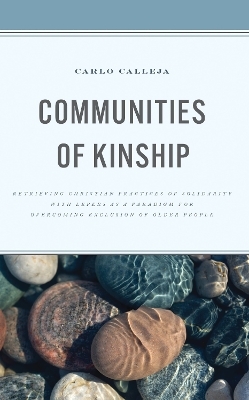
Communities of Kinship
Retrieving Christian Practices of Solidarity with Lepers as a Paradigm for Overcoming Exclusion of Older People
Seiten
2024
Lexington Books/Fortress Academic (Verlag)
978-1-9787-1197-6 (ISBN)
Lexington Books/Fortress Academic (Verlag)
978-1-9787-1197-6 (ISBN)
Finding parallels between the exclusion of lepers and the efforts of Christian communities to reforge kinship bonds with them in ancient and medieval times, Carlo Calleja argues that communities of kinship with older persons can help cultivate the virtues needed for the flourishing of oneself and society.
In Communities of Kinship: Retrieving Christian Practices of Solidarity with Lepers as a Paradigm for Overcoming Exclusion of Older People, Carlo Calleja describes kinship as a moral category, arguing that practicing kinship with others can cultivate virtues that shape the character of the agent. Contemporary Western society tends to focus on kinship as the sharing of blood ties or genetic material. On the other hand, the spiritual kinship that is proposed by religions tends to be exclusive and often nominal. For this reason, Calleja proposes practices and structures of solidaristic kinship, which involves sharing in the suffering of the other person. Finding parallels between the exclusion of lepers and the efforts of Christian communities to reforge kinship bonds with them in ancient and medieval times, he argues that communities of kinship with older persons can help cultivate the virtues needed for the flourishing of oneself and society.
In Communities of Kinship: Retrieving Christian Practices of Solidarity with Lepers as a Paradigm for Overcoming Exclusion of Older People, Carlo Calleja describes kinship as a moral category, arguing that practicing kinship with others can cultivate virtues that shape the character of the agent. Contemporary Western society tends to focus on kinship as the sharing of blood ties or genetic material. On the other hand, the spiritual kinship that is proposed by religions tends to be exclusive and often nominal. For this reason, Calleja proposes practices and structures of solidaristic kinship, which involves sharing in the suffering of the other person. Finding parallels between the exclusion of lepers and the efforts of Christian communities to reforge kinship bonds with them in ancient and medieval times, he argues that communities of kinship with older persons can help cultivate the virtues needed for the flourishing of oneself and society.
Carlo Calleja is a lecturer in ethics, social justice, and theology at the University of Malta.
Part I – Kinship and Applied Problems
Chapter 1: Kinship: Meaning, Structure, and Function
Chapter 2: Loss of Kinship with Older People
Part II – Theory and Practice of Solidaristic Kinship
Chapter 3: The Practice and Practices of Solidaristic Kinship
Chapter 4: Structures of Kinship
Part III – Learning from the Past
Chapter 5: The Exclusion of Lepers in Ancient and Medieval Times
Chapter 6: Practices and Structures of Kinship with Lepers
Part IV – Envisaging Communities of Kinship
Chapter 7: Communities of Solidaristic Kinship
Chapter 8: Kinship as a Political Act
| Erscheinungsdatum | 09.03.2024 |
|---|---|
| Sprache | englisch |
| Maße | 158 x 238 mm |
| Gewicht | 467 g |
| Themenwelt | Religion / Theologie ► Christentum ► Kirchengeschichte |
| ISBN-10 | 1-9787-1197-2 / 1978711972 |
| ISBN-13 | 978-1-9787-1197-6 / 9781978711976 |
| Zustand | Neuware |
| Informationen gemäß Produktsicherheitsverordnung (GPSR) | |
| Haben Sie eine Frage zum Produkt? |
Mehr entdecken
aus dem Bereich


aus dem Bereich
eine andere Geschichte der Papststadt
Buch | Softcover (2024)
C.H.Beck (Verlag)
CHF 25,20
die Macht des Dunklen in unserer Zeit und wie wir ihr entgegentreten
Buch | Hardcover (2025)
Verlag Herder
CHF 27,90


