


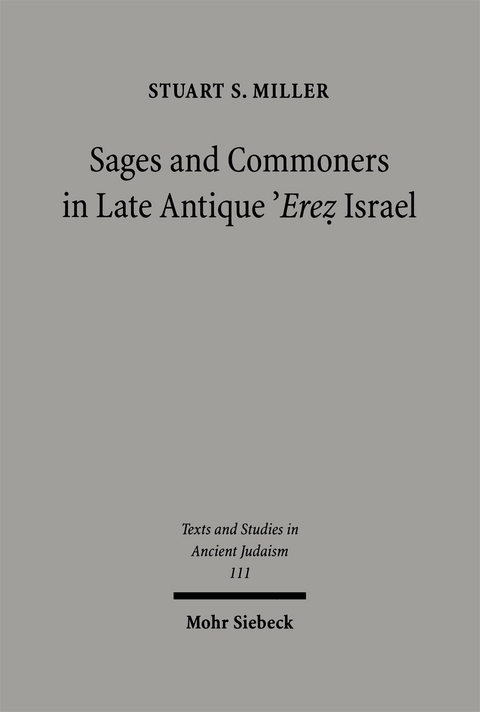
Sages and Commoners in Late Antique 'Erez Israel
A Philological Inquiry into Local Traditions in Talmud Yerushalmi
Seiten
2006
Mohr Siebeck (Verlag)
978-3-16-148567-1 (ISBN)
Mohr Siebeck (Verlag)
978-3-16-148567-1 (ISBN)
Im scharfen Kontrast zu kürzlich aufgestellten Behauptungen, die Rabbis seien eine relativ kleine, abgegrenzte Gruppe mit wenig Einfluß gewesen, zeigt Stuart S. Miller, daß ihre Bewegung sowohl weiter verbreitet als auch vielseitiger war, als das schlichte Zählen der namentlich bekannten Rabbis vermuten läßt. Er untersucht auch, auf welchem Weg die Rabbiner ihre Lehre ausbreiteten und so zu einer effektiven und produktiven intellektuellen Gemeinschaft wurden.
Stuart S. Miller addresses a number of issues in the history of talmudic Palestine that are at the center of contemporary scholarly debate about the role rabbis played in society. In sharp contrast to recent claims that the rabbis were a relatively small and insular group with little influence, this book demonstrates that their movement was both more expansive and diffuse than a mere counting of named rabbis suggests. It also underscores some of the dynamics that allowed rabbinic circles to spread their teachings and to ultimately consolidate into an effective and productive movement. Many overlooked terms and passages in which rabbis and the members of their circles appear in the Talmud Yerushalmi are investigated, and special attention is given to the identity of persons who are collectively referred to after their places of residence ("Tiberians," "Sepphoreans," "Southerners," etc.) While the results confirm the insular nature of the interests of the rabbis, they also point to the definition and coherence that this insularity provided their movement. Therein lies the secret of the "success" of rabbinic Judaism, which never depended upon sheer numbers but rather on the internal strength and sense of purpose of rabbinic circles. Subjects that are considered include: rabbinic "households," the identity of the 'ammei ha-'arez and their relationship to the rabbis, village sages and their connection to urban rabbis, and the venue of rabbinic "teachings," "instructions," "expositions," "pronouncements," and stories.
Stuart S. Miller addresses a number of issues in the history of talmudic Palestine that are at the center of contemporary scholarly debate about the role rabbis played in society. In sharp contrast to recent claims that the rabbis were a relatively small and insular group with little influence, this book demonstrates that their movement was both more expansive and diffuse than a mere counting of named rabbis suggests. It also underscores some of the dynamics that allowed rabbinic circles to spread their teachings and to ultimately consolidate into an effective and productive movement. Many overlooked terms and passages in which rabbis and the members of their circles appear in the Talmud Yerushalmi are investigated, and special attention is given to the identity of persons who are collectively referred to after their places of residence ("Tiberians," "Sepphoreans," "Southerners," etc.) While the results confirm the insular nature of the interests of the rabbis, they also point to the definition and coherence that this insularity provided their movement. Therein lies the secret of the "success" of rabbinic Judaism, which never depended upon sheer numbers but rather on the internal strength and sense of purpose of rabbinic circles. Subjects that are considered include: rabbinic "households," the identity of the 'ammei ha-'arez and their relationship to the rabbis, village sages and their connection to urban rabbis, and the venue of rabbinic "teachings," "instructions," "expositions," "pronouncements," and stories.
Born 1953; 1980 Ph.D. at New York University; Professor of Hebrew, History and Judaic Studies at the University of Connecticut.
| Erscheint lt. Verlag | 9.11.2006 |
|---|---|
| Reihe/Serie | Texts and Studies in Ancient Judaism |
| Verlagsort | Tübingen |
| Sprache | englisch |
| Maße | 164 x 239 mm |
| Gewicht | 960 g |
| Themenwelt | Geisteswissenschaften ► Religion / Theologie ► Judentum |
| Geisteswissenschaften ► Sprach- / Literaturwissenschaft ► Literaturwissenschaft | |
| Schlagworte | HC/Religion/Theologie/Judentum • Israel • Israel (Alt-I.); Geistes-/Kultur-G. • Israel (Alt-I.); Geistes-/Kultur-Geschichte • Jüdische Geschichte • Rabbiner • Talmud Yerushalmi |
| ISBN-10 | 3-16-148567-X / 316148567X |
| ISBN-13 | 978-3-16-148567-1 / 9783161485671 |
| Zustand | Neuware |
| Informationen gemäß Produktsicherheitsverordnung (GPSR) | |
| Haben Sie eine Frage zum Produkt? |
Mehr entdecken
aus dem Bereich


aus dem Bereich
Materialien, Beispiele und Übungen zum Biblisch-Hebräisch
Buch | Softcover (2025)
UTB (Verlag)
CHF 37,90


