


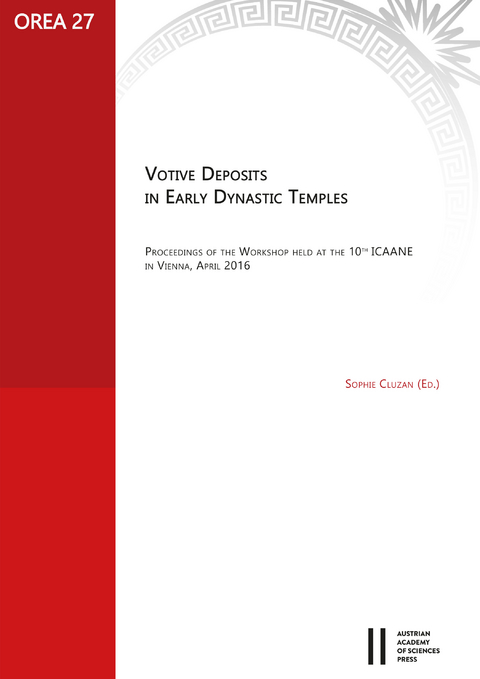
Votive Deposits in Early Dynastic Temples
Proceedings of the Workshop held at the 10th ICAANE in Vienna, April 2016
Seiten
2023
Verlag der österreichischen Akademie der Wissenschaften
978-3-7001-8203-0 (ISBN)
Verlag der österreichischen Akademie der Wissenschaften
978-3-7001-8203-0 (ISBN)
- Titel nicht im Sortiment
- Artikel merken
Between 2900 and 2330 BCE, the Euphrates and Tiger alluvial plain was the site of kingdoms known to be the first to use writing in both an intensive and an extensive way and within different contexts, from practical to political, economic, religious or historical ones. Along with this decisive evolution, human settlements clearly witnessed the existence of hierarchical political and religious systems as parts of an interregional network. While we can find many examples of diversity between them, these first historical kingdoms share many features and noticeable similarities. The deposition of goods in temples is one of these although it obviously followed different processes. This volume provides evidence of how an integrative approach mixing concept, context, text, materiality and symbols can enable a comprehensive portrayal of this multifaceted phenomenon.
Im Zeitraum 2900–2330 v. Chr. existierten in der Ebene zwischen Euphrat- und Tigris Königreiche, die erstmals umfassend Schrift in verschiedenen Kontexten verwendeten. Parallel zu dieser Entwicklung gab es erstmals hierarchische, politische und religiöse Systeme, die Teil eines überregionalen Netzwerks waren. Trotz zahlreicher Unterschiede weisen diese ersten historischen Königreiche doch viele Ähnlichkeiten auf. Die Deponierung von unterschiedlichen Objekten in Tempeln ist eine dieser Gemeinsamkeiten, auch wenn ihr offensichtlich unterschiedliche Praktiken zugrunde lagen. Seit dem Beginn der Ausgrabungen in dieser Region Ende des 19. Jahrhunderts wurde diesem Phänomen große Aufmerksamkeit geschenkt, wodurch zahlreiche Objekte freigelegt wurden. Auch wenn die Unterschiede zwischen den Kontexten früh erkannt wurden, wiesen alle auf die Verbindungen zwischen Teilen der Gesellschaft und den einst verehrten Gottheiten hin. Obgleich die frühdynastischen Könige in vielerlei Hinsicht mit den Gottheiten verbunden sind, führte dieser Umstand nicht dazu, dass andere Teile der Gesellschaft von der Präsenz in den Tempeln ausgeschlossen wurden, zumindest nicht was die Deponierung von Weihgaben betrifft. Dies wiederum kann als Ausdruck einer anderen Einstellung zum Tempel als Institution, zur Religion oder zur Herrschaft an sich betrachtet werden und muss als eines der Hauptmerkmale der frühdynastischen Gesellschaften angesehen werden. Dieser Band enthält eine Reihe neuerer Studien, die im Rahmen der 10. ICAANE vorgestellt wurden. Die Beiträge zeigen, wie ein integrativer Ansatz, der Kontext, Text, materielle Kultur und Symbolik miteinander verbindet, eine umfassende Darstellung dieses sehr vielfältigen Phänomens ermöglichen kann. Between 2900 and 2330 BCE, the Euphrates and Tiger alluvial plain was the site of kingdoms known to be the first to use writing in both an intensive and an extensive way and within different contexts, from practical to political, economic, religious or historical ones. Along with this decisive evolution, for the first time human settlements clearly witnessed the existence of hierarchical political and religious systems as parts of an interregional network. While we can find many examples of diversity between them, these first historical kingdoms share many features and noticeable similarities. The deposition of goods in temples is one of these although it obviously followed different processes. Starting with the beginning of excavations in this region at the end of the 19th century, recognition of this phenomenon yielded quantities of objects, mostly linked by their types and qualities. Even if variation between the contexts was recognized, all drew attention to the actual links between parts of the society and the divinities once honoured to which they are a testimony. Even though Early Dynastic kings are linked to gods in many special ways, this trend did not lead to the exclusion of other parts of society from being represented in the temples, at least through their deposition of goods. In turn, this can be viewed as the reflection of a different approach to the temple as an institution, to religion or to power itself, and must be considered as one of the key features of Early Dynastic societies. This volume offers a set of recent studies presented at the 10th ICAANE. It brings together scholars whose works provide evidence of how an integrative approach mixing concept, context, text, materiality and symbols can give a more realistic account of this diverse phenomenon and its relevance in a historical perspective.
Im Zeitraum 2900–2330 v. Chr. existierten in der Ebene zwischen Euphrat- und Tigris Königreiche, die erstmals umfassend Schrift in verschiedenen Kontexten verwendeten. Parallel zu dieser Entwicklung gab es erstmals hierarchische, politische und religiöse Systeme, die Teil eines überregionalen Netzwerks waren. Trotz zahlreicher Unterschiede weisen diese ersten historischen Königreiche doch viele Ähnlichkeiten auf. Die Deponierung von unterschiedlichen Objekten in Tempeln ist eine dieser Gemeinsamkeiten, auch wenn ihr offensichtlich unterschiedliche Praktiken zugrunde lagen. Seit dem Beginn der Ausgrabungen in dieser Region Ende des 19. Jahrhunderts wurde diesem Phänomen große Aufmerksamkeit geschenkt, wodurch zahlreiche Objekte freigelegt wurden. Auch wenn die Unterschiede zwischen den Kontexten früh erkannt wurden, wiesen alle auf die Verbindungen zwischen Teilen der Gesellschaft und den einst verehrten Gottheiten hin. Obgleich die frühdynastischen Könige in vielerlei Hinsicht mit den Gottheiten verbunden sind, führte dieser Umstand nicht dazu, dass andere Teile der Gesellschaft von der Präsenz in den Tempeln ausgeschlossen wurden, zumindest nicht was die Deponierung von Weihgaben betrifft. Dies wiederum kann als Ausdruck einer anderen Einstellung zum Tempel als Institution, zur Religion oder zur Herrschaft an sich betrachtet werden und muss als eines der Hauptmerkmale der frühdynastischen Gesellschaften angesehen werden. Dieser Band enthält eine Reihe neuerer Studien, die im Rahmen der 10. ICAANE vorgestellt wurden. Die Beiträge zeigen, wie ein integrativer Ansatz, der Kontext, Text, materielle Kultur und Symbolik miteinander verbindet, eine umfassende Darstellung dieses sehr vielfältigen Phänomens ermöglichen kann. Between 2900 and 2330 BCE, the Euphrates and Tiger alluvial plain was the site of kingdoms known to be the first to use writing in both an intensive and an extensive way and within different contexts, from practical to political, economic, religious or historical ones. Along with this decisive evolution, for the first time human settlements clearly witnessed the existence of hierarchical political and religious systems as parts of an interregional network. While we can find many examples of diversity between them, these first historical kingdoms share many features and noticeable similarities. The deposition of goods in temples is one of these although it obviously followed different processes. Starting with the beginning of excavations in this region at the end of the 19th century, recognition of this phenomenon yielded quantities of objects, mostly linked by their types and qualities. Even if variation between the contexts was recognized, all drew attention to the actual links between parts of the society and the divinities once honoured to which they are a testimony. Even though Early Dynastic kings are linked to gods in many special ways, this trend did not lead to the exclusion of other parts of society from being represented in the temples, at least through their deposition of goods. In turn, this can be viewed as the reflection of a different approach to the temple as an institution, to religion or to power itself, and must be considered as one of the key features of Early Dynastic societies. This volume offers a set of recent studies presented at the 10th ICAANE. It brings together scholars whose works provide evidence of how an integrative approach mixing concept, context, text, materiality and symbols can give a more realistic account of this diverse phenomenon and its relevance in a historical perspective.
is General Curator for the Near Eastern Department of the Louvre Museum, Paris
https://onix.oeaw.ac.at/Inhaltsverzeichnis/9783700182030_Inhaltsverzeichnis.pdf
| Erscheinungsdatum | 01.12.2023 |
|---|---|
| Reihe/Serie | OREA ; 27 |
| Verlagsort | Wien |
| Sprache | englisch |
| Maße | 210 x 297 mm |
| Gewicht | 1108 g |
| Themenwelt | Sachbuch/Ratgeber ► Geschichte / Politik ► Vor- und Frühgeschichte / Antike |
| Geisteswissenschaften ► Geschichte | |
| Schlagworte | Archäologie • Early Dynastic • Favissa • Hoards • OREA • Oriental and European Archaeology • Sophie Cluzan • Temples • Topography • Ur- und Frühgeschichte • Votive deposits |
| ISBN-10 | 3-7001-8203-1 / 3700182031 |
| ISBN-13 | 978-3-7001-8203-0 / 9783700182030 |
| Zustand | Neuware |
| Informationen gemäß Produktsicherheitsverordnung (GPSR) | |
| Haben Sie eine Frage zum Produkt? |
Mehr entdecken
aus dem Bereich
aus dem Bereich
der Weg zum Homo sapiens
Buch | Softcover (2025)
C.H.Beck (Verlag)
CHF 16,80


