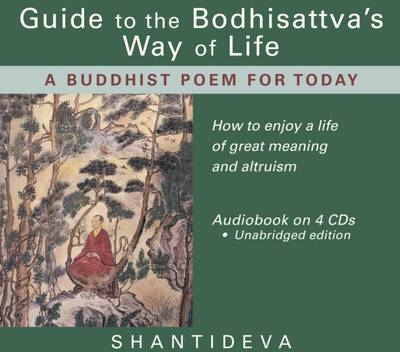
Guide to the Bodhistavva's Way of Life
Tharpa Publications (Verlag)
9780954879013 (ISBN)
- Titel ist leider vergriffen;
keine Neuauflage - Artikel merken
This famous and universally loved poem for daily living has inspired many generations of Buddhists and non-Buddhists since it was first composed in the 8th century by Shantideva. This new translation, made under the guidance of Geshe Kelsang Gyatso, conveys the great lucidity and poetic beauty of the original, while preserving its full impact and spiritual insight. Listening to the verses slowly, while contemplating their meaning, has a profoundly liberating effect on the mind. The poem invokes special positive states of mind, moves us from suffering and conflict to happiness and peace, and gradually introduces us to the entire Mahayana Buddhist path to enlightenment.
The great Indian Pandit Shantideva (AD 687-763) was born the crown prince of a royal family in Gujarat, a kingdom in western India. His father was King Kushalavarmana (Armour of Virtue) and his mother was recognized as an emanation of the Tantric Deity Vajrayogini. At his birth the prince received the name Shantivarmana (Armour of Peace). Even as a very young boy Shantivarmana showed great ability in spiritual matters and by the age of seven was already highly skilled in the inner science of religion. His principal Teacher at that time was a Yogi who had so fully developed penetrating wisdom that it is said he achieved unity with Manjushri, the Buddha embodying the wisdom of all enlightened beings. When Shantivarmana himself engaged in a meditation retreat, he too received a direct vision of Manjushri and many prophetic omens as well. Shortly afterwards King Kushalavarmana died, leaving Shantivarmana to inherit the throne. The night before his intended coronation, however, Manjushri appeared to him in a dream. He told the prince that he should renounce his kingdom and become a celibate monk. Immediately upon waking, Shantivarmana fled the palace and disappeared into the forest to meditate. Once again he received a vision of Manjushri, who handed him a symbolic wooden sword. Upon taking it Shantivarmana attained eight perfect realizations. He then travelled to the great monastic university of Nalanda where he took ordination from the Abbot Jayadeva (God of Victory) and was given ordination name of Shantideva (God of Peace). At Nalanda Shantideva's spiritual development progressed rapidly, especially as the result of his training in the profound and demanding methods of Tantra. However, because he did all his practices secretly at night and rested during the day, it appeared to others that he performed only three activities: eating, sleeping and defecating. For this reason, the other monks sarcastically referred to him as the 'Three Realizations'. Feeling he was a very irresponsible monk and a discredit to their illustrious university, they devised a plan to get rid of him. Incorrectly believing him to be deficient in meditational ability and ignorant of doctrinal theory, they arranged for Shantideva to deliver a discourse before the entire monastery. Their idea was that he would be so humiliated by this exposure of his ignorance that he would be shamed into leaving. When the day of the scheduled public humiliation arrived, Shantideva mounted the teaching throne and, much to the amazement of those assembled, delivered a discourse which, when written down, became known as Guide to the Bodhisattva's Way of Life, still considered the best set of instructions ever written for becoming a Bodhisattva - a being bound for full enlightenment.
Introduction Chapter 1: An Explanation of the Benefits of Bodhichitta Chapter 2: Purifying Negativity Chapter 3: Generating Engaging Bodhichitta Chapter 4: Relying upon Conscientiousness Chapter 5: Guarding the Mind with Alertness Chapter 6: Relying upon Patience Chapter 7: Relying upon Effort Chapter 8: Relying upon Mental Stabilization Chapter 9: The Perfection of Wisdom Chapter 10: Dedication
| Erscheint lt. Verlag | 29.7.2005 |
|---|---|
| Übersetzer | Kelsang Gyatso |
| Verlagsort | Ulverston |
| Sprache | englisch |
| Maße | 141 x 125 mm |
| Gewicht | 186 g |
| Themenwelt | Geisteswissenschaften ► Religion / Theologie ► Buddhismus |
| ISBN-13 | 9780954879013 / 9780954879013 |
| Zustand | Neuware |
| Informationen gemäß Produktsicherheitsverordnung (GPSR) | |
| Haben Sie eine Frage zum Produkt? |
aus dem Bereich