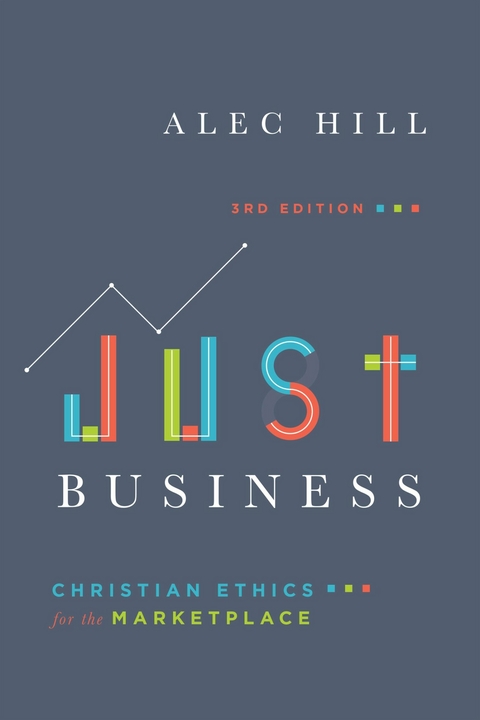
Alec Hill is president emeritus of InterVarsity Christian Fellowship/USA. He was formerly dean of the School of Business and Economics at Seattle Pacific University.
When the daily business news breaks away from stories of profit and loss, it often shines a spotlight on ethical failures. But Christians aim to be ethical in all the areas of daily life and work-not just when the spotlight is on them. For those facing the many questions and quandaries of doing business with ethical integrity, Alec Hill offers a place to begin.In this third edition of a popular textbook on business ethics, Hill carefully explores the foundational Christian concepts of holiness, justice, and love. These keys to God's character, he argues, are also the keys to Christian business ethics. Hill then shows how some common responses to business ethics fall short of a fully Christian response. Using penetrating case studies on such pressing topics as employer-employee relations, discrimination and affirmative action, and environmental damage, he clothes principles in concrete business situations. Updated throughout, and with a new chapter on international business, this new edition of Just Business is an excellent introduction to business ethics for students, and a timely refresher for men and women already in the marketplace.
Alec Hill is president emeritus of InterVarsity Christian Fellowship/USA. He was formerly dean of the School of Business and Economics at Seattle Pacific University.
1
A CHRISTIAN ETHIC
for BUSINESS
An ethical man is a Christian holding four aces.
Man is too complicated. I would have made him simpler.
Christianity has not so much been tried and found wanting,
as it has been found difficult and left untried.
You must be perfect as your heavenly Father is perfect.
CASE STUDY
Budget crunch. Maria manages a small division within a Seattle manufacturing company. Roughly 70 percent of the division’s annual $400,000 budget is allocated to the salaries and benefits of Maria and her three subordinates: Abe, Barb and Carl. Maria’s supervisor informs her that $100,000 needs to be cut from next year’s budget. Since nonpersonnel expenses constitute only $120,000 of the budget, Maria feels compelled to lay off one of her staff.
Before being hired and relocating from Chicago last year, Maria told Abe that his employment would “no doubt be a long-term arrangement.” This was not written into his contract and is, Maria believes, quite ambiguous. Abe’s work performance has been mediocre at best and his interpersonal skills are poor.
A long-term employee, Barb was divorced two years ago. She is now a single parent of three small children. It is evident that her work output has suffered as a result of her family responsibilities.
Carl is the most diligent of the three, regularly receiving the highest annual evaluations. Maria has learned that Carl recently inherited a substantial sum of money from his parents’ estate. She believes that he would have a much easier time finding employment elsewhere than either Abe or Barb.
What should Maria do?
IS A CHRISTIAN ETHIC POSSIBLE IN BUSINESS?
Managers often confront such nerve-wracking, heart-wrenching and guilt-producing scenarios. In their quest to do the “right thing” for shareholders and subordinates, they often experience a deep sense of uncertainty.
Why? Because the “shoulds” of life bring values and relationships to the forefront. Ethics—the study of doing the “right thing”—attempts to provide a value-laden framework, a grid through which real-life decisions can be made. What counsel does Christian ethics, the application of biblical values to the decision-making process, have for Maria? Does it provide a simple solution to her dilemma?
One approach is to view Scripture as a book of rules to be applied to specific situations: simply find the right rule and match it with the current problem. While this strategy may work well in relatively simple situations—such as when a worker is tempted to steal or an executive considers slandering a competitor—what about more complex situations like the one confronting Maria?
If Abe approaches her first, seeking to keep his job, should she heed Jesus’ admonition to “give to the one who asks you”? What if Barb and Carl then make similar requests? Or what if Abe were to assault Maria when he learns of the possible layoff? Is she to turn the other cheek, or should she demand restitution and bring criminal charges against him?1 Taking this line of reasoning a step further, is there a scriptural rule that provides guidance to Maria’s company in deciding how many units to produce or in which geographical areas to seek expansion?
Attempts to find easy answers to such enigmatic situations have led one skeptic to label Christian ethics “infantile.” He compares the “rule book” approach to the types of absolute commands typically given to children between the ages of five and nine, such as don’t talk to strangers or sing at the dinner table.2
While this criticism misunderstands the heart of Christian ethics, it should give pause to those who would take a simple rules-based approach. In ambiguous cases, it is clearly deficient in its capacity to give precise answers in every situation. Ironically, research indicates that corporations with highly detailed codes of ethics actually are cited more often for breaking the law than their counterparts without such explicit rules.3 Dietrich Bonhoeffer was bluntly uncharitable toward such an approach, labeling it “naive” and those who practice it “clowns.”4
Other critics attack the idea of a Christian business ethic from a different angle, arguing that Scripture has nothing relevant to say about business today. After all, they point out, the Bible was written two to three millennia ago, largely in the context of an agrarian economy. No doubt, Israel’s entire gross national product under King Solomon was less than the net worth of Google today. What significant insights, they ask, can Scripture give Maria in deciding the fates of Abe, Barb and Carl? Indeed, is the Bible even relevant to leveraged buy-outs and copyright infringement? Using Scripture as a business rulebook, they contend, would be like using ancient medical texts written by Galen and Hippocrates to train modern doctors.5
If the critics are correct in arguing, first, that the Bible is rule bound and, second, that it lacks relevance, we need not proceed any further. If they are right, Scripture has minimal applicability to modern business practices. However, if it can be demonstrated that Christian ethics is rooted in something much deeper, then these critics are wrong.
GOD’S CHARACTER
Christianity operates on the notion that ethics (the study of human character) parallels theology (the study of God’s character). When we behave in a manner consistent with God’s character, we act ethically. When we fail to do so, we act unethically. All of Scripture—from the law of Moses to Paul’s list of virtues and vices—serves to illustrate behavior that is congruent with God’s moral character.
This approach is quite different from human-based ethical systems, which generally focus on (i) egoism (promotion of individual pleasure), (ii) utilitarianism (maximize pleasure and minimize pain for all involved) or (iii) deontological reasoning (keeping moral rules such as “don’t harm others”).6
This is not to say, however, that Christian ethics totally rejects these approaches. To the contrary, there is much overlap. While concerned with human happiness and the fulfillment of ethical obligations, Christian ethics does not see these as its ultimate goal. Rather, it prizes the life that seeks to emulate God’s character.
Thus, Ignatius Loyola, founder of the Jesuits, was eulogized: “The aim of life is not to gain a place in the sun, nor to achieve fame or success, but to lose ourselves in the glory of God.”7 In a similar vein, reformer John Calvin wrote:
We are not our own: in so far as we can, let us therefore forget ourselves and all that is ours. Conversely, we are God’s: let us therefore live for him and die for him. We are God’s: let his wisdom and will therefore rule all our actions. We are God’s: let all the parts of our life accordingly strive toward him as our only lawful goal.8
HOLINESS-JUSTICE-LOVE
If being ethical is reflecting God’s character, then the critical question becomes, what is God like? Christianity’s answer includes such common responses as God’s orderliness and artistry in creation. It also goes much further, however, focusing on God’s self-revelation as recorded in Scripture and through his son Jesus Christ.
Three divine characteristics that have direct bearing on ethical decision making are repeatedly emphasized in the Bible:
Each of these qualities will be explored in much greater depth in the next three chapters. For now, it suffices to say that a business act is ethical if it reflects God’s holy-just-loving character. Such hyphenation is appropriate because the three qualities are so intertwined that it would be just as accurate to describe God as being loving-just-holy or just-loving-holy.
The human body provides a helpful illustration. If holiness is comparable to the skeleton in providing core strength, then justice is analogous to the muscles ensuring balance and love is similar to the flesh emanating warmth. Obviously, all three are needed in equal measure.
Just imagine a body with only a skeleton (or a business with only a code of ethics); it would be rigid and immobile. Or picture muscles without a skeleton and flesh (or a business steeped in detailed procedures and policy manuals); they would be cold and improperly focused. Finally, consider flesh unsupported by any infrastructure (or a business trying to meet every need); it would be undefined and undisciplined.
Christian ethics requires all three characteristics to be taken into account when decisions are made. Holiness, when untethered from justice and love, drifts...
| Erscheint lt. Verlag | 15.12.2017 |
|---|---|
| Verlagsort | Lisle |
| Sprache | englisch |
| Themenwelt | Geisteswissenschaften ► Religion / Theologie |
| Wirtschaft ► Betriebswirtschaft / Management ► Unternehmensführung / Management | |
| Schlagworte | Affirmative Action • Business Ethics • Christian business • Christian Business Ethics • Christian Ethics • Corporate Ethics • Discrimination • Employee • employer • Ethical • ethics • Holiness • Justice • Love • Marketplace • Work • Workplace Ethics |
| ISBN-10 | 0-8308-8799-7 / 0830887997 |
| ISBN-13 | 978-0-8308-8799-6 / 9780830887996 |
| Informationen gemäß Produktsicherheitsverordnung (GPSR) | |
| Haben Sie eine Frage zum Produkt? |
 EPUB (Adobe DRM)
Kopierschutz: Adobe-DRM
Adobe-DRM ist ein Kopierschutz, der das eBook vor Mißbrauch schützen soll. Dabei wird das eBook bereits beim Download auf Ihre persönliche Adobe-ID autorisiert. Lesen können Sie das eBook dann nur auf den Geräten, welche ebenfalls auf Ihre Adobe-ID registriert sind.
Details zum Adobe-DRM
Dateiformat: EPUB (Electronic Publication)
EPUB ist ein offener Standard für eBooks und eignet sich besonders zur Darstellung von Belletristik und Sachbüchern. Der Fließtext wird dynamisch an die Display- und Schriftgröße angepasst. Auch für mobile Lesegeräte ist EPUB daher gut geeignet.
Systemvoraussetzungen:
PC/Mac: Mit einem PC oder Mac können Sie dieses eBook lesen. Sie benötigen eine
eReader: Dieses eBook kann mit (fast) allen eBook-Readern gelesen werden. Mit dem amazon-Kindle ist es aber nicht kompatibel.
Smartphone/Tablet: Egal ob Apple oder Android, dieses eBook können Sie lesen. Sie benötigen eine
Geräteliste und zusätzliche Hinweise
Buying eBooks from abroad
For tax law reasons we can sell eBooks just within Germany and Switzerland. Regrettably we cannot fulfill eBook-orders from other countries.
aus dem Bereich