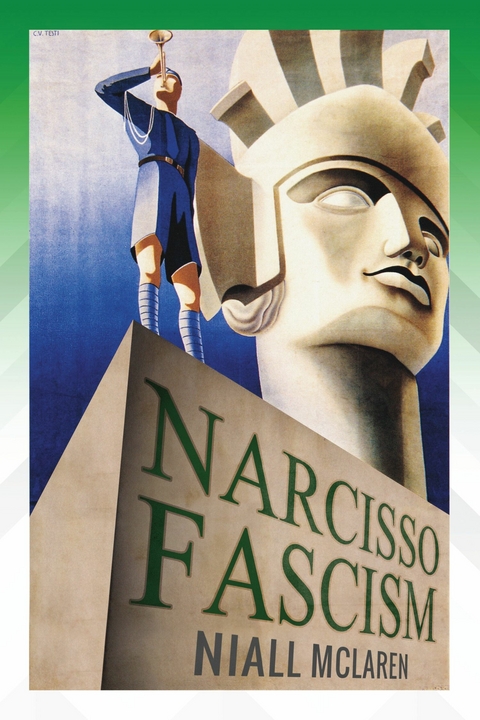
Narcisso-Fascism (eBook)
214 Seiten
Modern History Press (Verlag)
978-1-61599-756-5 (ISBN)
This book examines the biological, social and psychological influences driving one of the most important, and frightening, trends in modern international politics, right-wing extremism. It is radically unlike anything written on the topic before and its conclusions should make all of us stop ... and worry about the world we are leaving to our children. Niall McLaren is a recently-retired Australian psychiatrist with a particular interest in the application of the philosophy of science to psychiatry. Of this work, Prof. Alan Patience, of the School of Social and Political Sciences, Melbourne University, said:'Niall McLaren's new book weaves the disciplines of psychiatry and political science into a highly original approach to the political psychology of fascism... (His) book takes the analysis of fascism to another level, warning how genetically and psychologically ingrained the fascist urge is in human nature generally. In revealing this with rare clarity, this book will help counter the deeply disturbing drift towards neo-facism across the contemporary world.'
This book examines the biological, social and psychological influences driving one of the most important, and frightening, trends in modern international politics, right-wing extremism. It is radically unlike anything written on the topic before and its conclusions should make all of us stop ... and worry about the world we are leaving to our children. Niall McLaren is a recently-retired Australian psychiatrist with a particular interest in the application of the philosophy of science to psychiatry. Of this work, Prof. Alan Patience, of the School of Social and Political Sciences, Melbourne University, said:"e;Niall McLaren's new book weaves the disciplines of psychiatry and political science into a highly original approach to the political psychology of fascism... (His) book takes the analysis of fascism to another level, warning how genetically and psychologically ingrained the fascist urge is in human nature generally. In revealing this with rare clarity, this book will help counter the deeply disturbing drift towards neo-facism across the contemporary world."e;
Chapter 2: The idea of fascism.
When fascism comes to America it will be wrapped in the flag and carrying a cross.
Sinclair Lewis.
2.1. Whence fascism?
At some of Donald Trump’s election rallies in 2016, supporters were filmed giving straight arm salutes while shouting “Heil Trump.” After he assumed the presidency, pranksters posted on the internet photos of him giving speeches, along with quotes from Mein Kampf, as though they were his. Unfortunately, the joke backfired: his supporters took them as actual quotes from the Dear Leader and went into raptures. This adds new and ominous depths of meaning to what is now known as Poe’s Law, which originally said:
Without a winking smiley or other blatant display of humor, it is impossible to parody Creationism in such a way that someone won’t mistake for the genuine article 5.
What this says is that it is impossible to put a picture of Trump on the same page as a quote from the very font of fascism, and not have somebody take it as a genuine utterance from The Donald. This means that the expectations of his “base” were so extreme that they saw nothing wrong with identifying him with one of modern history’s most appalling regimes. Because their views, and what they wanted from him, fitted snugly into the Nazi template, people applauded tweeted quotes like these:
Any alliance whose purpose is not to wage war is senseless and useless (of NATO).
The great masses of the people will more easily fall victim to a big lie than a small one6.
This points to the message in the usually rather delphic writer, Theodor Adorno:
I consider the survival of [fascism] within democracy to be potentially more menacing than the survival of fascist tendencies against democracy.
That is, the danger of fascism lies within the nation, not outside. But Trump wasn’t alone: all around the world, country after country seems to be moving rapidly toward the hard right wing of politics. Brazil’s Jair Bolsonaro clearly idolised Trump and has himself been called the “Trump of the tropics.” In the UK, nativists pushed the country to sign itself out of the European Union, even though none of them appear to have considered the consequences. India’s Narendra Modi has ridden the twin tigers of nationalism and religious intolerance to power, and looks set to stay for some time to come. In the Philippines, Rodrigo Duterte has turned death squads on anybody who offends him. Nearby Thailand (which means Land of the Free in Thai) languishes under yet another military junta. Meanwhile, neighbouring Myanmar’s army has bludgeoned its way back into power and has unleashed the army and bands of religious fanatics on defenceless villagers.
In Europe, Poland and Hungary are pushing a nativist and socially reactionary program while throughout the continent, ultra-right wing parties are gaining ever-larger shares of the votes. In the Middle East, Saudi Arabia is an unabashed clericalist-fascist dictatorship but nobody bothers about this. Instead, the West directs its hostility at the marginally less malign Iranian theocracy. Across the Red Sea, Egypt’s brief experiment with democracy resulted in a military takeover, financed by Saudi Wahhabists who loathed the blundering but freely elected president in Cairo. In Africa, dictatorships are once again the norm, as in Ruanda and Uganda where the current autocrats came to power by deposing appalling regimes but, decades later, show no signs of wanting to go. This is in addition to the usual crop of intolerant and repressive regimes, such as Cuba, Venezuela, Byelarus, Cambodia, Uzbekistan and those hardy perennials, Russia, China and North Korea.
What does this mean? Are we reprising 1933, when Hitler was appointed Reichskanzler, opening the way for the Nazi dictatorship and all it brought? Is this a fascist revival? Before we can answer that question, we need to be clear that we know what fascism is, and whether we can recognise its early stages.
Very briefly, the Latin word fasce originally meant bundle or group. Its modern use derives from the insignia of office of the magistrates of Ancient Rome, an axe wrapped in a bundle of sticks. As the magistrate made his way through the throngs, a man preceded him carrying a fasce, just so the plebeians would know their fate if they offended the great man, the rod or the chopping block. This was adopted by the Fasci d’Azione Rivoluzionaria, the group of ardent nationalists and populists formed by Benito Mussolini in 1914, after he was expelled from the Socialist Party for supporting what became the Great War. It means Group for Revolutionary Action, they called themselves Fascisti, Fascists, and they adopted the ancient insignia so there was no mistaking them for socialists. In 1917, the British security service MI5 began paying Mussolini’s party £100 a week, in modern terms about £7,500, to publish prowar propaganda, which saved his motley collection of Fascisti from failure. The strident mix of nationalism, populism and conservatism was potent and, in 1922 (100 years ago this month), after considerable agitation and disturbance, the Fascists took control of the incompetent national government and began implementing their program.
Despite efforts to portray Mussolini as a comic opera dictator, he was anything but that. He was intelligent, capable, very hard-working, widely read and a man of the people (and, as everybody knew and accepted as his right, a man of the ladies as well). To neutralise the appeal of the Marxists who dominated the Italian Socialist Party, he and his colleagues formulated a set of principles collectively known as fascist doctrine. In various combinations, these have since served a considerable number of right wing governments, even though most of them resent anyone calling them fascists.
At about the same time in Germany, the post-war chaos was threatening the integrity of the state. Following the abortive French occupation of the Rhineland in early 1923, the German economy was in free fall. There was a real danger that, under French urgings, Bavaria and perhaps other states would separate from the Reich, allying with Catholic Austria or perhaps merging to form a new central European German-speaking state hostile to Protestant northern Germany. In November of that year, a small and essentially unknown group called the National Socialist German Workers’ Party, led by an Austrian who had served as a corporal in a Bavarian regiment, tried to block what they saw as an attempt by the Bavarian government to declare independence. Their putsch failed and the leaders were imprisoned for their troubles but the corporal made the best of his months in jail, dictating to his faithful assistant his thoughts on politics, society and the future directions of the Reich.
Adolf Hitler would come close to the top of the list of Most Reviled Humans of All Time but again, a lot of what is said about him is not true. He was not schizophrenic. He was paranoid in the sense of believing he was surrounded by enemies but he certainly was and it never reached psychotic intensity. He was not homosexual, repressed or otherwise. He believed that politics was violent and if they wanted to win, his party had to play it better but he was not personally violent. He was intelligent and again, widely-read; and he had an astounding memory for facts. Educationally, he left school by about age fifteen, after his father died, which he later regretted, but he also had no time for academics who did not have his life experience. He read voraciously, including Marx’s Das Kapital, which he found interesting. Socially, he was quite a misfit as he preferred to read history and politics rather than stand around drinking (he didn’t drink and later became vegetarian). He was not sociable in the ordinary sense of the word but he had considerable sympathy for the working classes and the down-trodden although not much for the wealthy and privileged. Ordinary Germans saw him as disciplined and ascetic, single-minded and selflessly devoted to the nation and the people, which amplified his appeal.
It seems unlikely that he knew of Mussolini’s work while dictating his political treatise, known as Mein Kampf [1], but he echoed many of the same cluster of ideas and showed how they could be applied to bring about a German recovery. Otherwise, he argued, the country would collapse in the chaos of a new dark age that would last for a very long time, and humanity itself would be so much the worse off. Since he took power in 1933, there have been numerous governments who either openly adhered to the principles of fascism, such as Franco’s Phalangist government in Spain, or followed the model in spirit, if not in name. Out of the many varieties, we can distil some essential features.
2.2: Essence of fascism.
Wikipedia’s entry on Definitions of Fascism is not encouraging, gloomily opining:
(This) is a highly disputed subject that has proved complicated and contentious. Historians, political scientists, and other scholars have engaged in long and furious debates concerning the exact nature of fascism and its core tenets.
It then lists definitions from some eighteen authors, starting with the Bulgarian communist, Georgi Dmitrov, from 1935:
Fascism is an open terrorist dictatorship of the most reactionary, the most chauvinistic, the most imperialistic elements of the financial capital... Fascism is neither the government beyond classes nor the government of the petty...
| Erscheint lt. Verlag | 1.8.2023 |
|---|---|
| Sprache | englisch |
| Themenwelt | Geisteswissenschaften ► Psychologie ► Persönlichkeitsstörungen |
| Geisteswissenschaften ► Psychologie ► Psychoanalyse / Tiefenpsychologie | |
| Sozialwissenschaften ► Politik / Verwaltung ► Politische Systeme | |
| Sozialwissenschaften ► Soziologie | |
| Schlagworte | Australia • Child • children • Conspiracy theories • Fascism • personality disorders • Political Ideologies • Political Science • Psychology • psychopathology • Social Science • Totalitarianism |
| ISBN-10 | 1-61599-756-3 / 1615997563 |
| ISBN-13 | 978-1-61599-756-5 / 9781615997565 |
| Informationen gemäß Produktsicherheitsverordnung (GPSR) | |
| Haben Sie eine Frage zum Produkt? |
 EPUB (Ohne DRM)
Digital Rights Management: ohne DRM
Dieses eBook enthält kein DRM oder Kopierschutz. Eine Weitergabe an Dritte ist jedoch rechtlich nicht zulässig, weil Sie beim Kauf nur die Rechte an der persönlichen Nutzung erwerben.
Dateiformat: EPUB (Electronic Publication)
EPUB ist ein offener Standard für eBooks und eignet sich besonders zur Darstellung von Belletristik und Sachbüchern. Der Fließtext wird dynamisch an die Display- und Schriftgröße angepasst. Auch für mobile Lesegeräte ist EPUB daher gut geeignet.
Systemvoraussetzungen:
PC/Mac: Mit einem PC oder Mac können Sie dieses eBook lesen. Sie benötigen dafür die kostenlose Software Adobe Digital Editions.
eReader: Dieses eBook kann mit (fast) allen eBook-Readern gelesen werden. Mit dem amazon-Kindle ist es aber nicht kompatibel.
Smartphone/Tablet: Egal ob Apple oder Android, dieses eBook können Sie lesen. Sie benötigen dafür eine kostenlose App.
Geräteliste und zusätzliche Hinweise
Buying eBooks from abroad
For tax law reasons we can sell eBooks just within Germany and Switzerland. Regrettably we cannot fulfill eBook-orders from other countries.
aus dem Bereich