


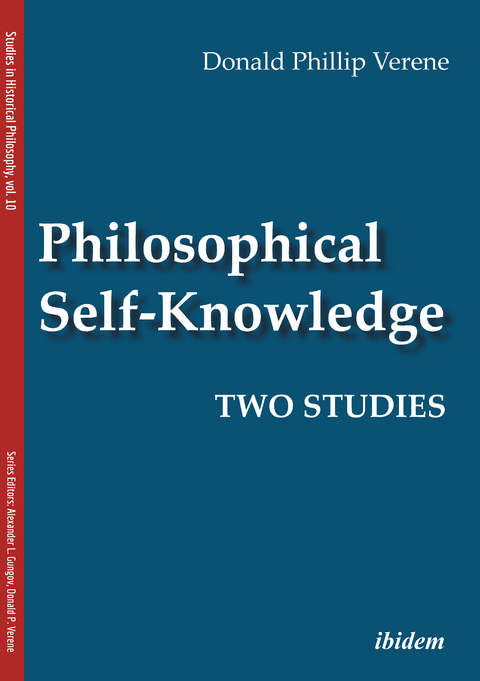
Philosophical Self-Knowledge
Two Studies
2024
ibidem (Verlag)
978-3-8382-1880-9 (ISBN)
ibidem (Verlag)
978-3-8382-1880-9 (ISBN)
- Titel nicht im Sortiment
- Artikel merken
We know ourselves to be human, but the question remains as to what it means to be human.
The inscription on the Temple of Apollo at Delphi, Gnothi seauton (Know thyself), is taken up by Socrates and pursued as the center of philosophy. Self-knowledge is the theme that endures throughout the history of philosophy. It is a theme that philosophy shares with literature. We know ourselves to be human, but the question remains as to what it means to be human. What we are is a metaphysical and ethical problem. Satire shows us how others see us. Memory, the mother of the Muses, gives us access to see ourselves as we have been, are now, and may be in the future. This work considers the idea of satire through the writings of Aristophanes, Lucian, Erasmus, Rabelais, Swift, Voltaire, and Joyce. It examines the nature of memory in terms of the views of Hesiod, Plato, Aristotle, Camillo, Vico, Hegel, and Joyce. Attention to Joyce in both instances is to Finnegans Wake. The author invites readers to take up the question of self-knowledge, to pursue it further in their own terms and sources.
The inscription on the Temple of Apollo at Delphi, Gnothi seauton (Know thyself), is taken up by Socrates and pursued as the center of philosophy. Self-knowledge is the theme that endures throughout the history of philosophy. It is a theme that philosophy shares with literature. We know ourselves to be human, but the question remains as to what it means to be human. What we are is a metaphysical and ethical problem. Satire shows us how others see us. Memory, the mother of the Muses, gives us access to see ourselves as we have been, are now, and may be in the future. This work considers the idea of satire through the writings of Aristophanes, Lucian, Erasmus, Rabelais, Swift, Voltaire, and Joyce. It examines the nature of memory in terms of the views of Hesiod, Plato, Aristotle, Camillo, Vico, Hegel, and Joyce. Attention to Joyce in both instances is to Finnegans Wake. The author invites readers to take up the question of self-knowledge, to pursue it further in their own terms and sources.
Donald Phillip Verene is Charles Howard Candler Professor Emeritus of Metaphysics and Moral Philosophy at Emory University and Fellow of the Accademia Nazionale dei Lincei. He is the author of numerous books, including Philosophy and the Return to Self-Knowledge, Knowledge of Things Human and Divine, Vico’s New Science: A Philosophical Commentary, and The Rhetorical Sense of Philosophy.
| Erscheinungsdatum | 28.10.2023 |
|---|---|
| Reihe/Serie | Studies in Historical Philosophy |
| Mitarbeit |
Herausgeber (Serie): Donald Philipp Verene, Alexander Gungov |
| Verlagsort | Hannover |
| Sprache | englisch |
| Maße | 148 x 210 mm |
| Gewicht | 160 g |
| Themenwelt | Geisteswissenschaften ► Philosophie ► Ethik |
| Geisteswissenschaften ► Philosophie ► Metaphysik / Ontologie | |
| Schlagworte | Philosophie • Philosophy • Satire • Selbstkenntnis • Self-knowledge |
| ISBN-10 | 3-8382-1880-9 / 3838218809 |
| ISBN-13 | 978-3-8382-1880-9 / 9783838218809 |
| Zustand | Neuware |
| Informationen gemäß Produktsicherheitsverordnung (GPSR) | |
| Haben Sie eine Frage zum Produkt? |
Mehr entdecken
aus dem Bereich

aus dem Bereich
Buch | Hardcover (2025)
Suhrkamp (Verlag)
CHF 32,15


