


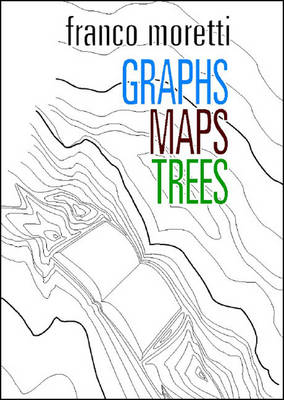
Graphs, Maps, Trees
Abstract Models for Literary History
Seiten
2005
Verso Books (Verlag)
978-1-84467-026-0 (ISBN)
Verso Books (Verlag)
978-1-84467-026-0 (ISBN)
- Titel erscheint in neuer Auflage
- Artikel merken
Zu diesem Artikel existiert eine Nachauflage

Stanford Professor Franco Moretti argues heretically that literature scholars should stop reading books and start counting, graphing and mapping them instead. He insists that such a move could bring new luster to a tired field, one that in some respects, he says, is among "the most backwards disciplines in the academy.
Professor Franco Moretti argues heretically that literature scholars should stop reading books and start counting, graphing, and mapping them instead. He insists that such a move could bring new luster to a tired field, one that in some respects is among "the most backwards disciplines in the academy." Literary study, he argues, has been random and unsystematic. For any given period scholars focus on a select group of a mere few hundred texts: the canon. As a result, they have allowed a narrow distorting slice of history to pass for the total picture.
Moretti offers bar charts, maps, and time lines instead, developing the idea of "distant reading," set forth in his path-breaking essay "Conjectures on World Literature," into a full-blown experiment in literary historiography, where the canon disappears into the larger literary system. Charting entire genres-the epistolary, the gothic, and the historical novel-as well as the literary output of countries such as Japan, Italy, Spain, and Nigeria, he shows how literary history looks significantly different from what is commonly supposed and how the concept of aesthetic form can be radically redefined.
Professor Franco Moretti argues heretically that literature scholars should stop reading books and start counting, graphing, and mapping them instead. He insists that such a move could bring new luster to a tired field, one that in some respects is among "the most backwards disciplines in the academy." Literary study, he argues, has been random and unsystematic. For any given period scholars focus on a select group of a mere few hundred texts: the canon. As a result, they have allowed a narrow distorting slice of history to pass for the total picture.
Moretti offers bar charts, maps, and time lines instead, developing the idea of "distant reading," set forth in his path-breaking essay "Conjectures on World Literature," into a full-blown experiment in literary historiography, where the canon disappears into the larger literary system. Charting entire genres-the epistolary, the gothic, and the historical novel-as well as the literary output of countries such as Japan, Italy, Spain, and Nigeria, he shows how literary history looks significantly different from what is commonly supposed and how the concept of aesthetic form can be radically redefined.
Franco Moretti is the author of many books, including Graphs, Maps, Trees; The Bourgeois; and Distant Reading, winner of the 2013 National Book Critics Circle Award for Criticism. His work has been translated into more than twenty languages. He is Professor Emeritus at Stanford, where he founded the Center for the Study of the Novel and the Literary Lab.
| Erscheint lt. Verlag | 27.7.2005 |
|---|---|
| Nachwort | Alberto Piazza |
| Verlagsort | London |
| Sprache | englisch |
| Maße | 163 x 224 mm |
| Gewicht | 340 g |
| Themenwelt | Geisteswissenschaften ► Sprach- / Literaturwissenschaft ► Anglistik / Amerikanistik |
| Geisteswissenschaften ► Sprach- / Literaturwissenschaft ► Literaturwissenschaft | |
| ISBN-10 | 1-84467-026-0 / 1844670260 |
| ISBN-13 | 978-1-84467-026-0 / 9781844670260 |
| Zustand | Neuware |
| Informationen gemäß Produktsicherheitsverordnung (GPSR) | |
| Haben Sie eine Frage zum Produkt? |
Mehr entdecken
aus dem Bereich



aus dem Bereich
Affektordnungen des Sozialen in der Gegenwartsliteratur
Buch | Softcover (2025)
De Gruyter (Verlag)
CHF 62,90


