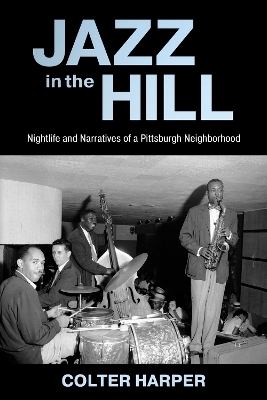
Jazz in the Hill
University Press of Mississippi (Verlag)
978-1-4968-4985-4 (ISBN)
From the 1920s through the 1960s, Pittsburgh’s Hill District was the heart of the city’s Black cultural life and home to a vibrant jazz scene. In Jazz in the Hill: Nightlife and Narratives of a Pittsburgh Neighborhood, Colter Harper looks at how jazz shaped the neighborhood and created a way of life. Beyond backdrops for remarkable careers, jazz clubs sparked the development of a self-determined African American community. In delving into the history of entrepreneurialism, placemaking, labor organizing, and critical listening in the Hill District, Harper forges connections to larger political contexts, processes of urban development, and civil rights struggles.
Harper adopts a broad approach in thinking about jazz clubs, foregrounding the network of patrons, business owners, and musicians who were actively invested in community building. Jazz in the Hill provides a valuable case study detailing the intersections of music, political and cultural history, public policy, labor, and law. The book addresses distinctive eras and issues of twentieth century American urban history, including notions of "vice" during the Prohibition Era (1920–1934); "blight" during the mid-twentieth century boom in urban redevelopment (1946–1973); and workplace integration during the civil rights era (1954–1968). Throughout, Harper demonstrates how the clubs, as a nexus of music, politics, economy, labor, and social relations, supported the livelihood of residents and artists while developing cultures of listening and learning. Though the neighborhood has undergone an extensive socioeconomic transformation that has muted its nightlife, this musical legacy continues to guide current development visions for the Hill on the cusp of its remaking.
Colter Harper is an ethnomusicologist and musician whose creative and scholarly work explores jazz, American nightlife, and the music of West Africa. Harper served as a Fulbright Scholar at the University of Ghana from 2018 to 2020 and has performed as a guitarist, including with the rock band Rusted Root. He is currently a teaching assistant professor in the Department of Music at the University at Buffalo.
Preface
Introduction: Jazz, Nightlife, and the Hill District
Part I: Dangerous Ground: Black and Tan Clubs, Vice, and Prohibition (1920–1934)
Chapter 1: Racial and Sexual Politics of Black and Tan Nightlife
Chapter 2: Claiming a Place for Jazz: The Collins and Paramount Inns
Part II: Pittsburgh’s Renaissance and Jazz’s Golden Age (1945–1968)
Chapter 3: Competing Visions of Modernity
Chapter 4: Life in the Jazz House: The Crawford Grill No. 2 and Hurricane Bar
Part III: The Paradox of Progress: Jazz as Black Musical Labor (1908–1977)
Chapter 5: Civil Rights and the Musicians Union
Chapter 6: Challenging Discrimination, Resisting Merger
Part IV: Jazz and the Community Archive (1968–1977)
Chapter 7: Hill Nightlife in the Wake of 1968
Chapter 8: The Community Archive in Practice
Epilogue: To Honor and Repair
Acknowledgments
Appendix
Notes
Index
| Erscheinungsdatum | 23.01.2024 |
|---|---|
| Reihe/Serie | American Made Music Series |
| Zusatzinfo | 49 b&w illustrations |
| Verlagsort | Jackson |
| Sprache | englisch |
| Maße | 152 x 229 mm |
| Gewicht | 272 g |
| Themenwelt | Kunst / Musik / Theater ► Musik ► Jazz / Blues |
| Geisteswissenschaften ► Geschichte ► Allgemeine Geschichte | |
| Geisteswissenschaften ► Geschichte ► Regional- / Ländergeschichte | |
| Sozialwissenschaften ► Ethnologie | |
| Sozialwissenschaften ► Soziologie | |
| ISBN-10 | 1-4968-4985-X / 149684985X |
| ISBN-13 | 978-1-4968-4985-4 / 9781496849854 |
| Zustand | Neuware |
| Informationen gemäß Produktsicherheitsverordnung (GPSR) | |
| Haben Sie eine Frage zum Produkt? |
aus dem Bereich