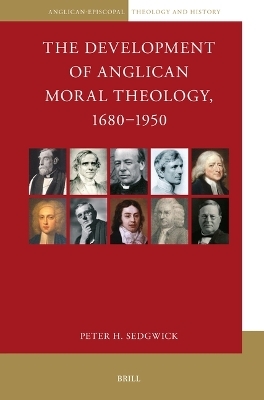
The Development of Anglican Moral Theology, 1680–1950
Brill (Verlag)
978-90-04-68808-7 (ISBN)
Peter H. Sedgwick, Ph.D. (1982), Durham University, was Principal of St. Michael’s College, Cardiff. He is a member of the Anglican Roman Catholic International Commission, Honorary Research Associate at Cardiff University and a fellow of the Center of Theological Inquiry, Princeton, USA. He has published widely, including The Origins of Anglican Moral Theology (Brill, 2018)
Contents
Acknowledgments
Introduction
Part 1: 1680–1830
1 The Changing Interpretation of English Religion, 1680–1750
1 Introduction: The Shape of the First Two Chapters
2 J. C. D. Clark and the Rethinking of English Politics after 1688
3 Religion in English Society after 1688
4 Religion in the Early Enlightenment
5 Conclusion
2 Theology and the English Enlightenment, 1660–1720
1 The End of the Reformation in Europe, and the Challenge to Christian Orthodoxy
2 Revelation and Scripture in the Early Enlightenment
3 Reason in the Early Enlightenment
4 Thomas Hobbes
5 John Locke and Empiricism
6 The End of the Seventeenth Century in England: Cambridge Platonism and the Latitudinarians
7 Shaftesbury and the Moral Sense School
8 The Challenge of Shaftesbury to Orthodox Christianity
3 Joseph Butler’s Rolls Sermons
1 Butler’s Early Life and Education
2 Butler and Samuel Clarke
3 Butler’s Later Life, 1721–1752
4 Butler’s Refutation of Hobbes
5 Butler on Shaftesbury and Hutcheson
6 Butler’s Critique of Locke: Religious Affections
7 Butler’s Critique of Locke: Personal Identity
8 Butler on ‘Superior Principles’
9 Butler on Benevolence
10 Butler on Self-Love
11 Butler on Conscience
12 Butler on Self-Deceit
13 The Significance of Butler
4 William Law
1 Introduction
2 Law’s Life
3 Law as a Non-Juror
4 Law as Controversialist: Hoadly
5 Law as Controversialist: Mandeville
6 A Serious Call: Vocation
7 A Serious Call: Asceticism
8 A Serious Call: Literary Style
9 A Serious Call: Celibacy and Virginity
10 A Serious Call: An Ecclesial Ethic
11 A Serious Call: The Place of Reason
12 A Serious Call: Sanctification
13 Conclusion
5 Anglican Moral Theology, 1730–1800: Gay, Tucker, Paley and Wesley
1 Introduction
2 The Mid-Eighteenth Century and the Influence of Locke
3 John Gay and Theological Utilitarianism
4 Edmund Law and Richard Watson on Moral Teaching and Conscience
5 William Paley and Later Theological Utilitarianism
6 The Demise of Theological Utilitarianism
7 John Wesley: Context and Life
8 Wesley and Sanctification
9 Wesley and Butler
10 Wesley and Enthusiasm
11 Wesley on Emotion in Moral Judgement
12 Conclusion
6 Coleridge
1 Introduction
2 The Re-evaluation of Coleridge
3 Coleridge’s Life
4 Coleridge on Paley and Jeremy Taylor
5 Coleridge’s Reading of Neoplatonism
6 Coleridge and Kant
7 Coleridge and Aids to Reflection
8 Coleridge’s Legacy
9 Conclusion
Conclusion to Part 1
Part 2: 1830–1950
7 John Henry Newman
1 Introduction: The Changing Historiography on Newman
2 The Anglican Newman
3 Newman’s Life
4 The Break with Evangelicalism
5 Newman on Humility
6 The Parochial Sermons
7 The University Sermons
8 Newman on Moral Character
9 Newman on Conscience
10 Newman on Personal Influence and Justice
11 Newman on Personal Responsibility
12 The Influence of Anglican Theologians: The Carolines
13 The Influence of Anglican Theologians: Butler
14 The Influence of Anglican Theologians: Coleridge
15 Conclusion
8 Frederick Denison Maurice
1 Introduction
2 Maurice’s Life
3 Moral Philosophy at Cambridge
4 Coleridge’s Influence on Maurice
5 Maurice’s Theological Anthropology
6 Maurice on Conscience
7 Biblical Theology and Christian Ethics
8 Criticisms of Maurice’s Theology
9 Maurice’s Contribution to Anglican Moral Theology
9 The Lux Mundi School
1 Introduction
2 The Influence of John Stuart Mill and Utilitarianism
3 The Lux Mundi Theologians: Charles Gore, Henry Scott Holland and R. C. Moberly
4 Philosophical Idealism at Oxford
5 Green’s Moral Philosophy
6 Bradley on Self-Realization
7 Donald MacKinnon on the British Idealists
8 Gore on Christ’s Moral Character
9 Gore on Social Morality
10 Holland on Faith and Moral Will
11 Holland on Christian Moral Character
12 Moberly on Self-Realization
13 Inge’s Response to Moberly’s Idealism
14 Moberly on Penitence and Beauty
15 Conclusion
10 William Temple’s Christian Ethics
1 Introduction
2 Temple’s Life
3 Edward Caird and William Temple
4 The Faith and Modern Thought
5 The Nature of Personality
6 Mens Creatrix
7 Christus Veritas
8 Nature, Man and God
9 Reviews of Nature, Man and God
10 Temple’s Later Theology in the 1930s
11 Temple’s Aquinas Lecture, 1943
12 Temple’s Significance
11 Kenneth Kirk: History and Casuistry
1 Introduction
2 The Revival of Thomism and the First World War
3 Kirk’s Life
4 Casuistry and Conscience
5 How the Church Can Change Its Mind
6 Lambeth Conference, 1930
7 The Vision of God
8 Contemporary Anglican Moral Theologians on Kirk
9 Conclusion
Conclusion: Anglican Moral Theology 1680–1950
Bibliography
Index
| Erscheinungsdatum | 30.01.2024 |
|---|---|
| Reihe/Serie | Anglican-Episcopal Theology and History ; 10 |
| Verlagsort | Leiden |
| Sprache | englisch |
| Maße | 155 x 235 mm |
| Gewicht | 781 g |
| Themenwelt | Geschichte ► Teilgebiete der Geschichte ► Religionsgeschichte |
| Geisteswissenschaften ► Religion / Theologie ► Christentum | |
| ISBN-10 | 90-04-68808-0 / 9004688080 |
| ISBN-13 | 978-90-04-68808-7 / 9789004688087 |
| Zustand | Neuware |
| Informationen gemäß Produktsicherheitsverordnung (GPSR) | |
| Haben Sie eine Frage zum Produkt? |
aus dem Bereich