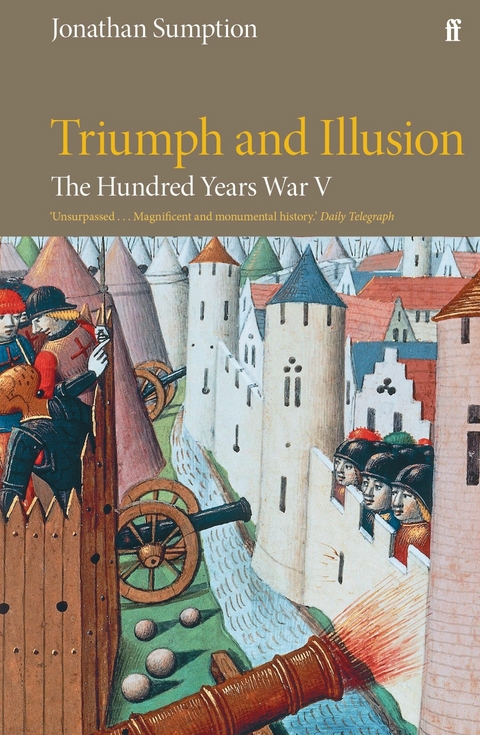
Hundred Years War Vol 5 (eBook)
1006 Seiten
Faber & Faber (Verlag)
9780571274581 (ISBN)
Jonathan Sumption is the author of Pilgrimage and The Albigensian Crusade, as well as his celebrated five-volume history of the Hundred Years War - Trial by Battle, Trial by Fire, Divided Houses, Cursed Kings and Triumph and Illusion. He was awarded the 2023 Franco-British Society Literary Award for Triumph and Illusion and the 2009 Wolfson History Prize for Divided Houses.
'Sumption is that rare and precious thing: a serious, decent, honest thinker . . . and one of our finest historians.' Dan Jones, Sunday Times'Gripping and eminently readable . . . a compelling justification for the enduring value of historical narrative.' The Times'Unsurpassed, and probably unsurpassable.' Daily TelegraphIn this final volume of his epic history of the Hundred Years War, Jonathan Sumption tells the story of the collapse of the English dream of conquest, from the opening years of the reign of Henry VI until the loss of all of England's continental dominions except Calais thirty years later. This sudden reversal of fortune was a seminal event in the history of the two principal nation-states of western Europe, ending four centuries of the English dynasty's presence in France and separating two countries whose fortunes had once been closely intertwined, creating a new sense of national identity in both. The legacy of these events would influence their divergent fortunes for centuries to come. Behind the clash of arms stood some of the most remarkable personalities of the age: the Duke of Bedford, the English Regent who ruled much of France; Charles VII of France, who patiently rebuilt his kingdom after the disasters of his early years; the captains populating the pages of Shakespeare - Fastolf, Montagu, Talbot, Dunois and, above all, the extraordinary figure of Joan of Arc who changed the course of the war in a few weeks at the age of seventeen. 'The Hundred Years War ends in England's agonising defeat - but triumph for Jonathan Sumption . . . There is no doubting his achievement. It is, as everyone says, a "e;monumental"e; work.' Spectator
The news of his father’s death was brought to the nineteen-year-old Dauphin at Mehun, the imposing castle on the banks of the Yèvre west of Bourges, whose ruins are today among the most romantic in France. On 30 October 1422, he was proclaimed King Charles VII by the small group of courtiers and ministers around him. It was a subdued occasion. The heralds’ cries of ‘Vive le Roi!’ rang out unheard by the world in the confined space of the castle chapel. The Pope, Martin V, recognised the new King’s title, and so did his allies in Scotland and Castile. But there was something provisional about Charles’s accession. The old coinage of Charles VI continued to be minted until 1429. The English continued to refer to him as ‘the Dauphin’. For many of his supporters too, among them Joan of Arc, he would remain ‘the Dauphin’ until he was crowned, a claimant to a kingdom that he might never possess. Charles’s ministers were very conscious of this. For years after his accession, their plans were dominated by the hope of capturing Reims, the coronation city of Kings of France, and crowning him there as King.1
Charles VII is celebrated as one of France’s greatest medieval kings, the ruler who brought a decisive end to more than a century and a half of Anglo-French wars. Le Très Victorieux Roy de France Charles, Septième de ce Nom, runs the inscription on Jean Fouquet’s famous portrait in the Louvre. Yet the personality of the man is an enigma, and for more than a decade after his accession he scarcely emerges from behind the overbearing figures of successive ministers. The new king was physically unimpressive: pallid, thin and sickly, with spindly legs that gave him a rather awkward gait. In the 1420s he was not the authoritative figure of his later years. He was withdrawn and taciturn, moody and depressive and uncomfortable in company, all symptoms of a basic lack of self-confidence which lasted into middle age and shines out of the melancholy figure in the portrait. It meant that he was easily led by strong-willed men. In spite of his youth, Charles had already experienced politics in all its raw brutality. At the age of fifteen, he had been plucked half-naked from the palace enclosure in Paris and hustled away as the Burgundian mobs took over the streets. He had been present a year later on the bridge of Montereau when his cousin John the Fearless Duke of Burgundy was hacked to death beneath his eyes by his ministers, an event which gave him a lifelong fear of plotters and assassins. Medieval princes learned their trade young, but Charles had acquired little experience of statecraft or war. He owed his accession to the premature deaths of his elder brothers. He had been brought up in the protective environment of the Angevin court in Provence far away from the turmoil of the royal court. Even after coming to the throne, he was sheltered from the daily dilemmas of diplomacy by determined ministers and distanced from the strategic decisions by overbearing mercenary captains. He was kept away from the fighting, for he was the last male of the Valois line apart from his son Louis, a fragile child born in July 1423, and his cousin Charles of Orléans, a prisoner in England. It is sometimes said that even in his early years, Charles’s passivity was just a façade, and that behind it he manipulated his servants, not the other way round. It is a possible view, but difficult to reconcile with the evidence.2
There was very little in the Dauphin’s situation to foretell the triumphs of his later years. The Duke of Burgundy’s official chronicler Georges Chastellain, a young man in 1422, would one day paint a vivid picture of the condition of Charles’s realm at his accession: a country ‘devastated, exhausted and torn apart, like a half-demolished edifice, ruinous on every side, its foundations undermined, a mere wreck of its former beauty and grandeur’. Images like these were often deployed in later years to heighten the dramatic impact of Charles’s ultimate victory. But the contrast was a real one. A ditty which mothers sang to their children plaintively asked what was left of the great kingdom which the Dauphin had inherited.
Aujourd’hui que reste t’il
A ce Dauphin si gentil
De tout son beau royaume?
It comprised less than half of the territory which his father had inherited in 1380.3
The ‘kingdom of Bourges’ controlled the whole of the territory south of the Loire, apart from the diminished English duchy of Guyenne in the south-west. In addition, it included Anjou and Maine in the west, the great city of Lyon and its region on the eastern march of the kingdom, and the large and rich province of Dauphiné, east of the Rhône, which was technically a part of the German Empire but had become the traditional endowment of the heir to the French throne. The political and economic heart of the Dauphin’s territory was a cluster of princely appanages in the basin of the Loire belonging to the various branches of the royal house. These comprised Touraine, which had been part of Charles’s own appanage as Dauphin; the extensive territories formerly owned by his great-uncle Jean de Berry in Poitou and Berry, which had passed to him by inheritance; the lands of the Duke of Bourbon in the Bourbonnais and Forez, which were governed by the Duchess Marie de Berry while her husband languished in an English prison; the duchy of Orléans, another appanage belonging to a prisoner of war in England, which was administered by the Duke’s officials from the castle of Blois; and finally the domains of the dukes of Anjou in Anjou and Maine. These provinces constituted a broad belt of rich agricultural land and important commercial cities extending in an arc from the Atlantic seaboard in the west to the foothills of the Massif Central in the east. They provided the Dauphin with the greater part of his revenues, his manpower and his political standing.
In due course, Charles would acquire the soubriquet ‘le Bien-Servi’, the ‘well-served’. The government of the kingdom of Bourges was staffed by a talented generation of administrators, lawyers and financiers, most of whom had risen through the patronage of the leading Armagnac princes and had fled from Paris after the Burgundian coup. It was these men who had created the institutions of Bourges and Poitiers from nothing after Charles broke with his father’s government in 1418. But the new king was not well-served. The problem lay at the highest levels of his government. The royal council was dominated by a clique of impetuous and violent men of the old Armagnac party, who had risen to prominence during the dictatorship of the Count of Armagnac in Paris. The most influential of them were compromised by their involvement in the two most disastrous acts of the Dauphin’s early years: the murder of John the Fearless in 1419 and the abduction of John V Duke of Brittany a year later. The unscrupulous and conspiratorial Jean Louvet, who had been the prime mover behind both decisions, was effectively the Dauphin’s first minister. We have it on Charles’s own authority that before his eventual removal in 1425 he had enjoyed ‘excessive and unreasonable powers’ over the whole machinery of government, including unlimited authority to deal with foreign governments and to dispose of the government’s revenues. He was said to have a pile of blank warrants bearing the Dauphin’s seal, with which to authorise whatever he chose. Like Louvet, and almost as influential, the Maine nobleman Guillaume d’Avaugour was a protégé of the dukes of Anjou. He had been present on the bridge of Montereau and was among the small caucus of councillors behind the attack on the Duke of Brittany. Tanneguy du Châtel, the headstrong and impulsive Breton soldier of fortune who served as Master of Charles’s household, had struck the first blow against John the Fearless on the bridge. William Viscount of Narbonne, a southerner and a son-in-law of the Count of Armagnac, had been in on the plot and joined in the affray around the dying Duke. Pierre Frotier, the ill-tempered bully who served as the captain of Charles’s personal bodyguard, had finished off the Duke by plunging a sword into his belly. The Picard Jean Cadart, the Dauphin’s physician since childhood and perhaps the nearest that Charles had to an adult friend, was admitted to the Dauphin’s council at about the time of his accession and became increasingly influential. He had not been present at Montereau but was believed to have helped persuade his master to authorise the deed. These were ‘scandalous and dishonest men’, in the words of a well-placed official of the Duke of Orléans. They controlled access to the Dauphin and directed his every move in the disastrous opening years of his reign, all the while busily lining their pockets. As a result, they had many enemies and were forever looking over their shoulders.4
Other men about the new King had a more creditable past and a more balanced judgement of the future, but perforce lived under the shadow of Louvet and his friends. Robert le Maçon, the...
| Erscheint lt. Verlag | 29.8.2023 |
|---|---|
| Sprache | englisch |
| Themenwelt | Geschichte ► Allgemeine Geschichte ► Mittelalter |
| Geisteswissenschaften ► Geschichte ► Regional- / Ländergeschichte | |
| ISBN-13 | 9780571274581 / 9780571274581 |
| Informationen gemäß Produktsicherheitsverordnung (GPSR) | |
| Haben Sie eine Frage zum Produkt? |
 EPUB (Adobe DRM)
Kopierschutz: Adobe-DRM
Adobe-DRM ist ein Kopierschutz, der das eBook vor Mißbrauch schützen soll. Dabei wird das eBook bereits beim Download auf Ihre persönliche Adobe-ID autorisiert. Lesen können Sie das eBook dann nur auf den Geräten, welche ebenfalls auf Ihre Adobe-ID registriert sind.
Details zum Adobe-DRM
Dateiformat: EPUB (Electronic Publication)
EPUB ist ein offener Standard für eBooks und eignet sich besonders zur Darstellung von Belletristik und Sachbüchern. Der Fließtext wird dynamisch an die Display- und Schriftgröße angepasst. Auch für mobile Lesegeräte ist EPUB daher gut geeignet.
Systemvoraussetzungen:
PC/Mac: Mit einem PC oder Mac können Sie dieses eBook lesen. Sie benötigen eine
eReader: Dieses eBook kann mit (fast) allen eBook-Readern gelesen werden. Mit dem amazon-Kindle ist es aber nicht kompatibel.
Smartphone/Tablet: Egal ob Apple oder Android, dieses eBook können Sie lesen. Sie benötigen eine
Geräteliste und zusätzliche Hinweise
Buying eBooks from abroad
For tax law reasons we can sell eBooks just within Germany and Switzerland. Regrettably we cannot fulfill eBook-orders from other countries.
aus dem Bereich