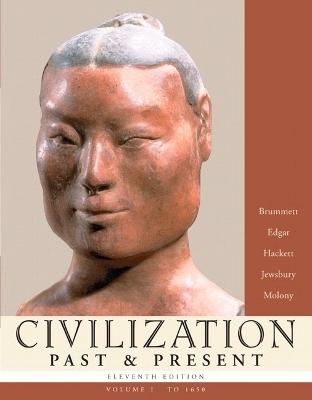
Civilization Past & Present, Volume I (to 1650)
Pearson (Verlag)
978-0-321-23627-2 (ISBN)
- Titel erscheint in neuer Auflage
- Artikel merken
The authors of the Eleventh Edition of Civilization Past and Present—specialists in Islamic, African, Asian, Ancient, Russian, and East European history—weave the diverse trends of world history into a clear and accessible analysis for today's students.
Civilization Past and Present, well known in the marketplace as a highly readable survey text, delivers a strong narrative of world history and a level of detail that is manageable for students and solid for instructors. Using images and documents that enhance the text's content, the narrative traces connections across cultures and introduces intriguing avenues of historical interpretation. The text examines all aspects of world history—social, political, economic, religious, cultural, and geographic.
Documents.
Maps.
Global Issues.
Discovery Through Maps.
Chapter Opener Image Descriptions.
To the Instructor.
To the Student.
1. Stone Age Societies and the Earliest Civilizations of the Near East.
The Origins of Humankind.
Preliterate Cultures.
Preliterate Society and Religion.
Mesopotamia: The First Civilization.
The Babylonian Empire, c. 2000–1600 b.c.e.
Egypt: Gift of the Nile.
Mesopotamian Successors to Babylon, c. 1600 – 550 B.C.E.
Later Empires of Western Asia, 550 – 331 B.C.E.
Document.
The Great Hymn to the Aton and Psalm 104.
Document.
The Majesty of Darius the Great: A Persian Royal Inscription.
Discovery Through Maps.
The Oldest Known Map: Catul Hüyük.
2. Ancient China: Origins to Empire.
Prehistory to 220 c.e.
The Origins of China, 6500 b.c.e. – 221 b.c.e.
The Qin and Han Empires, 221 b.c.e. –220 c.e.
Document.
The Wisdom of Confucius.
Document.
Legalism: The Theories of Han Feizi (d. 233 b.c.e. ).
Document.
From The Book of Songs “A Simple Rustic You Seemed.”
3. Ancient India: From Origins to 300 c.e.
Early India.
Dramatic Developments in Religion and Culture, 600–320 b.c.e.
The Mauryan Empire and Other Kingdoms, 320 b.c.e. –300 c.e.
Emergent Hinduism and Buddhism, 200 b.c.e. –300 c.e.
The Meeting of East and West: Networks of Exchange.
Document.
Rig-Veda: Creation and the Kinds of Men.
Document.
The Jains on the Souls in All Things.
Document.
The Ramayana: The Trial of Sita.
Global Issues : Migration.
4. Greece: Minoan, Mycenaean, Hellenic, and Hellenistic Civilizations, 2000–30 b.c.e.
Minoan and Mycenaean Civilizations, c. 2000–1200 b.c.e
Hellenic Civilization, c. 1150–500 b.c.e
The Golden Age of Greece, 500–336 b.c.e .
The Greek Cultural Achievement.
The Hellenistic Age, 336–30 b.c.e.
Hellenistic Society and Culture.
Document.
Homer—The Iliad: Andromache and Hector.
Document.
Aristophanes on the Shortcomings of Athenian Democracy.
Document.
Arrian: Alexander the Leader.
Discovery Through Maps.
The World According to Herodotus, c. 450 b.c.e.
5. Roman Civilization: The Roman World, c.900 b.c.e. to 476 c.e.
Early Italy and the Origins of Rome, c. 900–509 b.c.e.
The Early Republic and the Roman Conquest of Italy: 509–133 b.c.e.
The Late Republic: 133–30 b.c.e .
The Roman Empire and the Pax Romana : 30 b.c.e –476 c.e .
The Rise of Christianity.
The Roman Legacy.
Document.
Columella: Roman Farm Women.
Document.
Plutarch—The Murder of Tiberius Gracchus.
6. Byzantium and the Orthodox World: Byzantium, Eastern Europe, and Russia, 325-1500.
Byzantium: the Latin Phase: 325-610.
The Age of Consolidation: 610-1071.
Western and Turkish Invasions: 1071-1453.
Southeastern Europe to 1500.
Russia to 1500.
Document.
Anna Comnena.
Document.
The Acceptance of Christianity.
Discovery Through Maps.
A Sixth-Century Map: The Madaba Mosaic.
7. Islam: From Its Origins to 1300.
Arabia Before the Prophet.
Muhammad, Prophet of Islam.
Islamic Faith and Law.
The Expansion of Community and State.
The Abbasid Era, Zenith of Classical Islamic Civilization.
Islamic Culture.
Document.
The Qur’an.
Document.
The Early Islamic Conquests.
Document.
Ibn Sina’s Path to Wisdom.
Discovery Through Maps.
An Islamic Map of the World.
Global Issues : Religion and Government.
8. African Beginnings: African Civilizations to 1500 C.E.
The African Environment.
African Cultural Patterns.
Peopling of Africa.
The Bantu Dispersion.
Ethiopia and Northeastern Africa.
Empires of the Western Sudan.
West African Forest Kingdoms.
Swahili City-States in East Africa.
Kingdoms of Central and Southern Africa.
Document.
Emperor Zar’a Ya’kob’s Coronation and His Concern for the Church.
Document.
Ghana, as Described by Al-Bakri.
Discovery Through Maps.
Mansa Musa and The Catalan Atlas of 1375.
9. The European Middle Ages: 476–1348 c.e.
The Church in the Early Middle Ages.
The Merovingians and Carolingians.
Feudalism and Manorialism.
The Revival of Trade and Towns.
The Church in the High Middle Ages: 1000 – 1348.
The Crusades.
The Development of European States: 1000 – 1348.
Document.
Charlemagne: A Firsthand Look.
Document.
Muslim and Christian: Two Contemporary Perspectives.
10. Culture, Power, and Trade in the Era of Asian Hegemony, 220-1350.
India in the Classical and Medieval Eras.
China: Cultural and Political Empires.
Korea: From Three Kingdoms to One.
The Emergence of Japan in East Asia.
Document.
Faxian: A Chinese Buddhist Monk in Gupta India.
Document.
Bo Juyi: A Song of Everlasting Sorrow.
Document.
From The Pillow Book by Sei ShMnagon.
Discovery Through Maps.
Gog and Magog in the Ebstorf Mappamundi.
11. The Americas to 1492.
Origins of Americans and Their Cultures.
Emerging Civilizations in Mesoamerica.
Classical Mayan Civilization.
The Postclassical Era.
The Amerindians of North America.
Document.
Father Bernabé Cobo, “Pachacuti, the Greatest Inca.”
Global Issues : Location and Identity.
12. The Islamic Gunpowder Empires, 1300–1650.
New Polities in Eurasia.
The Ottoman Empire.
The Safavid Empire in Persia.
The Mughul Empire in South Asia.
Networks of Trade and Communication.
Document.
Evliya çelebi, “An Ottoman Official’s Wedding Night.”
Document.
The Coming of Ismail Safavi Foretold.
Document.
The Idea of Seclusion and Lady Nurjahan.
Discovery Through Maps.
The World Map of Piri Reis.
13. East Asian Cultural and Political Systems, 1300–1650.
China: The Ming Dynasty.
Korea: The Making of a Confucian Society.
Japan: The Era of ShMguns and Warring States.
Southeast Asia: States Within a Region.
Document.
A Censor Accuses a Eunuch.
Document.
Sotoba Komachi, a Fourteenth-Century Japanese NM Play.
Document.
A Traveller’s Account of Siam.
Discovery Through Maps.
Chinese World Map, c. 1500 c.e.
14. European Cultural and Religious Transformations.
The Renaissance and the Reformation 1300 – 1600.
Social Upheaval.
The Italian Renaissance.
Italian Renaissance Art.
The Northern Renaissance.
The Crises of the Catholic Church: 1300-1517.
Luther and the German Reformation.
Henry VIII and the Anglican Reformation.
Protestantism: from Switzerland to Holland.
Reform in the Catholic Church.
Document.
Machiavelli, The Prince: On Cruelty and Mercy.
Document.
Anne Ayscough (Mrs. Thomas Kyme), English Protestant Martyr.
Discovery Through Maps.
The Lagoon of Venice.
15. The Development of the European State System: 1300-1650.
Politics in an Age of Crisis, 1300–1500.
The Religious-Political Fusion.
Wars of Religions: The Spanish Habsburgs’ Quest for European Hegemony, 1556–1598.
Orthodox Europe: Russian Consolidation and Ottoman Expansion.
The Austrian Habsburgs’ Drive for Superiority and the Thirty Years’ War.
Document.
The Trial of Joan of Arc.
Document.
Simplicissimus on the Horrors of the Thirty Years’ War.
Discovery Through Maps.
A Pilgrim’s Map of Canterbury.
Global Issues : Power and Technology.
16. Global Encounters: Europe and the New World Economy, 1400–1650.
The Iberian Golden Age.
The Portuguese and Africa.
The Growth of New Spain.
Iberian Systems in the New World.
Beginnings of Northern European Expansion.
Document.
Portuguese Encounters with Africans.
Document.
Disease and the Spanish Conquest.
Discovery Through Maps.
Savage Pictures: Sebastian Munster’s Map of Africa.
| Erscheint lt. Verlag | 19.5.2005 |
|---|---|
| Sprache | englisch |
| Gewicht | 1111 g |
| Themenwelt | Geisteswissenschaften ► Geschichte ► Allgemeine Geschichte |
| ISBN-10 | 0-321-23627-0 / 0321236270 |
| ISBN-13 | 978-0-321-23627-2 / 9780321236272 |
| Zustand | Neuware |
| Informationen gemäß Produktsicherheitsverordnung (GPSR) | |
| Haben Sie eine Frage zum Produkt? |
aus dem Bereich