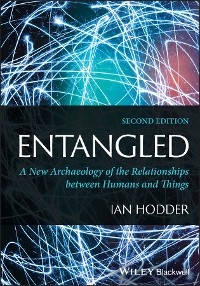
Entangled (eBook)
John Wiley & Sons (Verlag)
978-1-119-85587-3 (ISBN)
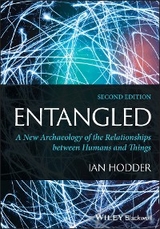
Offers a comprehensive and accessible introduction to the theory of material entanglement and entrapment, enriched with vivid examples from everyday life
Entangled explores how archaeological evidence can help provide a better understanding of the direction of human social and technological change, demonstrating how the interrelationship of humans and things is a defining characteristic of human history and culture. Using examples drawn from both the early farming settlements of the Middle East and daily life in the modern world, Ian Hodder highlights the complex co-dependencies of humans and things-arguing that the maintenance and sustaining of material worlds are the unseen drivers of human development.
Updated and expanded, Entangled offers new perspectives on the study of the relationality between things and humans. In this edition, the author reframes relationality in terms of various forms of dependence to better explore inequality, injustice, and the ways people get entrapped in detrimental social and economic situations. An entirely new chapter focuses on human dependence on other humans, such as between colonial powers and colonized people. Increased focus is placed on object-oriented ontologies and assemblages, symmetrical archaeology, and indigenous and radical approaches in archaeology that critique relationality and posthumanism. A wide range of new examples, references, and literature are presented throughout the book.
- Argues that dependence on things forces humans down particular evolutionary pathways and social trends
- Demonstrates how long-standing entanglements can be irreversible and increase in scale and complexity over time
- Integrates archaeology, natural and biological sciences, and the social sciences
- Presents a critical review of key contemporary perspectives, including material culture studies, phenomenology, evolutionary theory, cognitive archaeology, human ecology, and complexity theory
Entangled: A New Archaeology of the Relationships between Humans and Things, Second Edition is essential reading for undergraduate and graduate students, lecturers, researchers, and scholars in the fields of archeology, anthropology, material culture studies, and related fields across the social sciences and humanities.
Ian Hodder is Dunlevie Family Professor Emeritus in the Department of Anthropology at Stanford University and Professor of Archaeology at Koç University, Istanbul. He led a large-scale excavation project at the Neolithic site of çatalhöyük in Turkey between 1993 and 2018. His books include Symbols in Action, Reading the Past, The Leopard's Tale: Revealing the Mysteries of çatalhöyük, The Domestication of Europe, The Archaeological Process: An Introduction, and Archaeological Theory Today.
Ian Hodder is Dunlevie Family Professor Emeritus in the Department of Anthropology at Stanford University and Professor of Archaeology at Koç University, Istanbul. He led a large-scale excavation project at the Neolithic site of çatalhöyük in Turkey between 1993 and 2018. His books include Symbols in Action, Reading the Past, The Leopard's Tale: Revealing the Mysteries of çatalhöyük, The Domestication of Europe, The Archaeological Process: An Introduction, and Archaeological Theory Today.
Contents
Epigraph viii
List of Figures ix
Preface and Acknowledgements for First Edition xii
Preface and Acknowledgements for Second Edition xiii
1Thinking About Things Differently (from Things to Flows) 1
What Is a Thing? 1
Things-in-Themselves? 3
Changing Definitions of Entanglement 8
From Things to Strings 12
Weaker and Stronger Entanglements 14
Conclusion - (a) Why Process Matters 15
Conclusion - (b) Are We at One with Things? 16
2 Humans Depend on Things 19
Dependence: Some Introductory Concepts 20
Forms of Dependence 21
Reflective and Non-reflective Relationships with Things 22
Going Toward and Away from Things 24
Identification and Ownership 26
Some Previous Accounts of the Human Dependence on Things 29
Being There with Things 29
Material Culture and Materiality 32
Cognition and the Extended Mind 36
Conclusion: Things R Us 39
3 Things Depend on Other Things 41
Forms of Connection Between Things 43
Production and Reproduction 43
Exchange 43
Use 44
Consumption 44
Discard 44
Post-deposition 44
Affordances 49
From Affordance to Dependence 51
The French School - Operational Chains 52
Behavioral Chains 54
Things Depend on Past Things and on Future Things 58
Entangled Ideas 58
Conclusion 59
4 Things Depend on Humans 65
Things Fall Apart 68
Behavioral Archaeology and Material Behavior 70
Behavioral Ecology 74
Human Behavioral Ecology 79
The Temporalities of Things 83
Conclusion: The Unruliness of Things 84
5 Human-Human Entanglement 86
Inequality, Power and Entanglement 87
Poverty Traps 90
Emotional Bonds 92
Conclusion 93
6 Exploring Entanglement 95
The Physical Processes of Things 95
Temporalities 98
Forgetness 101
The Tautness of Entanglements and Path Dependency 103
Types and Degrees of Entanglement 105
Cores and Peripheries of Entanglements 108
Contingency 109
Conclusion 111
7 Entangled Abstractions and Bodily Engagements 113
Abstraction, Metaphor and Mimesis 114
From Granola to Beethoven 117
Abstract Entanglements at Çatalhöyük 123
Conclusion 126
8 Two Examples Regarding the Onset of Domestication and Sedentary Village Life: China and the Middle East 128
China 128
Middle East 130
Conclusion 138
9 Method 139
Tanglegrams 140
Formal Network Approaches 144
Sequencing Entanglements 147
Diachronic Entanglements 152
Interpretation 156
Conclusion 159
10 Toward an Entangled String Theory and Comparison with Other Approaches 160
Things Do Not Have Agency 161
There Is No Present, Only a Flow from Past to Future 163
Toward an Entangled String Theory 164
Other Contemporary Approaches 171
Latour and Actor Network Theory 172
Assemblage Theory 175
Containment and Enchainment 176
Ontologies 177
Material Engagement Theory 178
Agential Realism 179
Conclusion 180
11 Conclusion: From Things to Flows 182
Aquatic Culture? 182
Some Final Examples 183
Some Loose Ends 186
Bibliography 189
Index 209
Chapter 1
Thinking About Things Differently (from Things to Flows)
As I drove along Interstate 880 on my way to Oakland airport in the East Bay I watched the car in front of me. It appeared to be always the same car, but it was always changing. The gas was being used up, the tires were being worn down and the car changed its appearance to me as I watched it in different lights and thought about it in different ways. Was it always the same car? Was it a stable thing or lots of different things in sequence? It was rather like the conundrum of Theseus’s wooden ship. Heraclitus asked, whether if you changed all the planks and sails gradually, one by one, it would still be the same ship? And did the answer to the question really matter?
What Is a Thing?
This book is about the ways in which humans get caught up in things. So we need at the start to define what a thing is, and to distinguish it from other terms such as object. I take the view that everything is a thing – there is nothing (no thing) that is not a thing. We can use the word to refer to a great variety of entities, but most discussions of things tend to use the examples of simple everyday things like a jug, a hammer, a basket, a blind person’s white stick and so on. One colloquial use of the word ‘thing’ is that we often say ‘that thing’ when its name has momentarily escaped us and it merely exists for us as something. Or we talk of someone whose name we cannot remember as ‘thingy’ or ‘thingummyjig’. Indeed we also talk of people as things – as when we say ‘poor old thing’.
Bergson (1911 [1998]) argued that we tend to think of the world in terms of solids, and through much of this book I will use the term ‘thing’ to refer to simple entities that have substance and surface and exist in a medium such as air or water (Gibson 1986 [1979]). But we also need to consider whether more abstract ideas are also things. It is difficult to separate the material from the immaterial or intangible. ‘Intangible heritage’ has proved to be very tangible, in the form of words, dances, song and so on. It is difficult to separate the word ‘nation’ from a place, image, experience. Today the largest single machine in the world is the Hadron Collider. This massive machine that was built by the work of over ten thousand scientists and engineers from over 100 countries was the result of pursuing an idea about subatomic particles.
I am not sure there are any words or ideas that do not instantly conjure up images, feelings, material aggregations of some sort. Even abstract words like ‘justice’, ‘honor’, ‘theoretical’, ‘sublime’ are tagged in my mind with some image, maybe an inadequate representation of the concept (as a set of scales to indicate justice), but somehow I need these concrete aide-memoires. And of course more generally words are material things, whether spoken or written, and it is unclear to me whether a concept or feeling can exist without some word or association attached to it.
So I have come to see all ideas and concepts as to some degree material, even without making the argument that they are all related to material firings of synapses in the brain. The distinction between idea and material, thought and practice is thus unhelpful, and we can return to the viewpoint that the word ‘thing’ can be applied to everything. Certainly there are simple things like pots and pans and there are complex things like institutions and global supply crises. There are solid things like stone tools and hammers, but there are also liquid and gaseous things. Things can include actions as well as thoughts and intuitions. The word ‘thing’ thus has a very broad remit.
How can we distinguish the term ‘thing’ from other similar words such as ‘object’? The term ‘object’ is very tied up in a long history that opposes subject and object, mind and matter, self and other. It connotes an objectifying approach in which matter is analyzed, codified and caught in disciplinary discourse. In terms of etymology, the word refers to being thrown in the way. An object ‘stands against’. In this way it is different from the word ‘thing’ which in terms of etymology is all about gathering and connecting. Things pull together flows and relations into various configurations, whether the things are molecules and atoms, or whether they are books and computers, or whether they are institutions like schools and societies. For a period of time matter, energy and information are brought together into a heterogeneous bundle. Things assemble.
In a series of papers published in English in a 1971 volume, Martin Heidegger deals directly with objectness and thingness. In a chapter called ‘The thing’ he considers a jug. Heidegger notes that the jug has been produced from the earth so that the material it has been made from ‘has been brought to a stand’ (1971: 167). Since the jug stands up against us it can be described as an object. So an object is something we contemplate as distant from us and set up against us. We shall see in Chapter 2 that Heidegger talks of this type of object as present-at-hand. Particularly when objects break down, we come to notice them and have to deal with them, fix them. When a scientist explores a jug to see what it is made of and what it was used for, it becomes an object of study, something distanced and particular.
But for Heidegger there is an aspect of the jug that is not captured by describing it as an entity or an object. The jug takes what is poured into it, and then pours the liquid out. The water and wine come from a rock spring or from rain or from the grape growing in the earth. The pouring out can quench thirst for humans or be a libation to the gods. So the jug connects humans, gods, earth and sky. It is this ‘gathering’ that makes the jug a thing. Heidegger refers to Old High German in which a thing means a gathering to deliberate on a matter under discussion. The jug, as thing, gathers together for a moment humans, gods, earth and sky.
Elsewhere in the same book, Heidegger provides other examples of things. Thus a bridge can be seen as gathering the two banks of a stream in relation to each other, and it gathers people that cross the bridge, it gathers people and carts into town or workers into the fields (1971: 151–2). The bridge as thing can be explored in terms of its usefulness, its functionality in bringing different components together. In this book I will focus on how things involve humans and non-humans being together in heterogeneous mixes. Sometimes this happens in what the nineteenth-century archaeologist Pitt-Rivers (1874 (1906) and see Chapter 2) called the intellectual or conscious mind, perhaps somewhat equivalent to what Heidegger later called present-at-hand, but sometimes it occurs in what Pitt-Rivers called the automaton mind, that is, in the taken-for-granted bodily relations with things, similar to what Heidegger called ready-to-hand.
So things bring people and other things together. A good example is what happens when two people buy a house together. Perhaps each owns a share of the house. The two people may or may not be married to each other, but by buying a house together they are brought together with each other and with the house itself, and the house and its maintenance are caught up (in a way that I shall describe as entanglement) with them. Thus if the house springs a leak in the roof, the two have to fix it in order to maintain the house as livable, and to protect their financial investment. They put their money, their savings into the house and they borrow money from other people to buy the house – so if the property loses value through leaks and bad maintenance they may have to pay money back to the lender. So they are in a relation of debt to the lender. And they are tied to each other through the house – it becomes more difficult to separate or divorce, and the other person’s behavior becomes of great interest and weight – will she or he behave in such a way as to undermine the value of the house, or in such a way as to put a strain on the relationship so that the house might have to be sold and so on. So the house ties people together.
We often talk of doing science ‘objectively’, when we reduce bias and explore the object in a distanced and disinterested way. To do this we have to separate the jug, measure it, categorize it, break it up into its components. It becomes an object of study, isolated and compared. Such analysis is a stage in the exploration of things. But such a stage of study needs to be situated within a broader approach that connects objects, that explores their existence as things. In this latter sense the focus is on the complex ways in which a thing such as a house gathers humans and non-humans, links together for a moment matter, energy and information in useful ways.
Things-in-Themselves?
There is a long-standing debate about whether there is such as thing as a thing-in-itself, that is, a thing outside its relations. I started this book with Heraclitus, but I am not a philosopher, and I do not want this book to be about philosophy. Yet I want to argue that there are important implications of what might seem a rather esoteric debate.
Many archaeological theorists today take a relational view which would be in sympathy with the rejection of the idea of a thing-in-itself (e.g. Harris and Cipolla 2017). Others take the view that there is indeed something in things...
| Erscheint lt. Verlag | 8.8.2023 |
|---|---|
| Sprache | englisch |
| Themenwelt | Geisteswissenschaften ► Archäologie |
| Geschichte ► Allgemeine Geschichte ► Vor- und Frühgeschichte | |
| Schlagworte | Anthropologie • Anthropology • Archaeological Methods & Theory • archaeology • Archäologie • entanglement human development • Material Entanglement • material entanglement anthropology • material entanglement archaeology • material entrapment • material entrapment anthropology • material entrapment archaeology • material studies entanglement theory • Methoden u. Theorie der Archäologie • Social & Cultural Anthropology • Social Archaeology • Sozialarchäologie • Soziale u. kulturelle Anthropologie |
| ISBN-10 | 1-119-85587-X / 111985587X |
| ISBN-13 | 978-1-119-85587-3 / 9781119855873 |
| Informationen gemäß Produktsicherheitsverordnung (GPSR) | |
| Haben Sie eine Frage zum Produkt? |
 EPUB (Adobe DRM)
Kopierschutz: Adobe-DRM
Adobe-DRM ist ein Kopierschutz, der das eBook vor Mißbrauch schützen soll. Dabei wird das eBook bereits beim Download auf Ihre persönliche Adobe-ID autorisiert. Lesen können Sie das eBook dann nur auf den Geräten, welche ebenfalls auf Ihre Adobe-ID registriert sind.
Details zum Adobe-DRM
Dateiformat: EPUB (Electronic Publication)
EPUB ist ein offener Standard für eBooks und eignet sich besonders zur Darstellung von Belletristik und Sachbüchern. Der Fließtext wird dynamisch an die Display- und Schriftgröße angepasst. Auch für mobile Lesegeräte ist EPUB daher gut geeignet.
Systemvoraussetzungen:
PC/Mac: Mit einem PC oder Mac können Sie dieses eBook lesen. Sie benötigen eine
eReader: Dieses eBook kann mit (fast) allen eBook-Readern gelesen werden. Mit dem amazon-Kindle ist es aber nicht kompatibel.
Smartphone/Tablet: Egal ob Apple oder Android, dieses eBook können Sie lesen. Sie benötigen eine
Geräteliste und zusätzliche Hinweise
Buying eBooks from abroad
For tax law reasons we can sell eBooks just within Germany and Switzerland. Regrettably we cannot fulfill eBook-orders from other countries.
aus dem Bereich