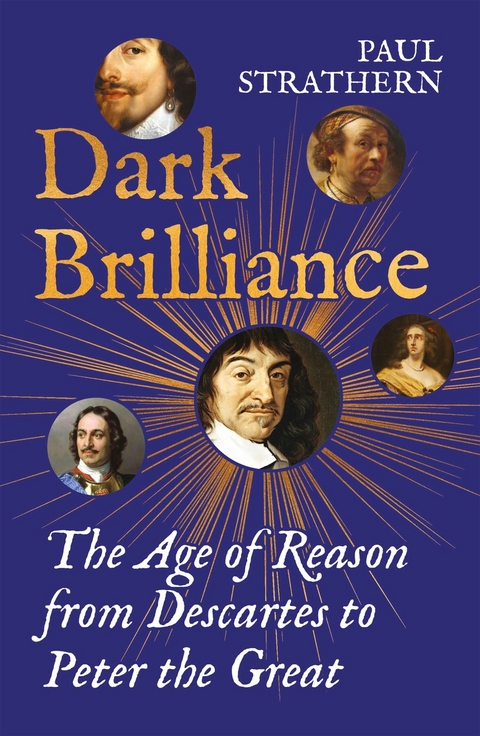
Dark Brilliance (eBook)
400 Seiten
Atlantic Books (Verlag)
978-1-83895-857-2 (ISBN)
Paul Strathernstudied philosophy at Trinity College, Dublin. He is a Somerset Maugham Award-winning novelist; author of two series of books - Philosophers in 90 Minutes and The Big Idea: Scientists who Changed the World; and several works of non-fiction, including The Borgias, The Florentines and The Other Renaissance.
A sweeping history of the Age of Reason, which shows how, although it was a time of progress in many areas, it was also an era of brutality and intolerance, by the author of The Borgias and The Florentines. During the 1600s, between the end of the Renaissance and the start of the Enlightenment, Europe lived through an era known as the Age of Reason. This was a revolutionary period which saw great advances in areas such as art, science, philosophy, political theory and economics. However, all this was accomplished against a background of extreme political turbulence and irrational behaviour on a continental scale in the form of internal conflicts and international wars. Indeed, the Age of Reason itself was born at the same time as the Thirty Years' War, which would devastate central Europe to an extent that would not be seen again until the twentieth century. The period also saw the development of European empires across world and a lucrative new transatlantic commerce began, which brought transformative riches to western European society. However, there was a dark underside to this brilliant wealth: it was dependent upon mass slavery. By exploring all the key events and bringing to life some of the most influential characters of the era, including Caravaggio, Rembrandt, Newton, Descartes, Spinoza, Louis XIV and Charles I, Paul Strathern tells the story of this paradoxical age, while also counting the human cost of imposing the progress and modernity upon which the Western world was built.
Paul Strathernstudied philosophy at Trinity College, Dublin. He is a Somerset Maugham Award-winning novelist; author of two series of books - Philosophers in 90 Minutes and The Big Idea: Scientists who Changed the World; and several works of non-fiction, including The Borgias, The Florentines and The Other Renaissance.
CHAPTER 1
REASON AND RATIONALE
BY THE EARLY 1600S, Europe was approaching the height of the Little Ice Age. This had begun around two centuries previously, when a mysterious decrease in sunspots reduced solar radiation, causing average temperatures across northern Europe to begin to fall by as much as two degrees Celsius. Owing to the vagaries of meteorological currents, this reduced the temperature in some locations by more than ten degrees. Arctic glaciers and pack ice began to expand; the Norse colonies in Greenland vanished, and contact between Europe and Greenland itself was severed for three centuries. Regular fierce storms in the North Sea flooded the German and Danish coasts, resulting in offshore islands vanishing beneath the waves. In the Netherlands, the dykes were breached, causing the inland Zuider Zee (Southern Sea) to expand through the heart of the country. All over northern Europe there were protracted icebound winters, followed by regular ‘years without summer’. This was the time when Flemish painters produced scenes filled with padded figures breathing smoky breath as they skated along frozen Dutch canals and ice-sheeted fields. Meanwhile, glaciers ground down the mountainsides of the Alps, slowly but inexorably pulverizing entire villages. Year upon year crops failed, and famine swept the lands of central Europe.
As if all this was not enough, in 1618 Europe plunged into the first pan-continental war in its history – the most vicious and widespread conflict it would endure until the world wars of the twentieth century. This was the Thirty Years’ War, by the end of which the population of Europe would be slashed by more than 10 per cent, with some regions in Germany losing as many as 60 per cent of their inhabitants. Here was devastation almost on the scale of the Black Death some three centuries previously, when the bubonic plague is thought to have accounted for the loss of more than a third of the continent’s population.
The Thirty Years’ War began as a conflict between the major Catholic powers of northern Europe (essentially France and the Holy Roman Empire) and the Protestants (mainly newly converted German states allied to powerful Sweden). However, this simple generalization masks a host of particular anomalies.
Take, for instance, the case of the twenty-two-year-old French Catholic thinker René Descartes, who would later become known as one of the leading intellectuals of his era. In these early years, Descartes was unsure of precisely what he wanted to do with his life. He had a small amount of inherited money, and was possessed of the vague idea that he would follow a life of intellect. So that he could pursue his thoughts and experiments freely, without censure from the Catholic authorities in his native land, he had taken up residence in the newly independent Netherlands. Here a more liberal atmosphere prevailed, tolerant of Catholics, Protestants, and the numerous Jewish refugees fleeing persecution in countries ranging from Portugal to Poland.
Descartes’s very name would become synonymous with rational thought; thus it comes as something of a surprise to witness his reaction to the outbreak of the Thirty Years’ War. Despite being a Catholic, and devoid of military experience, he volunteered to join the army of Prince Maurice of Orange, a Dutch Protestant force. Indeed, he would later claim that he had taken a commission in the army because he felt sure that this would provide him with sufficient time and peace, devoid of social distractions, in order to think. Descartes was in the habit of rising late, and he had found that lying in bed in the morning best suited his mental processes.
It was during this period that he learned the rudiments of military engineering, which came easily to his superb mathematical mind. However, his life as a late-rising officer in Prince Maurice’s army evidently proved too onerous, and around a year later he switched his allegiance and joined the Catholic army of Duke Maximilian of Bavaria. Here he was able to embark upon his philosophical pursuits in earnest, especially when the Bavarian army made its customary withdrawal from hostilities and took up winter quarters at Neuberg an der Donau, a small walled Bavarian town on the upper reaches of the Danube.
In common with previous years, the harsh winter set in early – and as a result the town and the surrounding countryside were soon smothered in a permanent blanket of solid snow. To escape from the cold, Descartes shut himself away in a small stove-warmed room where he was able to pursue his studies in peace. However, we know that something must have been bothering him, for he recorded that on the night of 10–11 November 1619 his sleep was disturbed by a series of unsettling dreams. At one point he imagined himself struggling against an overpowering wind as he tried to make his way down the street towards the church at his old school back in France. A friend called out to him from a nearby courtyard. Later, he heard ‘a noise like a crack of lightning’, after which the darkness of his room was filled with swirling sparks. Then he saw a dictionary and a book of poetry on his desk…
When Descartes awoke he was convinced that his dreams had revealed to him the purpose of his life. Through the irrational turmoil of unconscious images rising before his mind’s eye, he had glimpsed his calling: he would devote himself to the rational pursuit of truth. By use of reason alone he would discover the answer to the ultimate philosophical questions: Who am I? What do I know? How can I learn the truth? How do I know that this is the truth…?
We must imagine Descartes lying in bed, in his cosy windowless room, its ceiling supported by solid wooden beams, in the corner a tiled Bavarian stove radiating heat. Outside, at the lower end of the sloping cobbled street, the ice-edged river would have been visible, tendrils of mist rising from its dark gliding surface. The attics of the shabbier houses bordering the river provided makeshift dormitories for the common soldiery of Duke Maximilian’s army, by now stirring from their chilly sleep beneath heaped skins. In the rooms below, the families with whom they had been billeted listened warily as they heard the curses and thumps from above. Meanwhile, the mercenary units camped outside the town walls were also coming to life. Burly figures breaking through the frozen entry flaps to their coarse canvas tents; others huddled in blankets, coaxing life into the smoking fires amidst the camp. The sergeants-at-arms shouting at the bowed youngsters ferrying logs from the stacks beneath the town walls to the glowing ashen circles of the fires.
As Descartes would later put it: ‘Since I desired to devote myself wholly to the search for truth, I thought it necessary… to reject as utterly false anything in which I could discover the least grounds for doubt.’ This would cause him to embark upon a process of radical thought, an introspective intellectual exercise in which he sought to eliminate all possibility of delusion. To do so, he imagined that:
some malicious demon of the utmost power and cunning has employed all his energies in order to deceive me. I shall think that the sky, the air, the earth, colours, shapes, sounds and all external things are merely the delusions of dreams which he has devised to ensnare my judgement. I shall consider myself as not having hands or eyes, or flesh, or blood or senses, but as falsely believing that I have all these things.
There remained but one thing that it was impossible for him to doubt. No demon, however cunning and devious, could make him doubt that he existed:
While I wanted to think everything false, it must necessarily be that I who thought was something; and remarking that this truth, I think, therefore I am, was so solid and so certain that all the most extravagant suppositions of the sceptics were incapable of upsetting it, I judged that I could receive it without scruple as the first principle of the philosophy that I sought.
Descartes would prove to be more than just a perceptive thinker. He would also become a scientist, not afraid to be as steadfast in the pursuit of truth in his experiments as he was in his rational thinking. His philosophy of reason would lead him to undertake vivisectional investigations of animals, such as cats and rabbits. As he recorded after one such experiment: ‘If you cut off the end of the heart of a living dog, and insert your finger through the incision into one of the concavities, you will clearly feel that every time the heart shortens, it presses your finger, and stops pressing it every time it lengthens.’
Unflinching reason led him to conclude that all creatures were automata, governed entirely by the laws of physics, devoid of feelings or consciousness. Only humans were possessed of these qualities, because they alone had immortal souls. But the interaction of incorporeal spirit (the soul or mind) and mechanical matter puzzled him at first. How could the mind interact with the body? After further experiments he concluded that this interaction took place in the pineal gland, a small organ located deep within the human brain: ‘There the soul comes in contact with the “vital spirits”, and through this contact there is interaction between soul and body.’
However, as he continued with his cool-headed vivisection of splayed and pinned un-sedated animals, undeterred by their squirming bodies and shrill cries, he made a disquieting discovery. Some other vertebrates also possessed a pineal gland. This, he decided,...
| Erscheint lt. Verlag | 1.2.2024 |
|---|---|
| Zusatzinfo | 2x8pp colour plates |
| Verlagsort | London |
| Sprache | englisch |
| Themenwelt | Geschichte ► Allgemeine Geschichte ► Neuzeit (bis 1918) |
| Geisteswissenschaften ► Geschichte ► Regional- / Ländergeschichte | |
| Schlagworte | Adam Smith • Age of Reason • Caravaggio • Charles I • Descartes • Enlightenment • Europe • Francis Bacon • French Revolution • Happiness • History • Isaac Newton • Law • Liberty • Locke • Louis XIV • Philosophy • Politics • Rembrandt • Sartre • Science • Sociology • Spinoza • Thomas Paine • Voltaire |
| ISBN-10 | 1-83895-857-6 / 1838958576 |
| ISBN-13 | 978-1-83895-857-2 / 9781838958572 |
| Informationen gemäß Produktsicherheitsverordnung (GPSR) | |
| Haben Sie eine Frage zum Produkt? |
 EPUB (Wasserzeichen)
DRM: Digitales Wasserzeichen
Dieses eBook enthält ein digitales Wasserzeichen und ist damit für Sie personalisiert. Bei einer missbräuchlichen Weitergabe des eBooks an Dritte ist eine Rückverfolgung an die Quelle möglich.
Dateiformat: EPUB (Electronic Publication)
EPUB ist ein offener Standard für eBooks und eignet sich besonders zur Darstellung von Belletristik und Sachbüchern. Der Fließtext wird dynamisch an die Display- und Schriftgröße angepasst. Auch für mobile Lesegeräte ist EPUB daher gut geeignet.
Systemvoraussetzungen:
PC/Mac: Mit einem PC oder Mac können Sie dieses eBook lesen. Sie benötigen dafür die kostenlose Software Adobe Digital Editions.
eReader: Dieses eBook kann mit (fast) allen eBook-Readern gelesen werden. Mit dem amazon-Kindle ist es aber nicht kompatibel.
Smartphone/Tablet: Egal ob Apple oder Android, dieses eBook können Sie lesen. Sie benötigen dafür eine kostenlose App.
Geräteliste und zusätzliche Hinweise
Buying eBooks from abroad
For tax law reasons we can sell eBooks just within Germany and Switzerland. Regrettably we cannot fulfill eBook-orders from other countries.
aus dem Bereich