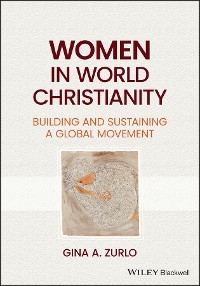
Women in World Christianity (eBook)
John Wiley & Sons (Verlag)
978-1-119-87478-2 (ISBN)
A groundbreaking, comprehensive, and interdisciplinary analysis of women's experiences in World Christianity
Women in World Christianity: Building and Sustaining a Global Movement is the first textbook to focus on women's experiences in the founding, spread, and continuation of the Christian faith. Integrating historical, theological, and social scientific approaches to World Christianity, this innovative volume centers women's perspectives to illustrate their key role in Christianity becoming a world religion, including how they sustain the faith in the present and their expanding role in the future.
Women in World Christianity features findings from the Women in World Christianity Project, a groundbreaking study that produced the first quantitative dataset on gender in every Christian denomination in every country of the world. Throughout the text, special emphasis is placed on women in the twentieth and twenty-first centuries, the period of Christianity's shift from the global North to the global South. Easily accessible chapters - organized by continent, tradition, and select topics - introduce students to the wide variety of Christian belief and practice around the world. The book also discusses issues specifically relevant to women in the church: gender-based violence, ecology, theological education, peacebuilding and more. This textbook:
- Provides a balanced view of women's involvement in Christianity as a world religion and how they sustain the faith today
- Introduces students to female theologians around the world whose scholarship is generally overlooked in Western theological education
- Discusses women's essential contributions to Christian mission, leadership, education, relief work, healthcare, and other social services of the church
- Complements the growing body of literature about Christian women from different continental, regional, national, and ecclesiastical perspectives
- Explores the contributions of contemporary Christian women of all major denominations in Africa, Asia, Europe, Latin America, North America, and Oceania
- Helps students become more aware of the unique challenges women face worldwide, and what they are doing to overcome them
Women in World Christianity: Building and Sustaining a Global Movement is an excellent primary textbook for introductory courses on World Christianity, History of Christianity, World Religions, Gender in Religion, as well as undergraduate and graduate courses specifically focused on women in World Christianity.
GINA A. ZURLO (Boston University) is Co-Director of the Center for the Study of Global Christianity and Research Fellow at Boston University's Institute on Culture, Religion, and World Affairs. She is the author of Global Christianity: A Guide to the World's Largest Religion from Afghanistan to Zimbabwe and From Nairobi to the World: David B. Barrett and the Re-imagining of World Christianity. She is also co-author of the World Christian Encyclopedia, 3rd edition, and co-editor of the World Christian Database. She was named one of the BBC's 100 most inspiring and influential women of 2019 for her work in quantifying religion worldwide.
A groundbreaking, comprehensive, and interdisciplinary analysis of women s experiences in World Christianity Women in World Christianity: Building and Sustaining a Global Movement is the first textbook to focus on women s experiences in the founding, spread, and continuation of the Christian faith. Integrating historical, theological, and social scientific approaches to World Christianity, this innovative volume centers women s perspectives to illustrate their key role in Christianity becoming a world religion, including how they sustain the faith in the present and their expanding role in the future. Women in World Christianity features findings from the Women in World Christianity Project, a groundbreaking study that produced the first quantitative dataset on gender in every Christian denomination in every country of the world. Throughout the text, special emphasis is placed on women in the twentieth and twenty-first centuries, the period of Christianity s shift from the global North to the global South. Easily accessible chapters organized by continent, tradition, and select topics introduce students to the wide variety of Christian belief and practice around the world. The book also discusses issues specifically relevant to women in the church: gender-based violence, ecology, theological education, peacebuilding and more. This textbook: Provides a balanced view of women s involvement in Christianity as a world religion and how they sustain the faith today Introduces students to female theologians around the world whose scholarship is generally overlooked in Western theological education Discusses women s essential contributions to Christian mission, leadership, education, relief work, healthcare, and other social services of the church Complements the growing body of literature about Christian women from different continental, regional, national, and ecclesiastical perspectives Explores the contributions of contemporary Christian women of all major denominations in Africa, Asia, Europe, Latin America, North America, and Oceania Helps students become more aware of the unique challenges women face worldwide, and what they are doing to overcome themWomen in World Christianity: Building and Sustaining a Global Movement is an excellent primary textbook for introductory courses on World Christianity, History of Christianity, World Religions, Gender in Religion, as well as undergraduate and graduate courses specifically focused on women in World Christianity.
GINA A. ZURLO (Boston University) is Co-Director of the Center for the Study of Global Christianity and Research Fellow at Boston University's Institute on Culture, Religion, and World Affairs. She is the author of Global Christianity: A Guide to the World's Largest Religion from Afghanistan to Zimbabwe and From Nairobi to the World: David B. Barrett and the Re-imagining of World Christianity. She is also co-author of the World Christian Encyclopedia, 3rd edition, and co-editor of the World Christian Database. She was named one of the BBC's 100 most inspiring and influential women of 2019 for her work in quantifying religion worldwide.
Introduction: Why Women in World Christianity?
“Women have comprised the majority of Christians globally, at least for the last three centuries for which we have statistics. ‘World Christianity’ could be considered ‘as a Woman’s Movement’ (Robert 2006), so it behooves scholars and practitioners to observe women’s dynamics closely to ascertain significant patterns in the development of worldwide Christianity.”
Angelyn Dries (Dries 2016, p. 315)
Mary’s Magnificat is the longest speech by a woman in the New Testament. It is recorded in Luke 1:46–55 (NIV) at her visit with her cousin, Elizabeth; both the women pregnant with prophets, and for Mary, the anticipated Messiah in her womb.
46 And Mary said:
“My soul glorifies the Lord
47 and my spirit rejoices in God my Savior,
48 for he has been mindful
of the humble state of his servant.
From now on all generations will call me blessed,
49 for the Mighty One has done great things for me –
holy is his name.
50 His mercy extends to those who fear him,
from generation to generation.
51 He has performed mighty deeds with his arm;
he has scattered those who are proud in their inmost thoughts.
52 He has brought down rulers from their thrones
but has lifted up the humble.
53 He has filled the hungry with good things
but has sent the rich away empty.
54 He has helped his servant Israel,
remembering to be merciful
55 to Abraham and his descendants forever,
just as he promised our ancestors.”
In Eastern Orthodox Christianity, this pericope is called the Ode of the Theotókos, in other traditions it is called the Song of Mary, or the Canticle of Mary. It appears in liturgical services of Catholic, Eastern Orthodox, and Anglican churches around the world. Mary was an unmarried teenager with an illegitimate son yet spoke of God’s favor upon her and God’s judgment on the rich and powerful. Her words are revolutionary, and she represents the poor, struggling, overlooked, and marginalized. The Magnificat was perceived to be so dangerous that it was banned during British imperial rule in India (1858–1947), the dictatorship in Guatemala (1980s), and the Argentine military junta (1974–1983) (Connelly 2014). It is a song of joy and pain, of victory over injustice, and of a faithful woman embracing God’s plan. Mary does not ask for anything in her prayer; instead, she describes a prophetic vision of a world to come that promises justice. As Catholic theologian Nepolean James Raj concluded, “The knowledge of the hopes of Mary is an unquenchable spark which sustains hope in all who dream of an egalitarian society, justice, liberation, equality and full humanity” (Raj 2021, p. 136). Mary declares the inauguration of a new kingdom that rejects those of the past that relied on violence and exploitation (Evans and Chu 2021).
Mary has been a source of inspiration and veneration for women throughout Christian history. Women are the majority of the world’s 2.5 billion Christians today, and many are demanding the justice, equality, and full humanity that Mary describes in her song. They are crying out against the violence in their societies, communities, and churches that relegate women to second-class status. Girded by their faith and encouraged by Mary and other women of the past, Christian women are increasingly breaking cultural barriers, becoming public figures, and participating in human flourishing. For example, consider Catholic sisters, who outnumber male priests and professed religious men on every continent. Consider the many women who persist despite indignities and threats of violence, notably sexual violence. In the Democratic Republic of the Congo (95% Christian) – once pronounced the “rape capital of the world” – women keenly realize that peacebuilding is part and parcel to Christian witness and must involve all spheres of life: social, political, and religious. Consider the many women who were the first at something previously unattainable for their sex: Lucia Okuthe was the first woman ordained an Anglican priest in Kenya (1983), Anne Burghardt was the first woman general secretary of the Lutheran World Federation (2021), and the first collection of writings from female theologians in the Pacific Islands was released in this century, Weavings: Women Doing Theology in Oceania (Johnson and Filemoni-Tofaeono 2003).
Yet, the centrality of women’s contributions to the development of Christianity worldwide was not always recognized. Only since the 1970s have there been concerted efforts to uncover Christian women of the past and more seriously acknowledge women’s activities as central, not marginal, to Christian life. Perhaps the most comprehensive analysis of global Christianity over time are the three editions of the World Christian Encyclopedia (1982, 2001, 2019). Each Encyclopedia features an entry for every country of the world, including small island nations in the Caribbean and the Pacific Islands that often get left off the map. Each entry includes quantitative data on religious and nonreligious adherence, as well as a list of every known denomination in the country and indicators of their growth or decline. These entries include photos of Christians in those countries, graphs illustrating the data, and a brief history of when different churches were formed and their contributions to Christian life. Despite all this information, the first two editions of the Encyclopedia included very few mentions of women, as if they had little to do with Christianity’s spread or continuation. Women were barely counted at all – until now.
Gender and Quantitative Research on World Christianity
In the 1960s, David B. Barrett – a trained aeronautical engineer turned Anglican missionary priest – embarked on a novel idea. Using available technology in research for the social scientific study of religion, Barrett wanted to assess how many people in the world adhered to each religion. He compiled the most comprehensive global assessment of religious affiliation to date and published his results in the World Christian Encyclopedia (Barrett 1982), which contained an analysis of religious adherence down to the denominational level in each country. For the first time, the world’s Christians were counted and included together in a single book, featuring new African Christian movements, among which Barrett lived and worked in Nairobi, Kenya. Yet, despite years of collecting and analyzing data and travel to 212 countries, Barrett overlooked variables that would have been critical for sociologists to uncover drivers of religious change. Sex and age distributions were omitted from Barrett’s analyses, which was especially ironic since gender was a prominent factor in missionary statistics dating to the nineteenth century and at the height of the Western missionary movement (Dennis 1897; Student Volunteer Movement 1911). Barrett was a product of several male-dominated contexts: British and American elite universities, dominated by males; American professionalized, institutionalized sociology was largely male; the adherents of Christianity, though majority female, operated within male-oriented hierarchies and leadership structures; and engineering and the hard sciences were also essentially men’s clubs. Data on the gender makeup of religious communities was admittedly difficult to obtain, but so was nearly all the data Barrett collected during the 13-year production of the World Christian Encyclopedia (Zurlo 2017, 2023).
The contemporary home of Barrett’s research legacy, the Center for the Study of Global Christianity, sought to remedy the omission of gender in the third edition of the World Christian Encyclopedia from 2015 to 2019, which made extensive efforts to feature women in the narrative of World Christianity. The Encyclopedia includes examples of highly organized women’s movements worldwide, such as the Young Women’s Christian Association and Anglican Mothers’ Unions. It describes women who provide education, combat HIV/AIDS, advocate for gender rights, and faithfully serve their congregations and local communities. The book included influential Christian women of the past, such as the female followers of Jesus who arrived in modern-day France in 49 CE, female founders of African Independent Churches such as Christiana Abiodun Emmanuel (1907–1994) in Nigeria, and the unnamed nineteenth-century Bible women in sub-Saharan Africa, East Asia, and Southeast Asia.
This research sparked increased interest in the role of women in churches around the world and the desire to include a gender variable in the World Christian Database (Johnson and Zurlo 2022). As a result, the...
| Erscheint lt. Verlag | 26.7.2023 |
|---|---|
| Sprache | englisch |
| Themenwelt | Geisteswissenschaften ► Geschichte |
| Geisteswissenschaften ► Religion / Theologie ► Christentum | |
| Schlagworte | Christentum • gender world Christianity • Geschichte • Geschichte des Christentums • History • History of Christianity • Religion • Religion & Theology • Religion & Theology Special Topics • Religion and Gender • Religion u. Theologie • Spezialthemen Religion u. Theologie • women Christian missions • women global Christianity • women global Christianity textbook • women history of Christianity • women world Christianity • women world Christianity history • women world Christianity introduction • women world Christianity textbook |
| ISBN-10 | 1-119-87478-5 / 1119874785 |
| ISBN-13 | 978-1-119-87478-2 / 9781119874782 |
| Informationen gemäß Produktsicherheitsverordnung (GPSR) | |
| Haben Sie eine Frage zum Produkt? |
 EPUB (Adobe DRM)
Kopierschutz: Adobe-DRM
Adobe-DRM ist ein Kopierschutz, der das eBook vor Mißbrauch schützen soll. Dabei wird das eBook bereits beim Download auf Ihre persönliche Adobe-ID autorisiert. Lesen können Sie das eBook dann nur auf den Geräten, welche ebenfalls auf Ihre Adobe-ID registriert sind.
Details zum Adobe-DRM
Dateiformat: EPUB (Electronic Publication)
EPUB ist ein offener Standard für eBooks und eignet sich besonders zur Darstellung von Belletristik und Sachbüchern. Der Fließtext wird dynamisch an die Display- und Schriftgröße angepasst. Auch für mobile Lesegeräte ist EPUB daher gut geeignet.
Systemvoraussetzungen:
PC/Mac: Mit einem PC oder Mac können Sie dieses eBook lesen. Sie benötigen eine
eReader: Dieses eBook kann mit (fast) allen eBook-Readern gelesen werden. Mit dem amazon-Kindle ist es aber nicht kompatibel.
Smartphone/Tablet: Egal ob Apple oder Android, dieses eBook können Sie lesen. Sie benötigen eine
Geräteliste und zusätzliche Hinweise
Buying eBooks from abroad
For tax law reasons we can sell eBooks just within Germany and Switzerland. Regrettably we cannot fulfill eBook-orders from other countries.
aus dem Bereich